Industry targeting Australia’s elderly expands as debate over AI’s humanity in aged care intensifies

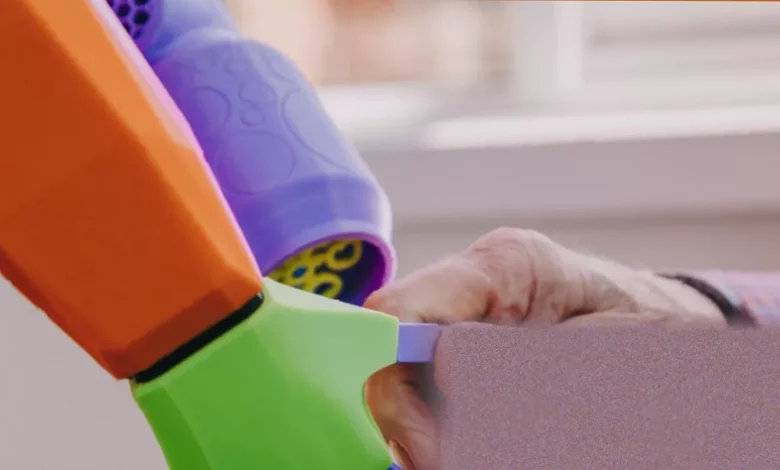
Residents at an aged care facility in Toowoomba, Queensland, can board a replica of France’s Lourdes Station and, from platform 1, take the 9.45am St Vincent’s Express through the Swiss Alps. The virtual reality train carriage — complete with fine-dining high tea and large screens showing real scenery — was designed to tackle the boredom, loneliness and isolation that all too often define life in residential care. “We take boredom away, we take loneliness away, isolation away, and bring in hope,” said Elzette Lategan, the residential care services manager at St Vincent’s Care.
Virtual escapes and robot companions
The Toowoomba experience is one of the more imaginative examples of how technology is being deployed in Australian aged care. Aged Care Research and Industry Innovation Australia (ARIIA), a government-funded advisory body, says virtual reality can also be used to distract people from pain, guide them through relaxation exercises and games, recreate memories and support reminiscence therapy for people living with dementia. ARIIA’s research indicates it can improve mood, cognition, memory, problem-solving skills and spatial awareness, and may help reduce pain, anxiety and social isolation. The organisation also notes that VR is being used to train staff by simulating stressful scenarios in a risk-free environment, helping to upskill workers quickly at a time of acute workforce shortages.
Alongside virtual worlds, physical robots are entering care homes. The social humanoid robot Abi, produced by Andromeda Robotics, uses AI and machine learning to recognise faces, understand emotions and remember conversations. She speaks 90 languages, allowing her to communicate with residents in their preferred tongue. Andromeda recently expanded into the United States, deploying Abi in senior care facilities in California, after accumulating more than 3,500 hours of operational use in Australian homes. The company’s long-term ambition is to make Abi a household name in social robotics, extending into education and home companionship.
Other robotic technologies in the sector include PARO, a robotic pet designed to stimulate people with dementia; Care-O-bot, a domestic robot that can carry meals and assist with mobility; Zora, a software platform that helps nurses; and Matilda, an AI social companion that has been shown to improve emotional well-being and provide respite for carers. A robot called Daisy, developed by Dex-Lab, has demonstrated potential in leading group exercises and conversations. Professor Wendy Moyle, who runs the social robotics laboratory at Griffith University, says such tools can free up carers to spend more time on genuine human interaction. “People might dislike the idea of a machine that helps spoon-feed people,” she said, “but that might free up a staff member to talk to them about their lives.”
The limits of technology
Yet the rapid advance of artificial intelligence, machine learning and robotics in aged care is not without serious concerns. Moyle, who describes herself as a fan of technology, warns that engineers often charge ahead without involving health professionals or the people who will ultimately use the inventions. She points to a machine designed to lift someone off the bed, pick them up off the floor or out of a chair. “No one wanted to go in it – they were frightened,” she said. “Frightened of the size, of being lifted that high.” She also notes that a “virtual hospital” already operating in China signals how quickly the technology is moving, but argues that Australia needs to think beyond entertainment-focused gadgets. “Most of the time people have to go into an aged care facility because they can’t shower or dress themselves, or because they’re incontinent,” she said. “There needs to be more of an emphasis on the types of technology that will assist people wanting to stay home.”
Researchers from the University of Sydney have gone further, warning that the industry and governments are “subscribing to this vision of technological rescue” that distracts from structural problems and reinforces ageism. In an article for The Conversation, they wrote that according to the companies selling AI for aged care, “older people are incidents waiting to happen and data sources to be mined”. They argued that AI relies on “stereotypical ideas of older people as technophobic and passive”, and that companies paint the sector as fundamentally broken, with their product the solution — a framing that buries the need for broader reforms. Dr Barbara Barbosa Neves, one of the researchers, said older people are rarely involved in the design or the datasets used to train AI, leading to systems that marginalise rather than empower them. “The best role AI can play is through supporting care practices that include and empower older people and staff, centring their voices and experiences,” the researchers wrote.
A study has found that Australia is among the countries most hesitant globally regarding trust in AI, and the Australian government’s own experience with the Integrated Assessment Tool — an algorithm-driven system for eligibility and funding decisions — faced backlash due to a lack of flexibility for human expertise and transparency. Future AI pilots are intended to include health professionals in testing phases. Broader research also indicates that widespread AI adoption could lead to deskilling and reduced critical-thinking abilities among early-career researchers, alongside increased risks of ageism and reinforcement of biases against older individuals and the aged care workforce. Moyle agrees that technology should never replace the human element. “Robots don’t have emotional responses,” she said. “We’re working on one with soft skin that will give you a hug. But most robots give not a lot of emotional response.”
Smart homes for independence
While much of the attention falls on robots and virtual reality, a quieter revolution is taking place in smart home technology. For some time, smart wearables have been able to monitor heart rate and temperature and detect falls. Now sensors can sound an alarm if a stove has been left on unattended, and smart speakers let family members send scheduled messages and reminders. Systems like those offered by Alarm.com use sensors to monitor daily routines, providing peace of mind while allowing seniors to maintain independence.
In care homes and private residences, electronic wheelchairs can help pick someone up and take them to a shower that turns on automatically. Beds can roll a person over to make it easier to change them, and mattresses can sense if someone with dementia is about to get out of bed. Moyle envisions a future where such technology helps people stay at home longer, supported by AI that automates administrative tasks like scheduling and shift management, and predictive analytics that anticipate health issues by analysing patterns in vital signs, medication adherence and mobility data. The Australian government’s Aged Care Data and Digital Strategy 2024–2029 includes AI as a key component, with plans to publish reports on safe AI use, develop policy positions and promote pilot programs. But the shadow of workforce shortages looms large: by 2030 Australia is projected to face a shortfall of approximately 110,000 aged care workers, and technology is being pushed as a partial remedy for a system that has also struggled with chronic neglect and abuse. As Moyle put it, “You’ll never get rid of humans. Well, I don’t think we’ll get rid of humans.”