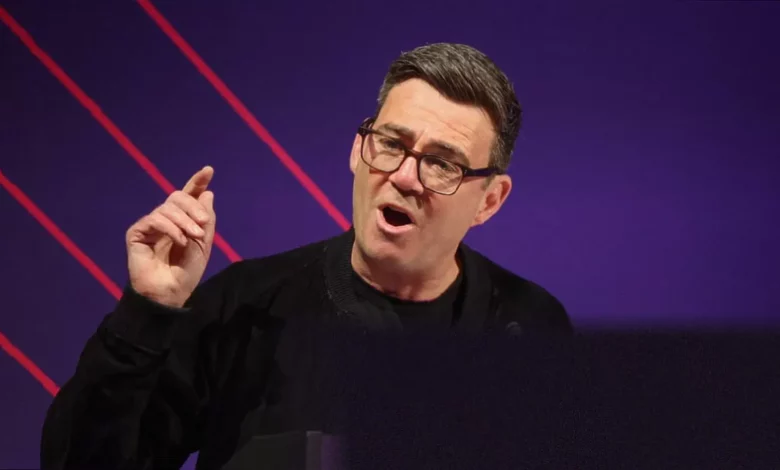
Andy Burnham has stood before an audience in Leeds and declared that Britain has been on “the wrong path” for 40 years, launching a blistering indictment of neoliberal economics as he prepares to fight a by-election that will test whether Labour can hold one of its safest northern seats. The Greater Manchester mayor’s speech at the Great Northern Investment Summit was framed as the opening of a “much bigger debate” about how politics must change to work for the North of England – a debate he intends to make the centrepiece of his campaign in Makerfield.
The by-election, triggered by the resignation of Labour MP Josh Simons to allow Burnham to contest the seat, is expected on 18 June. The National Executive Committee has approved his candidacy, clearing a significant hurdle. But the constituency, held by Labour since its creation in 1983, is no longer the shoo-in it once was. Recent local elections saw Reform UK win every ward in the area, and national polling suggests the party is gaining traction, making Makerfield a marginal seat that will be fiercely fought.
Burnham did not shy away from the scale of the challenge. “Makerfield is no ordinary by-election,” he said. “I believe the by-election is very necessary. People are losing faith in politics more than anything. That’s what people’s votes were saying on Thursday 7 May. They deserve a bigger response than politicians have given them before, and that’s what I intend to provide in this by-election like no other.”
In his speech, Burnham set out what he called his “core argument”: that 40 years of deindustrialisation, deregulation, privatisation and austerity have drained economic, social and political power from communities across the north. He pointed to the 1980s as devastating for places such as Ashton-in-Makerfield, a decline compounded by the policies of the 1990s and the austerity measures of the 2010s. “It all adds up to 40 years of neoliberalism that have not been kind to the north of England,” he said. “Forty years of trickle-down economics that did not, in the end, trickle down very much at all to Platt Bridge or Hindley. In fact, that system has siphoned wealth out of those places and into the hands of people for whom life was already very good.”
🚨 VICTORY INCOMING 🚨
According to reports in today’s @thetimes, after months of campaigning led by @KemiBadenoch & the @Conservatives team, it looks like @RachelReevesMP is going to scrap @@UKLabour’s plan to hike fuel duty
🇬🇧⛽️ A huge victory for drivers across the UK! pic.twitter.com/JkHdpeZGxq
— Richard Holden MP (@RicHolden) May 18, 2026
The mayor argued that the same system created an economy that did not work for most working people, leading to the loss of good jobs, the decline of high streets, and the neglect of towns. Households, he said, were forced to “pay over the odds for the daily basics – energy, housing, water, transport”. And in the 2000s, and particularly the 2010s, councils across the north were “stripped of the resource and power to do anything about it”.
Burnham’s critique went to the heart of the relationship between central and local government. “If politics can’t fix something as simple as a pothole, you’ve got a very big problem,” he said. “Why should people have faith in the ability of politics to do anything if it can’t do something as simple as that?” He described the situation as deeply unfair on hardworking councillors who “get swept away because of the failure of national government to protect local government”. The answer, he argued, is a “completely different relationship between national and local government”.
While acknowledging progress on devolution over the past decade, Burnham said the reality beneath the combined authorities was “hollowed out councils” and an “unaccountable state” where services such as housing and energy are delivered by fragmented, arm’s-length agencies that local councillors cannot control. He cited his own experience in Makerfield, where he and Josh Simons had to “move heaven and earth” to get agencies to deal with flooding in the constituency.
The wider context of his argument has been shaped by the long shadow of austerity. Research has suggested that the cuts imposed from 2010 contributed to approximately 190,000 excess deaths between 2010 and 2019, significantly slowing gains in life expectancy, with poorer regions – particularly in the North East – disproportionately affected. The deindustrialisation of the 1980s, meanwhile, continues to reshape northern communities, stripping them of jobs and a sense of economic control.
Lots of focus on Makerfield; but Aberdeen South will tell us a lot about battle for right. Is the first by-election you’d expect the Tories to be properly competitive in, they were a close second in 2024 (and did well in area in May). Big test if they can squeeze the Reform vote
— Luke Tryl (@LukeTryl) May 18, 2026
Burnham’s move to return to Parliament is widely seen as a strategic positioning for a potential leadership challenge against Prime Minister Keir Starmer, who is under significant pressure after recent election results. At the Downing Street lobby briefing, the prime minister’s spokesperson refused to repeat Starmer’s earlier stated ambition to fight any challenge and serve a full second term, telling reporters simply: “You’ve got his words.” The spokesperson also declined to say whether the prime minister expected a leadership election, pointing instead to comments by David Lammy that no timetable yet exists.
The broader political landscape saw other northern mayors take the stage at the Leeds summit. Kim McGuinness, the North East mayor, said it was “northerners who will provide this country with the drumbeat of economic growth”, noting that more than £60bn had been committed to the North in government funding and private investment over the past two years. She spoke of a “radical shift in the way that people access power in this country” and launched a prospectus she said presented a “new age of ideas and opportunity”. But Burnham’s message underscored the gap between the mayoral vision and the daily reality of councils that, he insisted, had been stripped of agency.
Elsewhere, the chancellor, Rachel Reeves, is expected to announce that the planned 5p increase in fuel duty due this autumn will not go ahead, according to reports. The prime minister’s spokesperson declined to comment on “tax speculation” but said the government was “determined to keep costs down for motorists who are paying more because of the war in Iran”. The spokesperson noted that the 5p cut had already been extended twice. The shadow transport secretary, Richard Holden, claimed the move would be a “huge victory for drivers” and a result of Conservative campaigning.
Burnham is in the running… but why did the jogging mayor drive home? https://t.co/750EjIr7wu
— Daily Mail (@DailyMail) May 17, 2026
Holden’s party, meanwhile, is grappling with its own electoral dynamics. Kemi Badenoch, the leader of the opposition, has achieved her highest ever rating in the ConservativeHome survey of party members, well ahead of Nick Timothy. But overall Conservative performance in recent local elections has been poor, with support shifting towards Reform UK. The potential for electoral pacts is being discussed: one suggestion involves the Conservatives standing aside for Reform UK in Makerfield in exchange for Reform UK backing the Tories in Aberdeen South, where a by-election will also take place.
Aberdeen South is seen as a critical battleground for the right. Luke Tryl, the More in Common pollster, said the contest would “tell us a lot about the battle for the right”. The SNP are clear favourites, but Tryl noted that it is the first by-election where the Tories would be expected to be properly competitive, having finished a close second in 2024. “Big test if they can squeeze the Reform vote,” he said. Reform UK has selected Jo Hart, an ex-nurse, whose campaign will focus on oil and gas, while the Scottish Conservatives have put forward Douglas Lumsden.
Away from the set-piece politics, Burnham has also been defending his personal habits against accusations that his jogging routine is staged. In response to a Daily Mail article headlined “Burnham is in the running… but why did the jogging mayor drive home?”, he posted on social media that it is part of a regular routine: he often leaves his car at Newton station and runs to pick it up. “I did it again today because I had a pint at the match,” he wrote. He delivered similar messages to a GB News presenter and a pro-Reform UK YouTuber. The exchange prompted him to joke at the summit that the main advice he was getting was “for God’s sake, get some new running shorts”.
The Great Northern Investment Summit, hosted by Anita Rani and featuring Tracy Brabin, the West Yorkshire mayor, and Paul Thwaite, the NatWest chief executive, was intended to shape “the next decade of northern growth”. But it was Burnham’s speech that struck the most combative tone – a direct challenge to a political system he says has drained the north of power and resources. As he put it, “they just don’t have the agency that they should have to protect people from these changes. And that’s the broken state of local government in England that we see right now, particularly felt in councils across the north.”