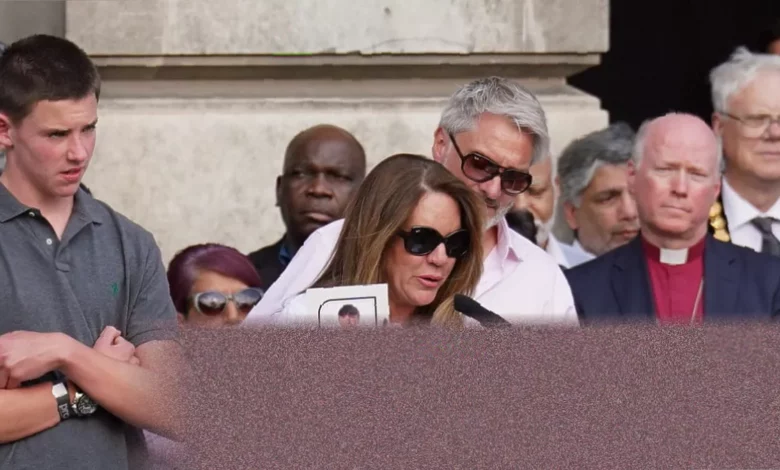
Two families, united in grief, seek answers after their sons’ deaths. Emma Webber clutches one of Barney’s old T-shirts as she attends the public inquiry into how he died, while Mark Nowak watches bodycam footage of his son Henry being handcuffed by police as he lay bleeding on a Southampton pavement. Both mothers and fathers are bound not only by loss but by a shared determination that these tragedies should not be exploited for political gain.
Barney Webber, a 19-year-old university student, was walking home in Nottingham with his friend Grace O’Malley-Kumar on 13 June 2023 when both were fatally stabbed by Valdo Calocane, a paranoid schizophrenic who had recently been discharged from hospital and was not taking his medication. Calocane then killed 65-year-old school caretaker Ian Coates and seriously injured three other pedestrians – Wayne Birkett, Sharon Miller and Marcin Gawronski – before being caught. A statutory public inquiry into the attacks began on 23 February 2026, chaired by Her Honour Deborah Taylor, examining Calocane’s risk management, the emergency services’ response and the wider timeline. Its findings are due next year.
To the Nowark family.
With all of my love.
💔❤️ pic.twitter.com/SaXrP2Rd9O— Emma (@MrsEmmaWebber) June 3, 2026
Eighteen-year-old Henry Nowak died on 3 December 2025 in Southampton after being stabbed by Vickrum Digwa, who then falsely accused Nowak of assault and racism. Police bodycam footage released by Hampshire and Isle of Wight Constabulary shows officers handcuffing Nowak as he lay dying, ignoring his repeated statements that he could not breathe and had been stabbed. Digwa was sentenced to life imprisonment with a minimum term of 21 years for murder; his mother was convicted of assisting an offender. The Independent Office for Police Conduct is reviewing the police response. Protests followed the release of the footage, with speakers including the far-right activist Tommy Robinson, who accused Hampshire police of institutional racism. Justice Secretary Shabana Mahmood stated that there could be “no justification for hijacking this tragedy to stir up violence and disorder.” Mark Nowak condemned the police treatment of his son but urged against using his death to create division.
The Nottingham families fought for a public inquiry into how Calocane was free to kill, and they fervently hope its lessons will save lives. But, as Emma Webber put it in a video this week offering her sympathies to Henry Nowak’s parents, they want to avoid “political grandstanding”. Yet this week, the shadow home secretary, Chris Philp, advanced an argument that has long bounced around the rightwing infosphere: that doctors hesitated to section Calocane – who is black – partly because of controversy over disproportionately high section rates for black men, leading “directly to the murder of three innocent people”. Philp also noted that the Southport killer Axel Rudakubana’s headteacher was accused of racially stereotyping a black boy when describing her concerns about him, though the subsequent public inquiry did not find that central to what followed. The shadow equalities secretary, Claire Coutinho, tweeted that the Nottingham killings, the Southport stabbings and the Manchester Arena terror attack – where a security guard failed to challenge the suicide bomber for fear of seeming racist – were evidence of racism being “weaponised in public services”, costing innocent lives.
I gave evidence to the Nottingham Inquiry on Friday.
In my view the Inquiry will shape mental health care for the next decade, as did the inquiry into the killing of Jonathan Zito in 1992.
I made 3 points:
That in mental health we have a social responsibility…..
— louis appleby (@ProfLAppleby) May 31, 2026
Nigel Farage has been remorselessly pumping out the same message – that anti-racism is somehow more dangerous than racism itself – while threatening to repeal swathes of anti-discrimination law if Reform UK gets elected. The party has proposed scrapping the Equality Act 2010, which protects against discrimination on grounds including age, disability, gender reassignment, race, religion, sex and sexual orientation. Critics describe the plan as “absurd” and warn it would remove vital protections for many groups.
The complex interplay between mental health care, race and public safety decisions demands thorough explanation. Calocane was sectioned and discharged four times. Two of his doctors testified that race did not influence those decisions. But Dr Jonathan Gibson, who saw Calocane four months before the killings and now believes he should have pushed for his patient to be forcibly medicated, testified that he had been repeatedly told psychiatry was “institutionally racist” and too coercive, especially with young black men. He said he was “viscerally” aware of that argument and “I do not believe it had no bearing on VC’s care.” The inquiry will have to reconcile these accounts. Professor Louis Appleby, the former mental health tsar, warned last week that the pendulum had swung too far from public safety towards respecting patients’ wishes.
Racism has been weaponised in our public services.
Axel Rudakubana. Valdo Calocane. The Manchester Arena bomber.
In each case the fear of being called racist stopped people doing their jobs to prevent innocent people from being killed.
It must stop. pic.twitter.com/jXVNksoqS3
— Claire Coutinho (@ClaireCoutinho) June 4, 2026
Similar dilemmas have surfaced elsewhere. In Southport, on 29 July 2024, 17-year-old Axel Rudakubana killed three young girls and injured ten others at a dance workshop. He had a history of violence and behavioural issues, an autism spectrum diagnosis, and an obsession with online violent content. The head of the Prevent counter-terrorism scheme resigned following a review into failings that preceded the attack. During the Manchester Arena bombing inquiry, security guard Kyle Lawler testified that he had a “bad feeling” about the bomber, Salman Abedi, but did not approach him for fear of being branded a racist. He said he was unable to raise the alarm because he had no radio and felt unable to leave his post for fear of losing his job. Another guard, Mohammed Agha, also saw Abedi but did not have strong suspicions, noting only that he seemed nervous.
These cases expose the difficulty of walking a high wire in already pressured careers. As the original Nottingham inquiry heard, the victims were tested for drugs and alcohol while Calocane was not – a decision Grace O’Malley-Kumar’s father, Sanjoy Kumar, described as “disgusting”. Eleven NHS trust staff were sacked for inappropriately accessing the medical records of the Nottingham attack victims. The parents of Barnaby Webber and Grace O’Malley-Kumar have given evidence, describing the inquiry as “bruising and heartbreaking”. David Webber recounted how the family tracked his son’s phone and panicked when it moved to a police station, and that police provided very little information.
The lesson of Henry Nowak’s awful death is not that the legacy of the Macpherson report – which in 1999 found the Metropolitan Police to be “institutionally racist” after the murder of Stephen Lawrence – has somehow ceased to matter. It is that lessons must be learned from both. The Macpherson report’s 70 recommendations led to legislative reforms including the Race Relations (Amendment) Act 2000; challenges remain in achieving proportional representation in senior police roles and fully eradicating institutional racism. But as the Nottingham families know, kneejerk assumptions either way are dangerous. If any professional has been too squeamish, the takeaway is that the legacy of Macpherson does not need dismantling, as Farage now argues. Instead, the country needs a nuanced understanding of how mental health care, race and public safety interact – one that does not pour petrol on bonfires or casually throw decades of progress under the bus. Too many families are left holding nothing but faded T-shirts.