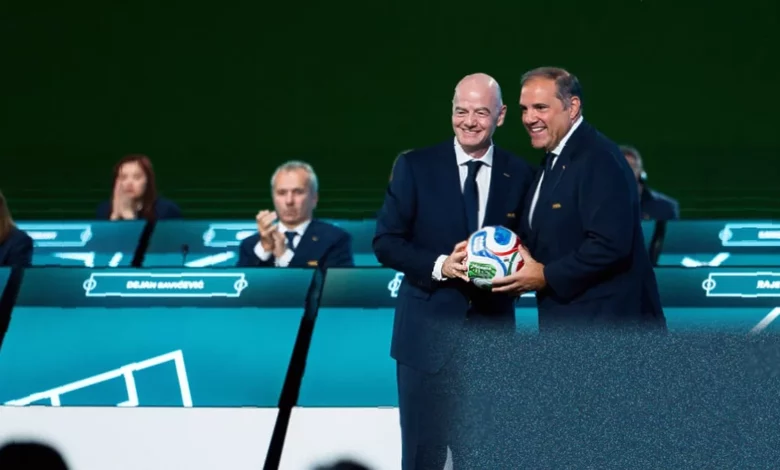
Gianni Infantino will seek re-election as Fifa president next year, a contest that is all but certain to be a coronation. The 54-year-old announced his intention to stand during the closing minutes of the 76th Fifa congress in Vancouver, telling delegates he wanted them to be the first to know. In reality, the outcome has been an open secret since before his previous victory in 2023, after a statutory ruling allowed him to count his first 39 months in office as not part of his term limits. With the public endorsements of the African, Asian and South American confederations already secured – representing 111 of the 211 potential votes – Infantino will be elected unopposed for a third consecutive time, matching the pattern of 2019 and 2023. The election is scheduled for 18 March 2027 at the 77th Fifa congress in Rabat, Morocco.
Revenue and influence
The clearest explanation for Infantino’s ability to command such overwhelming support lies in the financial figures he presented to congress. Fifa’s forecast revenues for the 2027–2030 cycle have risen to $14bn (£10.3bn), a sum more than three times higher than the revenue budgeted for the 2011–2014 cycle. The increase is driven by the expansion of flagship tournaments – the men’s and women’s World Cups – as well as the newly expanded Fifa Club World Cup and the inaugural Fifa Women’s Club World Cup. Infantino promised that Fifa’s financial distribution to its 211 member federations would rise by 20% over the next four years, to a minimum of $2.7bn. That represents an eightfold increase in development funding compared with pre-2016 programmes. “Fifa’s money is your money,” he told delegates, who greeted the announcement warmly.
The direct link between revenue and Infantino’s grip on power is unmistakable. By distributing ever-larger sums to federations – many of which rely heavily on Fifa funding – he secures their loyalty at the ballot box. The Fifa council also agreed to increase payments to the 48 teams participating in the upcoming World Cup by at least $2m, raising preparation money from $1.5m to $2.5m and qualification compensation from $9m to $10m. The boosts were intended to help cover higher-than-expected costs of participation in North America. Uefa had lobbied for these increases on behalf of several European associations, citing concerns that some teams might lose money on the tournament, though Fifa insisted the changes were not a direct reaction to that lobbying. Infantino’s claim last month that “there would be no football in 150 countries in the world” without Fifa’s largesse is strongly contested, but there is no doubt that such funding is highly effective in buttressing his power.
New regulations and controversies
Beyond the financial headlines, the congress and the accompanying Fifa council meeting delivered several significant regulatory developments. A surprise announcement was the launch of a consultation process for a new regulation that would compel senior club teams to field at least one homegrown player under the age of 21 on the pitch at all times. The proposal, intended to boost youth development and increase playing time for young, domestically developed players, is at an early stage, with a formal proposal expected within the next year. Fifa sources claimed that Uefa’s president, Aleksander Ceferin, was behind the idea, which emerged after a meeting of the six confederation leaders, but those close to the Slovene disputed that. What is not in doubt is that the proposal faces fierce opposition from clubs, which are already discussing the possibility of a legal challenge should Fifa proceed.
Referees at the upcoming World Cup will also operate under new directives, including automatic red cards for players who cover their mouths while speaking to opponents or who leave the pitch during a dispute. The directive on covering mouths appears to stem from an incident involving Vinicius Junior and Gianluca Prestianni. Additionally, the cutoff point for automatic one-match suspensions due to yellow cards has been adjusted for the expanded 48-team tournament: single yellow cards will be wiped out after the group stage and again after the quarterfinals.
Infantino’s attempt to stage a diplomatic gesture between the Palestinian and Israeli delegations backfired. He repeatedly and increasingly desperately pressed the Palestinian Football Association’s president, Jibril Rajoub, to take the stage alongside Basim Sheikh Suliman, the Israeli FA’s vice-president. Rajoub refused. The episode displayed a curious mixture of cynicism – seeking to reduce a decades-long conflict to a photo opportunity – and naivety, stemming from Infantino’s oft-repeated belief that football can unite the world.
Calendar conflicts and legal challenges
Fifa confirmed that the next men’s Africa Cup of Nations will take place in the summer of 2027, from 19 June to 17 July, co-hosted by Kenya, Uganda and Tanzania. Qualification matches will be played across three Fifa international windows, with the draw scheduled for 19 May 2026. However, little progress was made on agreeing the international match calendar beyond 2030, the next big issue dividing the sport. The timing of the 2034 World Cup in Saudi Arabia will be the key, with January and February the favourite slot – a decision certain to provoke further conflict with World Leagues and the global players’ union, Fifpro. Fifpro Europe, together with the European Leagues group, has already filed a legal claim against Fifa, challenging its unilateral control over the international match calendar and the expansion of the Fifa Club World Cup, arguing it violates EU competition law and players’ rights under the EU Charter of Fundamental Rights.
The Club World Cup itself is set to expand to 32 teams in 2025, hosted in the United States from 14 June to 13 July. Uefa has indicated it will back a further expansion to 48 teams for the 2029 edition, provided it is not held biennially. A preliminary tournament is also expected as a means of pushing Fifa’s revenues beyond the $14bn mark. Yet Infantino appears to be delaying the debate on these calendar issues until after next year’s election, leaving clubs and leagues seeking answers.
There was no repeat of last year’s walkout by European representatives in protest at Infantino’s late arrival. Instead, Uefa members stayed largely on the periphery. The decision to hold next year’s congress in Rabat – where Infantino will be re-elected – underscores the shifting geopolitical centre of gravity in world football. Fifa’s annual flagship event has not taken place in Europe since Paris in 2019 (excluding two virtual events from Zurich during the pandemic). Following a run of congresses in Qatar, Rwanda, Thailand, Paraguay and Canada, it was Europe’s turn, but Infantino’s next diplomatic target is the king of Morocco, Mohammed VI, whose country is co-hosting the 2030 World Cup with Spain and Portugal.
In a notable counterpoint to Infantino’s focus on revenue and distribution, Concacaf president Victor Montagliani – speaking in his home city of Vancouver – emphasised that Fifa’s priority should be service rather than power. Montagliani is widely seen as a credible candidate should a genuinely open presidential election take place in 2031, although there have been murmurings that Fifa’s statutes could be altered yet again to permit Infantino a fourth full term, extending his presidency to 15 years.