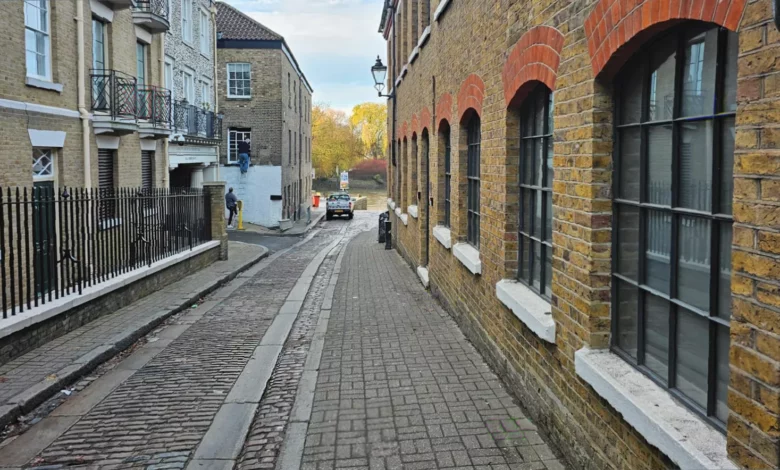
For generations, residents and visitors alike have assumed Richmond’s Water Lane simply describes the path down to the river. In fact, the name is a modern invention, chosen deliberately to hide the truth: the town’s water supply came from a deep well beside the Thames, and the “Water” brand was a marketing tactic to persuade drinkers they weren’t sipping the dirty river itself.
From Thames Lane to Water Lane: A Marketing Ploy
The passage at the bottom of Richmond Hill was originally called Town Lane, and later Thames Lane — an honest reference to where it led. That changed sometime after 1860, when the former Collins Brewery at the foot of the alley was taken over by the local vestry to house a steam engine. The engine powered a pump that drew water from a deep well next to the Thames and pushed it into the town’s supply. To distance the town’s drinking water from the heavily polluted river, the alley was rebranded Water Lane, a name that suggested purity rather than sewage-laced tidal mud.
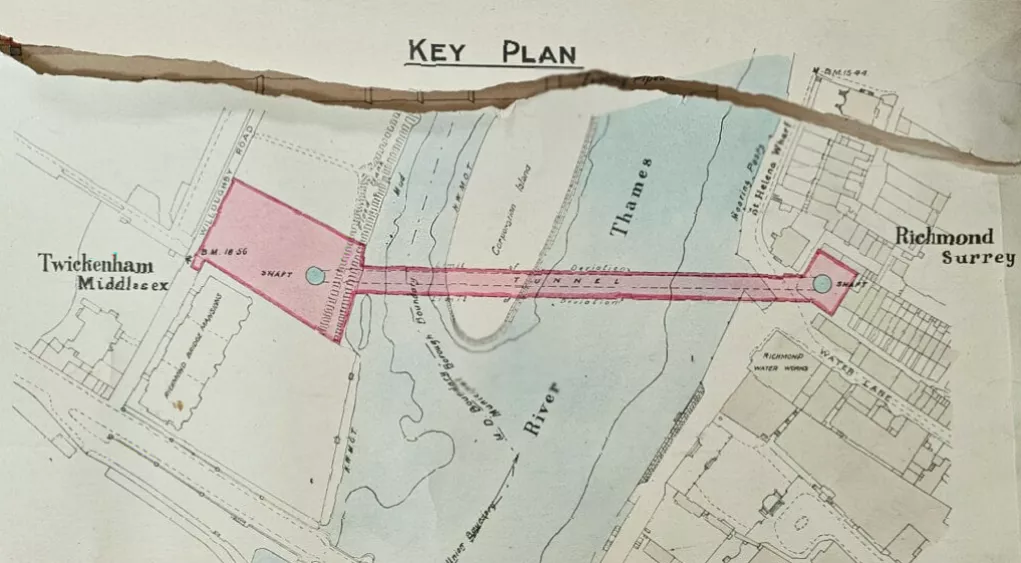
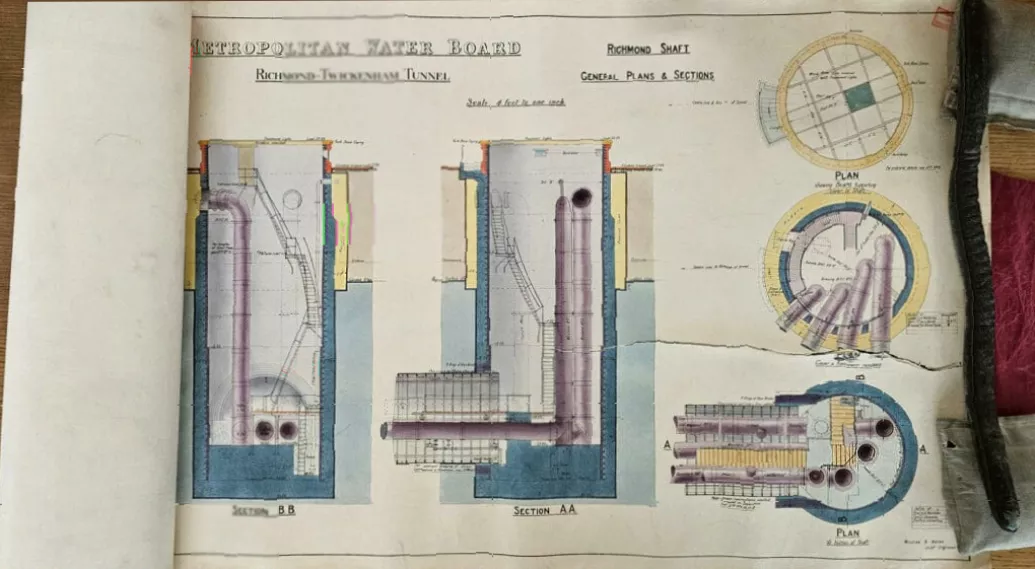
The plan worked — for a while. The waterworks closed when a large water pipe was laid under the Thames from the other side of the river, connecting Richmond to the Hampton mains supply. The top of that water main is still visible at the bottom of the alley as a large fenced-off shaft that drops deep below the riverbed.
The Brewery That Became a Waterworks
The story of Water Lane is inseparable from the former Collins Brewery, which stood on the corner at the river end. The brewery itself was founded by at least 1703 — possibly as early as 1715 — and operated for around 150 years before closing in 1860. Its large brick buildings then found a new purpose: between 1875 and 1879, the vestry converted the brewery into a pumping station for the municipal waterworks. A well was bored to a depth of 1,447 feet to tap into clean groundwater, and the adjacent Riverside House became the engineer’s residence and office. Both the waterworks building and Riverside House are now Grade II listed. Archaeological evaluations at 12-14 Water Lane in 2023 uncovered 18th-century brick wall foundations from the brewery era, along with evidence of a World War II bomb strike that had led to demolition and clearance.
The steam-powered water pump was a critical piece of Victorian infrastructure, part of a wider response to the sanitary crisis. Richmond’s was one of many such stations built across Britain from the 1840s onwards, using technology that had its roots in Thomas Newcomen’s early steam pumps from 1712.
A Cobbled Descent to the River
Walk down Water Lane today, and the defining feature is the cobblestone path with a long row of flat stones. These were laid to help carts roll up and down the steep slope, carrying cargo from barges that unloaded on the Thames foreshore at low tide. This was before the construction of weirs in this part of the river — Richmond Weir was built in 1894 — which later regulated the tides and ended the need for tidal loading.
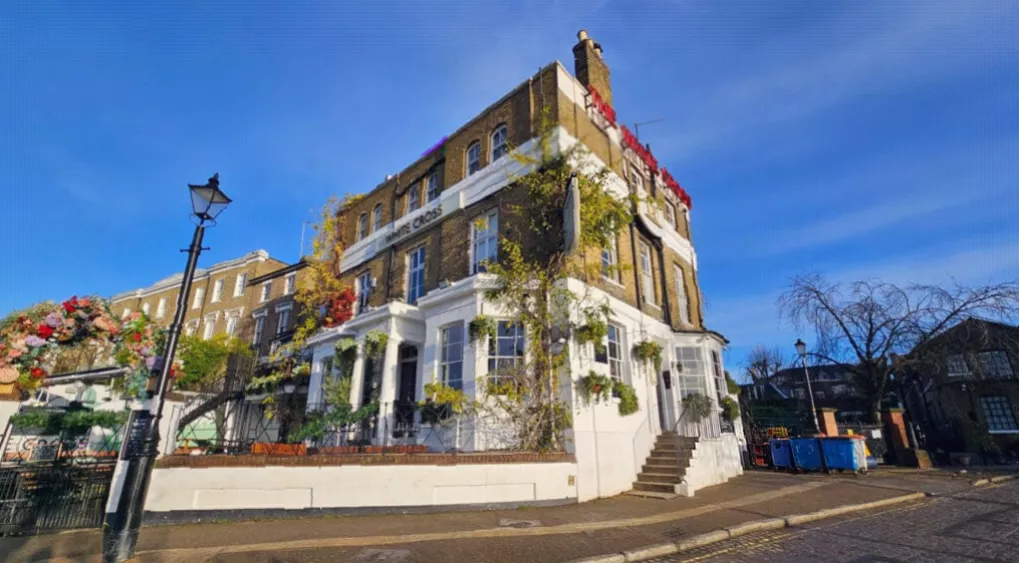
At the bottom, next to the water main shaft, stands the White Cross pub, a Grade II listed building that has been a fixture since at least 1748, when it was known as the Waterman’s Arms. The current building dates from the early to mid-19th century, likely around 1838, and was renamed the White Cross shortly after. Theories for the name vary: one suggests it honoured a landlord named Samuel Cross; another links it to a former Observant Franciscan friary on the site, whose symbol was a white cross. Remains of that friary may still exist in the pub’s cellars. The White Cross has been associated with Young’s Brewery since at least 1869 and is famous for being cut off by the Thames at very high tides. Tide warning signs are posted, and the pub lends wellington boots to visitors caught unawares by its watery fate.
Pubs, Cottages and Cinemas
Further up the lane, the Watermans Arms has been a pub since at least 1660, making it one of Richmond’s oldest surviving hostelries — though the current building dates to 1898. It underwent a significant refurbishment in 2019, giving it a more modern, dining-focused interior, but still retains its historical character. Early period cottages line one side of the passage, while a mix of old warehouse buildings and very modern offices fill the other.
A striking addition is the 1990s block of flats that runs up one side, with a classically 1990s colonnaded entrance to the car park and, oddly, a stone-clad upper floor trying to look much older than it really is. This faux effect is repeated with a campanile-style tower above the main entrance — a textbook example of late-20th-century architectural whimsy. Opposite stands a row of three modern houses built in a heritage style in 2012, replacing a former back garden that had long been fenced off and neglected.
Further along, the modern brick-clad office block that runs along the opposite side was originally built in 1980 on the site of the former Gaumont Cinema. That cinema, originally opened as the New Royalty Kinema in 1914, became the Gaumont in 1949 and closed in 1980. Its auditorium was demolished in 1983, but a covenant requiring cinema use on the site led to the construction of the Filmhouse — later Curzon Richmond, which opened in its current form in 2008. The original 18th-century Georgian townhouse facade and foyer were retained and are now used as offices and a restaurant. The Curzon chain was established in 1934.
As an alley, Water Lane has that odd late-20th-century feel, where modern buildings tried to fit into an old town by mimicking vernacular styles — what critics sometimes call Poundbury vernacular, after the development championed by the then Prince of Wales — only to end up sticking out like a sore thumb. Yet it remains a charming passage to the river, its layered history written in cobbles, bricks and the name itself.