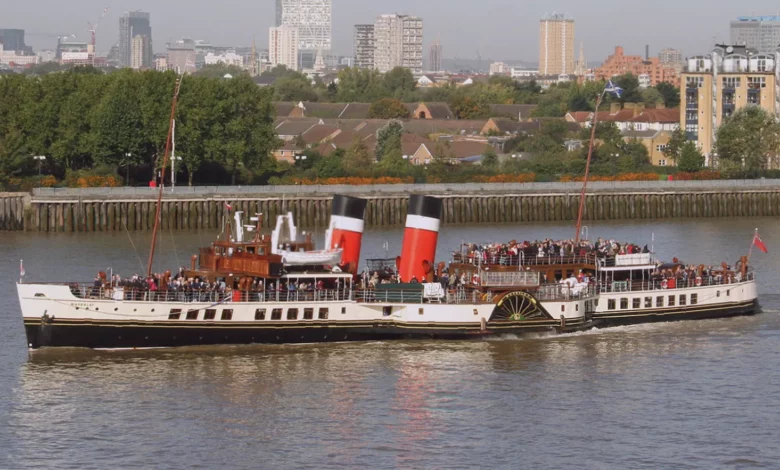
London will host the world’s last seagoing paddle steamer this autumn, when the PS Waverley returns to the Thames for a series of voyages between 24 September and 11 October 2026. The 80-year-old vessel, launched on the River Clyde in 1946, will offer passengers a rare chance to cruise past the capital’s landmarks and, for the first time in this programme, venture out to the eerie WWII sea forts that still stand in the Thames Estuary.
The Waverley’s London visit includes departures from Tower Pier and other points along the river, with a mix of return trips and one-way sailings that allow passengers to alight at a coastal town and catch the train home. Among the highlights is the ship’s passage under Tower Bridge — a spectacle that happens every time she sails upstream, thanks to a distinctive design choice. The paddle steamer carries a tall mast that is deliberately too high to clear the bridge’s raised walkways, forcing the famous bascules to open for her. What appears to be a quirk of naval architecture is, in fact, a cunning feature that treats passengers to the sight of London’s most iconic bridge lifting in welcome whenever the Waverley approaches.
The mast serves no practical purpose other than to necessitate the bridge’s opening, a tradition that adds to the ship’s theatrical appeal. On the Thames, where many vessels have similarly superfluous masts, the Waverley’s version ensures that each transit becomes a moment of shared spectacle for those on board and on the riverbanks alike.
Steam, steel and survival: the story of the Waverley
The PS Waverley was built by A. & J. Inglis in Glasgow for the London and North Eastern Railway, replacing an earlier paddle steamer of the same name that was sunk during the Dunkirk evacuation in May 1940. She entered service on 16 June 1947, initially running the Firth of Clyde route from Craigendoran to Arrochar, passing through Loch Goil and Loch Long. By 1973, rising operating costs threatened her retirement, but the Paddle Steamer Preservation Society bought her for a nominal £1 and formed the charity Waverley Excursions to keep her afloat.
Over the decades the ship has undergone multiple restorations. A major £7 million Heritage Lottery Fund-supported rebuild and reboilering took place between 2000 and 2003; a £2.3 million boiler refit appeal in 2019, backed by public donations, trusts and the Scottish Government, allowed her to return to service in August 2020; and a £1.5 million winter refit has restored her to her original 1940s appearance. She is powered by a 2,100 hp triple-expansion steam engine and now carries up to 860 passengers, down from an original 1,350 due to modern safety regulations.
Recognised as “a vessel of pre-eminent national importance,” the Waverley is listed in the National Historic Fleet by National Historic Ships UK. The 2026 season is set to be her longest in more than a decade, running until 18 October, though a fuel surcharge has been introduced to cover rising costs. The ship is the only seagoing paddle steamer still operating in the world; the only other historic paddle steamer in Great Britain, PS Kingswear Castle, sails on the River Dart in Devon. Recent operational hiccups — a port paddle wheel breakdown in October 2025, a boiler valve cancellation in June 2025, and a collision with Brodick Pier in September 2020 — have not dimmed the enthusiasm of her supporters, who continue to fundraise for annual maintenance.
Thames Forts: wartime relics in the estuary
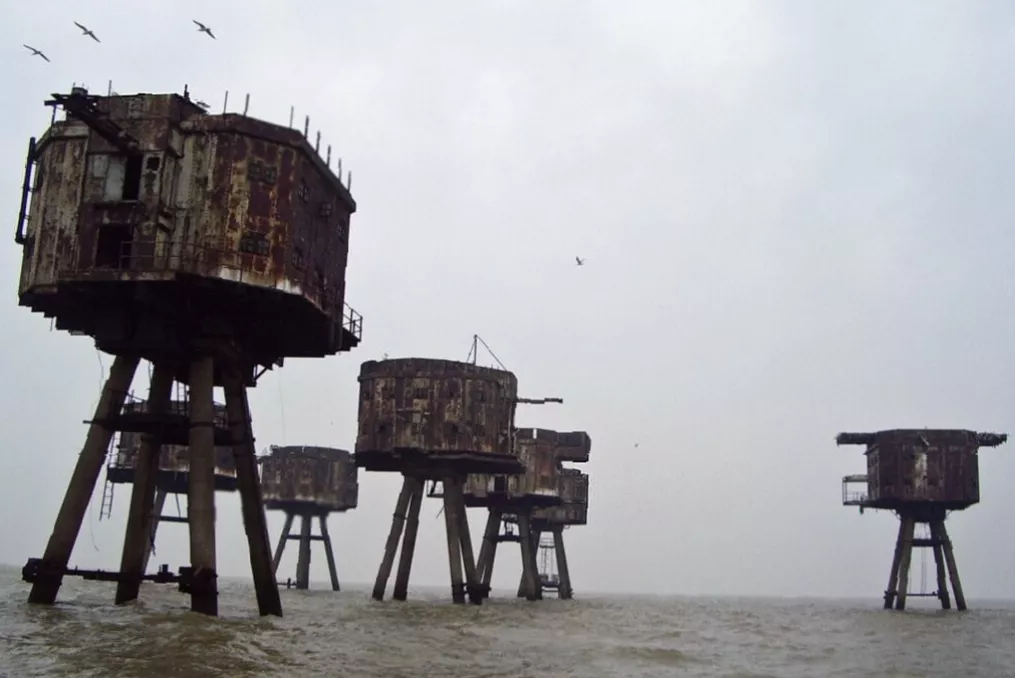
For passengers seeking something beyond the usual river cruise, the Waverley’s programme includes dedicated trips to the Thames Sea Forts — the Maunsell Forts built between 1942 and 1943 to defend the approaches to London from air raids and naval mines. Designed by civil engineer Guy Maunsell, the forts came in two types: naval forts on concrete pontoon bases with twin towers, and army forts consisting of seven interconnected towers linked by catwalks. Three army forts — Nore, Redsand and Shivering Sands — were constructed in the Thames Estuary. During the war, these structures are credited with shooting down 22 enemy aircraft and around 30 flying bombs, as well as deterring German naval vessels.
Decommissioned in the late 1950s, the forts later became notorious as pirate radio bases in the 1960s. Today only Redsand and Shivering Sands remain; Nore was dismantled in 1959 after storm and collision damage. Redsand is considered the best preserved, but access is difficult and hazardous, with tours typically operating from ports such as Queenborough and Southend. The Waverley’s Thames Fort trips — scheduled for Sunday 27 September, Friday 2 October and Saturday 10 October — offer a rare, safe vantage point from which to view the rusting hulks that still guard the estuary.
The full timetable for the London visit is as follows: Saturday 26 September to Tilbury and Southend; Sunday 27 September to Gravesend, Southend and the Thames Forts; Wednesday 30 September to Gravesend, Southend and Whitstable; Friday 2 October to Gravesend, Southend and the Thames Forts; Saturday 3 October to Gravesend and Rochester; and Saturday 10 October to Southend and the Thames Forts. Adult tickets for an evening return cruise from Gravesend passing under Tower Bridge are priced at £57. Bookings can be made through the Waverley Excursions website or by calling 0141 243 2224.