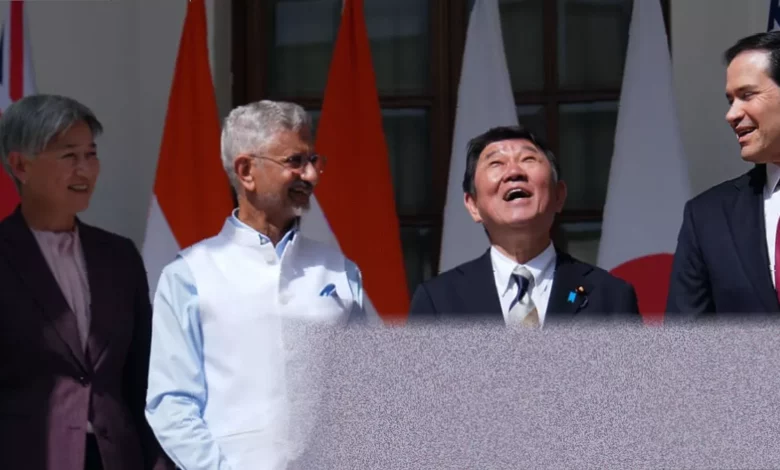
The Quad nations will invest $20bn in critical minerals and surveillance – a package of initiatives designed to secure strategic supply chains and counter Chinese maritime influence in the Indo-Pacific. The four countries – Australia, the United States, India and Japan – announced the plans after a meeting in New Delhi attended by US secretary of state Marco Rubio, who described the group as comprising countries “who share strong values – strong, vibrant democracies” with “many aligned interests”.
In a joint statement, the Quad said it would mobilise $20bn (£15.7bn) in government and private money to strengthen critical mineral supply chains, including by identifying projects in the four member nations. The ministers also agreed two maritime initiatives: one that integrates their surveillance capabilities, and another that will feed enhanced real-time information to commercial shipping at sea. The new Indo-Pacific Maritime Surveillance Collaboration Initiative aims to create a “Common Operating Picture” and share near real-time data across the region’s strategic shipping lanes, according to officials.
The Fiji port project is the Quad’s first joint regional infrastructure venture. Australia’s foreign minister, Penny Wong, said the group was cooperating on port development in the South Pacific island nation, where China has made a concerted push for greater influence. “We recognise our obligation – our responsibility – to provide real choices, particularly as strategic circumstances in our region are deteriorating,” Wong said. The Quad Ports of the Future Partnership is intended to address inadequate port capacity in the Pacific Islands and serve as a model for future projects. Separately, the Quad set a goal of connecting South Pacific islands through undersea cables by the end of the year, integrating them economically with the four democracies rather than China – an initiative that builds on the Quad Partnership for Cable Connectivity and Resilience launched in 2023 to counter Beijing’s Digital Silk Road.
China reacted sharply. Foreign ministry spokesperson Mao Ning said cooperation “should not be directed against any third party” and that Beijing “does not support exclusive cliques or bloc confrontations”. The Quad ministers had earlier expressed being “seriously concerned” about the South China Sea and East China Sea, opposing “destabilising or unilateral actions” – a clear reference to Beijing. According to officials, Beijing is annoyed that Fiji is pivoting to Western security partners after previously courting Chinese investment under its Belt and Road Initiative.
The Quad also launched an Indo-Pacific energy security initiative to strengthen regional fuel and energy supply chains, with the United States due to host a Quad fuel security forum later in 2026.
Housing tax changes defended
Housing minister Clare O’Neil has defended the federal budget’s property tax changes, saying they will have a “modest affordability effect” on house prices. Speaking to the ABC’s News Breakfast, O’Neil said the changes – which include limiting new negative gearing to new-builds and adjusting capital gains tax – would be “difficult” for some people but “they’ll mean about 75,000 rental households become first home owning households”. Treasury modelling in the budget estimates the measures will slow house price growth by two per cent over two years under current tax settings.
“What it says is that this will have a modest affordability effect on house prices in Australia,” O’Neil said. “But at the end of the day, the thing that is driving house prices is actually not our tax sets, it’s a fundamental mismatch between how many homes we’re building and how many homes we need. On supply, building more homes is the best thing to put downward pressure on house prices. At the moment, that project is being hit from all sides. You’ve got the conflict in the Middle East, which is driving up construction costs, you’ve also got a big surge in interest rates as well.”
Appearing on Sunrise alongside Liberal frontbencher Michaelia Cash, O’Neil acknowledged not everyone supported the changes. She pointed to polling in the Australian Financial Review that gave the capital gains tax changes a net approval rating of zero – 36 per cent approved and 36 per cent opposed. “What they show is that lots of people are supportive of what the government is doing. And then some people don’t support what the government’s doing,” O’Neil said. “That is what you’d expect to see in a budget that does some tough but necessary things for the country. In politics, you don’t do the popular thing. You do the right thing.” Polling published by Guardian Australia found only a third of Australians support the negative gearing and CGT changes.
Australia and the US are working together as allies, and through the Quad, to help shape the Indo-Pacific for the better including through delivering resilient infrastructure for the Pacific. Valued speaking with US Secretary of State Marco Rubio in Delhi to discuss this work. pic.twitter.com/RigY1PsDvv
— Senator Penny Wong (@SenatorWong) May 26, 2026
Outgoing Nacc boss under fresh scrutiny
Paul Brereton, the outgoing boss of the National Anti-Corruption Commission (Nacc), has defended his controversial tenure but pushed back against suggestions he contributed to the suffering of robodebt victims. Facing Senate estimates for the last time before he leaves the role on 6 July, Brereton said he was wrong to be involved in considering referrals related to the illegal welfare debt scheme, which was the subject of a landmark royal commission. But he hit back at Greens senator David Shoebridge, who asked if he would apologise to victims and the families of people who died after being issued debt notices.
In October 2024, the Nacc inspector found Brereton had engaged in misconduct when he involved himself in proceedings that rejected further investigation into senior public servants involved in robodebt, including the then human services department secretary Kathryn Campbell, who was an army reserve colleague of Brereton’s. Brereton told the hearing his involvement “was entirely in good faith, in the interests of the then infant commission in providing guidance, how a very complex issue might be addressed without suggesting the outcome of that issue”. He added: “As I have said earlier, with the benefit of hindsight, it would have been better if I was not involved in that at all. And, of course, I am sorry for the delay that that has caused. However, to suggest that that is the main cause of the appalling tragedy that the robodebt victims have suffered, is, I suggest, gilding the lily on your part.”
At the same estimates hearing, inspector Gail Furness revealed she had started a second investigation into Brereton. Furness said she began a complaint investigation on 14 April 2026 and provided a draft report to Brereton on 28 April, and is now awaiting his response. The complaint – which had been made some months earlier – relates to Brereton’s consulting work for the Inspector-General of the Australian Defence Force (IGADF) while serving as Nacc commissioner. Brereton, the author of the Afghanistan war crimes inquiry, had continued that consultancy without the federal government’s knowledge after taking up the Nacc role in 2023. Furness said the second investigation is not related to the first. It was also disclosed at estimates that the Australian Federal Police and the federal government’s special investigator for war crimes allegations have asked the Nacc to investigate media leaks about the arrest of Ben Roberts-Smith, who faces five charges of war crime murder related to his service in Afghanistan.
Syrian returnees face heated reception
Independent MP Monique Ryan has called for the women and children who arrived in Australia from a Syrian detention camp to be treated “sensitively and gently”. The group left the al-Roj detention camp last week and landed at Melbourne airport on Thursday night, where chaotic scenes broke out and scuffles with media workers were reported. Speaking on the Today show, Ryan said the last thing the children need is “an aggressive media”. “We’re talking about kids who have grown up in a camp in Syria who haven’t been exposed to Australia at all,” she said. “And I would suggest that we should treat them sensitively and gently upon their arrival. And remember that there’s vulnerable kids and that the last thing they need to be subjected to on their arrival is an aggressive media.” Ryan also defended the government, saying Labor was “watching the situation closely and monitoring it”.
Housing minister Clare O’Neil, appearing on the same programme, was repeatedly asked whether Australia was safer with the group present but declined to give a direct yes-or-no answer. “We are working with national security agencies on this,” O’Neil said. “This is a difficult issue and a long running issue for the country. We are lucky to have some of the best national security agencies in the world supporting us here in Australia, and they will be monitoring this situation extremely closely. And we do trust them to support the country to be safe.” When asked why the returnees were not questioned at the airport and whether they would attend de-radicalisation programs, O’Neil deferred to the home affairs minister. She noted that this was not the first repatriation – a group of orphans from the camp was brought back by the Morrison government.
Moriarty begins Washington posting
Greg Moriarty, Australia’s former defence secretary, has begun his term as ambassador to the United States, succeeding Kevin Rudd. Moriarty posted on social media after meeting President Donald Trump on Thursday. The appointment was announced earlier this year after Rudd stepped down. Moriarty has extensive national security experience, including involvement in the AUKUS pact, and previously served as ambassador to Iran and Indonesia and worked in US Central Command.
University class sizes surge, learning suffers
A report by the National Tertiary Education Union (NTEU) has found that university class sizes have surged since before the pandemic, with student learning declining as a result. The NTEU surveyed more than 4,000 university staff across the country. The proportion of tutorials with 30 or more students has more than doubled since 2019, from 12 per cent to 27 per cent, while only 9 per cent of tutorials now fall within the optimal range of 10 to 19 students. More than eight in ten staff said their ability to support students individually had been compromised, and just 1.7 per cent reported an improvement in student outcomes since 2019. NTEU president Dr Alison Barnes said the “class size explosion is being felt at campuses nationwide” and that “students aren’t getting the attention they need and their education suffers. This could have a dangerous ripple effect that we feel for generations.” Australia already performs poorly internationally on faculty-to-student ratios; no Australian university ranks in the top 300 on QS World University Rankings for that measure, and the average score on the “learning experience” indicator is 12.5 out of 100, well below the global average of 28.1.