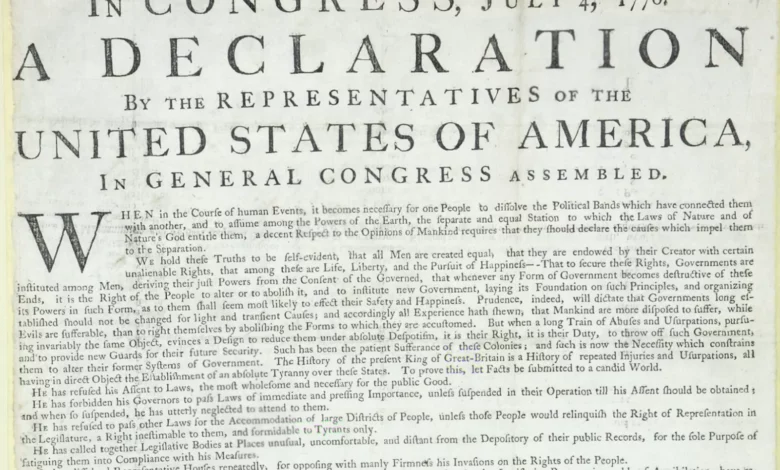
A rare surviving printed copy of the American Declaration of Independence — one of the famed “Dunlap broadsides” — is to go on display at the Science Museum in London this autumn as part of a new exhibition exploring the role of science in the early United States.
Printed by Irish-born John Dunlap on the night of 4 July 1776, the broadsides were the first published versions of the Declaration. Dunlap, who had emigrated to America at the age of ten and later became the official printer for the Continental Congress, is thought to have produced around 200 copies that night, using every sheet of paper he could lay his hands on. The original source copy used for that printing — which may have been in Thomas Jefferson’s handwriting — has been lost.
Only 26 copies of the Dunlap broadside are known to survive today. Three are held in British repositories; the Library of Congress owns two. One of these rare documents will now travel to London for the Science Museum’s exhibition. Copies were originally sent to government authorities, military commanders and colonial assemblies across the thirteen states; George Washington received his copy and ordered it read to his troops on 9 July 1776, weeks before the official engrossed version was signed on 2 August.
The exhibition, titled Becoming America: How Science Shaped a Nation, opens on 23 October 2026 and runs until 25 April 2027. Admission is free but tickets must be booked in advance.
Alongside the Declaration, the exhibition uses maps, paintings, scientific instruments and historic artefacts to trace four transformative decades in North American history — from Britain’s takeover of French territories in the 1760s through to the establishment of the United States and the presidency of George Washington in the 1790s.
A central theme of the exhibition is scientific knowledge developed by Indigenous peoples and communities of African descent in 18th-century North America. Particular attention is given to the Haudenosaunee Confederacy, described as one of the world’s oldest participatory democracies. Visitors will also encounter the almanac of Benjamin Banneker, a freeborn astronomer, mathematician and surveyor of African descent who worked on surveying the new capital, Washington, D.C.
The exhibition devotes considerable space to specific scientific contributions that shaped the nation. Among the objects on display will be a rare copy of Benjamin Franklin’s map of the Gulf Stream. Franklin became intrigued by Atlantic currents after noticing that mail ships travelling from Britain to America took far longer than those making the return journey. Working with his cousin Timothy Folger, a Nantucket ship captain who sketched the stream from his own experience, Franklin produced the first chart of the Gulf Stream. Published in London in 1769, the map is remarkably accurate when compared with modern satellite imagery. It transformed transatlantic navigation, speeding up mail delivery and commercial shipping.
A surveyor’s compass believed to have been used to mark the Mason-Dixon Line will also go on display. The line was surveyed between 1763 and 1767 by English astronomers and surveyors Charles Mason and Jeremiah Dixon to settle a long-running border dispute between the Calvert family of Maryland and the Penn family of Pennsylvania. It was the first geodetic survey in the New World and a major scientific and engineering achievement. The line later became a symbolic dividing point between the northern and southern United States, particularly in debates over slavery.
The exhibition will also explore how American agriculture was shaped by ideas imported from Britain, including the influence of the British Agricultural Revolution on George Washington’s farming methods at Mount Vernon. Washington corresponded with English agriculturalists such as Arthur Young and adopted techniques including crop rotation and “horse-hoeing” — deep ploughing. Tools, plans and equipment used to improve productivity and mechanise farming on his estates will feature. It is noted that Washington’s enslaved workforce implemented these innovations but did not benefit from them.
Items for the exhibition come from the Science Museum Group Collection and are on loan from Mount Vernon, the Library of Congress, the American Philosophical Society, the National Trust, the British Museum, the Royal Collection Trust and The National Archives.
John Dunlap, the printer who produced the broadside, went on to become a prosperous land speculator. A friend later noted that towards the end of his life he “became intemperate so as to fall in the street”. He died of apoplexy in 1812 and was buried with military honours.