A 14-year-old boy has become the 11th person to die in water-related incidents during the heatwave, after his body was recovered from the River Thames near Donnington Bridge in Oxford. Emergency services were called to the scene at around 5.30pm on Wednesday, and Thames Valley Police confirmed that the boy’s family have been informed. His death is being treated as “unexplained but not suspicious”. Local sources have named the boy as Baltazar L’Quy, of Timorese descent.
The tragedy comes as the UK endures a record-breaking heatwave that saw temperatures climb to 35.1C in Kew Gardens, west London, on Tuesday. The hot weather is expected to continue into the weekend, with Thursday forecast to feel “very warm” for many, particularly in the South East, where London could see highs of 31C, according to the Met Office. A yellow heat health alert has been issued by the UK Health Security Agency (UKHSA) for eastern and south-east England and London, running from 4pm on Thursday until 8pm on Saturday. The UKHSA warned that water-related incidents could increase and highlighted the risks of cold-water shock and drowning.
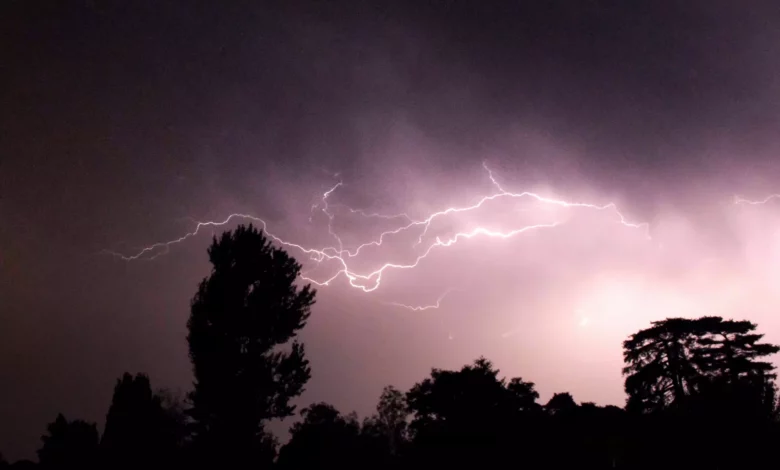
Overnight, heavy downpours and frequent lightning strikes hit parts of the Midlands and northern England as “very warm and unstable conditions” developed, said Met Office spokeswoman Nicola Maxey. Since Tuesday, more than 85,000 lightning strikes have been recorded across the UK, Northern Ireland and the Republic of Ireland. Coleshill in Warwickshire saw 25.4mm of rain between 9pm Wednesday and 3am Thursday, while Solihull recorded 15.6mm. Looking ahead, Maxey said the very hot conditions are expected to ease through the rest of the week, with a band of rain moving eastwards over the weekend and temperatures returning closer to seasonal averages.
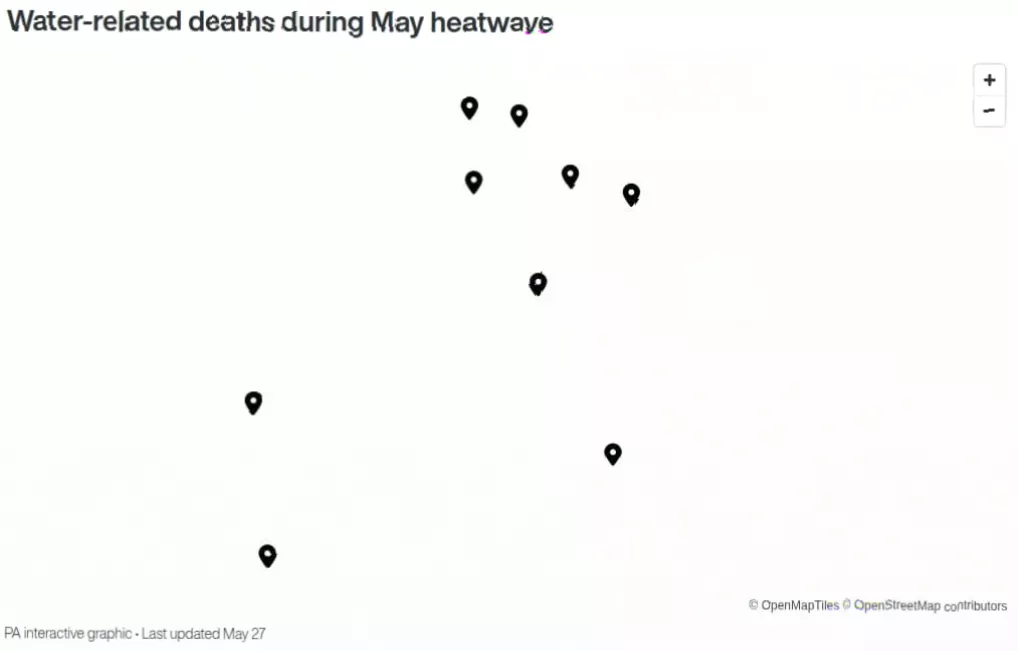
This latest death is part of a grim toll across the country. Since Sunday, water-related fatalities have been reported in South Yorkshire, West Yorkshire, Cornwall, Hampshire, Warwickshire, Cheshire, Pembrokeshire, Lincolnshire, Lancashire and now Oxford. Among those who died are Declan Sawyer, 15, at Swanholme Lakes in Lincoln; a 72-year-old woman pulled from the water at West Angle Bay beach in Pembrokeshire; Reco Puttock, 13, at Leadbeater Dam near Halifax; a teenage girl at Kingsbury Water Park in Warwickshire; and a man in his 60s who suffered a cardiac arrest after entering the sea at Tregirls Beach, Padstow, to help two family members. Junior Slater, 12, died in the River Ribble at Ribchester, Lancashire. A 17-year-old boy was found dead in Pickmere Lake in Cheshire, and the body of a teenager was recovered from Rother Valley Country Park in Rotherham. Another teenage boy died at Hawley Lake on the Hampshire-Surrey border, and a separate incident in Swanscombe, Dartford, also claimed a teenager’s life. Police have said none of the deaths are being treated as suspicious.
Cold-water shock: a hidden danger
Experts have repeatedly warned that warm air temperatures mask a deadly risk: British waters remain dangerously cold even in summer, often below 15C. Cold-water shock triggers an involuntary gasp, rapid breathing, and a surge in heart rate and blood pressure, which can lead to panic, disorientation, loss of swimming ability and even cardiac arrest in fit, healthy individuals. The effects last one to two minutes, but they can be fatal. The RNLI has emphasised the “very real risk” of swimming in open water during the heatwave. The Royal Life Saving Society UK (RLSS UK) has pleaded with the public to “stop and think” before entering the water, noting that when air temperatures reach 25C the accidental drowning risk is five times higher. Research shows that drowning deaths are three times more likely on days above 25C compared with average summer days.
The UKHSA’s yellow heat health alert specifically warns that water-related incidents could increase, and the UKHSA has also previously issued amber alerts for other regions, describing a “greater risk to life” for vulnerable people. Early-season heatwaves are particularly hazardous because bodies have not yet acclimatised to the heat, experts say.

The National Water Safety Forum (NWSF) urges the public to “Respect the Water”. A spokesperson said that while it is too early to say whether the number of deaths during this heatwave is unusual, hot weather often correlates with a rise in accidental drownings. The NWSF’s latest data shows 202 accidental water-related fatalities occurred last year (2025), with the majority (57%) at inland waters such as rivers, lakes, reservoirs, quarries and lochs. In previous years, the NWSF recorded 193 accidental drownings in 2024 and 236 in 2023. In 2021, 277 people drowned accidentally, 61 of whom were swimming. The pattern shows that May 2024 saw the highest monthly number of accidental water-related deaths, with 28 fatalities.
Data from the Office for National Statistics for England and Wales, which records deaths specifically from drowning and submersion in natural water, shows 87 such deaths in 2022, 96 in 2023 and 73 in 2024.
Males are disproportionately affected, accounting for 84% of accidental water-related fatalities in 2024 and 83% in 2023. Young people aged 10 to 29 make up more than a quarter (26%) of accidental drowning deaths over the past five years. Child drowning is a particular concern: in England, 41 children died from drowning between April 2022 and March 2023, most during the summer months. Children under five and those aged 13 to 17 are at highest risk, and drowning rates are higher for children in deprived areas and for Black children. A high proportion of child drownings — 90% in one report — occurred without adult supervision.

Many drownings happen when people do not intend to enter the water at all: 44% of accidental drownings occur during activities like walking or running near water. Alcohol and drugs are also a factor, particularly among men. The NWSF’s 2015 strategy aimed to halve accidental drownings by 2026, but reports indicate child drowning deaths have risen in recent years.
The stretch of the Thames near Donnington Bridge has seen tragedies before: a 13-year-old boy drowned there in 2015 and a 15-year-old in 2012. Safety organisations advise anyone entering open water to do so slowly, wear a wetsuit, use flotation devices, and if they fall in unexpectedly, to “Float to Live” — tilt the head back, keep ears submerged, relax and breathe normally while calling for help.