
Robberies carried out at knifepoint have fallen by a fifth across key areas of the UK, including London, Manchester and Birmingham, according to Home Office figures released during National Knife Crime Awareness week.
The data shows that between June 2024 and March 2026, the number of knife-enabled robberies across seven hotspot areas dropped from 15,918 to 12,633 – a reduction of approximately 20 per cent. Nationally, knife homicides have fallen by 27 per cent and overall knife crime has decreased by 5 per cent in the year ending September 2025, while hospital admissions for knife assaults are down 10 per cent.
Within the police force areas leading the charge, West Midlands Police and British Transport Police recorded the largest falls, both down 39 per cent, followed by the Metropolitan Police with a 17 per cent reduction, according to Home Office analysis.
The figures reflect a broader drop in serious violence that officials attribute to a coordinated, intelligence-led approach combining national operations with targeted local policing.
Inside the raid: Operation Sceptre in action
At the heart of the push against knife crime is Operation Sceptre, the bi-annual campaign led by the National Police Chiefs’ Council (NPCC) that focuses on enforcement, education and prevention. This year alone the operation has resulted in 243 arrests and the seizure of 159 knives.
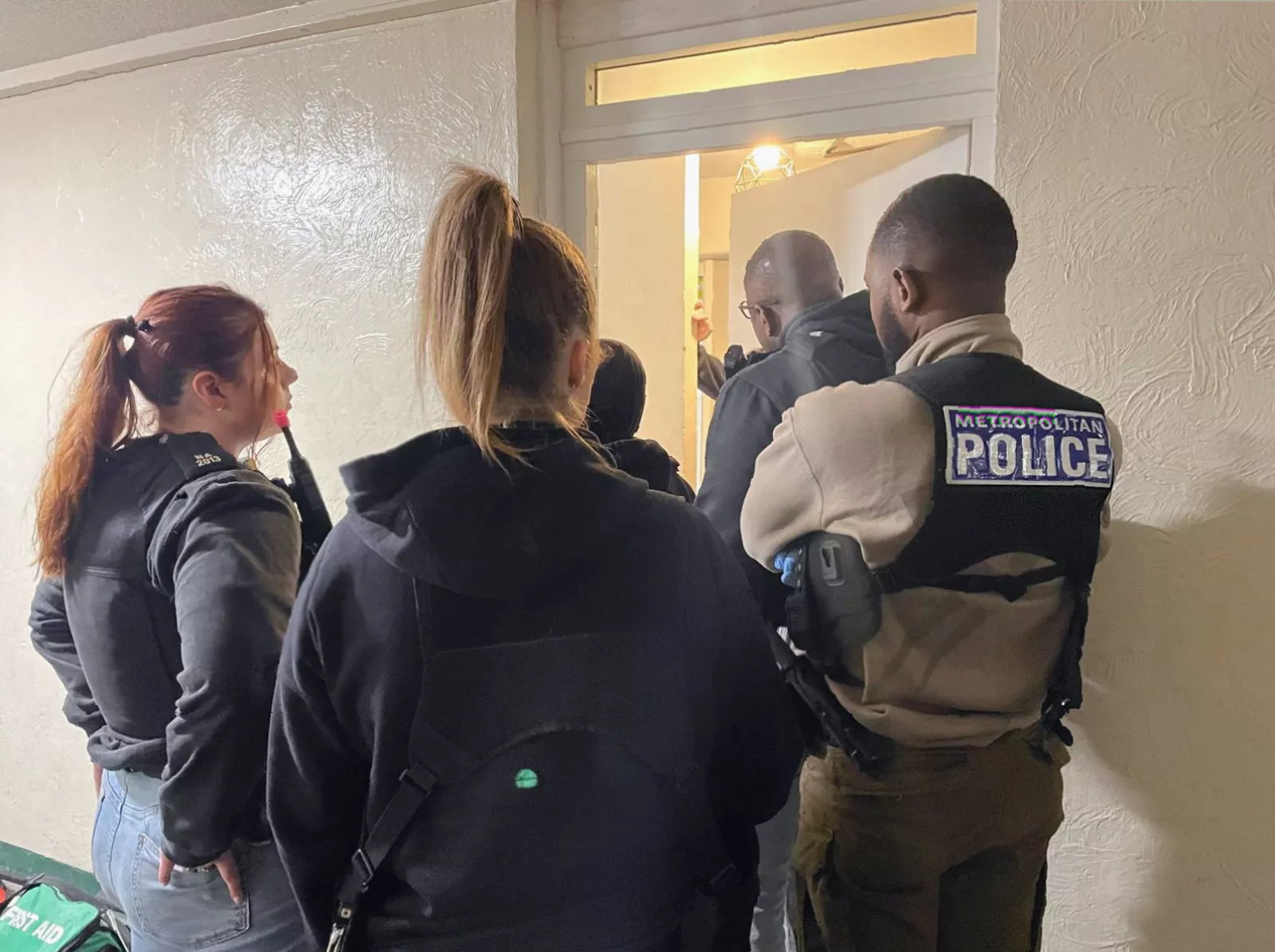
Metro joined Crime and Policing Minister Sarah Jones and officers from the Metropolitan Police as they raided a flat in Wood Green, north London, as part of the operation. The target was a suspect in his 30s alleged to carry a blade and travel the area on a black mountain bike, wearing sunglasses and a hoodie, and known to frequent both his family address and local “crack houses”.
After a short drive to the suspect’s known address, a silent team of officers approached the block of flats, one carrying an “enforcer” – a tool used to batter down doors if entry is refused. Repeated commands to open the door were met with refusal from a woman inside, while an agitated dog barked. Following a tense standoff, the woman eventually allowed three officers inside, telling them the dog “doesn’t like the police”. A search of the flat found no sign of the suspect.
The team then moved to a suspected crack den where the target was known to hang out. Officers faced the added risk of encountering unknown people inside, possibly under the influence of drugs. But the flat was empty; neighbours told police the occupants had been evicted the previous week and the locks changed. The raid ended without an arrest.
Despite the outcome, Minister Jones praised the operation. “What I saw was exceptional policing,” she said. “Navigating a really difficult situation when you are trying to arrest a wanted man, you don’t know where he is. The reason knife crime is down is the professionalism of our police force, who are targeting known offenders and putting them behind bars.”
Inspector Kito Johnson, who led the operation in Haringey and Enfield, reported that knife crime in the two boroughs has fallen by 17 per cent, while knife crime involving injury is down 24 per cent. “I’m massively proud of my team,” he said.
The Knife-Enabled Robbery Group: a new model of collaboration
Officials say the sustained reductions are the result of innovation and collaboration emerging from the Home Office-led Knife-Enabled Robbery Group, set up in October 2024. The group brings together seven police forces that collectively accounted for 70 per cent of knife-enabled robberies in the year to June 2024: the Metropolitan Police, Greater Manchester Police, West Midlands Police, West Yorkshire Police, South Yorkshire Police, Avon and Somerset Police, and British Transport Police.
The taskforce was created with the explicit ambition of halting the rise of knife-enabled robbery offences within six months. By combining intelligence and analysis, the forces have been able to spot crime patterns earlier and strengthen investigations. Every force in the group has seen reductions. Provisional data for the 12 months to August 2025 shows a 10 per cent overall fall in these areas compared with the year ending June 2024 baseline, with West Midlands reporting a 30 per cent drop (771 fewer robberies), British Transport Police 26 per cent (107 fewer), Avon and Somerset 14 per cent, South Yorkshire 8 per cent, West Yorkshire 7 per cent, the Metropolitan Police 5 per cent and Greater Manchester Police 3 per cent.
Operation Sceptre itself has a long track record of removing weapons from streets. During a single Sceptre week in May 2023, forces removed 9,737 knives and made 1,693 arrests, 829 of which were directly related to knife crime. In November 2025, Merseyside Police alone removed 230 knives, executed 16 warrants and made 40 arrests. A notable finding from the May 2025 operation was that 98 per cent of recovered knives came from amnesty bins, with only 2 per cent resulting from stop-and-search, warrants or weapon sweeps – underscoring the importance of surrender schemes.
Broader enforcement is also taking place through the County Lines Programme, which targets exploitative drug networks that fuel knife crime by involving young people. Since July 2024, over 3,000 county lines have been closed, resulting in more than 8,200 arrests, including 1,600 line holders charged, and around 1,000 knives seized.
In total, 63,611 knives have been removed from UK streets through police seizures, surrender schemes and border interventions, the Home Office confirmed.
Ministerial and expert assessment
Minister Sarah Jones said the government remains focused on halving knife crime within the next decade. “It’s a mission of ours to halve knife crime in the next 10 years, and we are on track,” she said. “We are targeting knife-enabled robbery in particular. Operation Sceptre this week will see lots of people locked up and lots of prevention work. We will always ensure the police have the resources and funding they need.”
Jones emphasised the importance of early intervention. “We know that the biggest issue young people worry about is knife crime. A real passion of mine is to get involved with the kids who are on the cusp of criminality and try to pull them away from that.”
Patrick Green, chief executive of the Ben Kinsella Trust – set up after the fatal stabbing of 16-year-old Ben Kinsella in north London in 2008 – welcomed the figures but cautioned that the work is far from over. “These figures show national coordinated leadership from the government, and targeted policing, are making a tangible difference with thousands fewer knife robberies than just two years ago,” he said. “It’s important to recognise that behind every reduction is a life spared the fear, harm or long-lasting impact of violence.
“We must continue to prioritise prevention, work closely with young people and ensure they feel supported, informed and empowered to make safe decisions long before they ever feel pressure to carry a knife.” The Trust has reached over 30,000 young people through its “Choices & Consequences” workshops and continues to campaign for “Ben’s Law”, which increased mandatory life sentences for knife-related murders.
Knife-enabled crime victims are predominantly male, and about half are under 25. Teenagers aged 15 to 19 are four times more likely to be stabbed than adults aged 30 to 44. London continues to have the highest rate of serious knife crime in England, with 17.89 offences per 10,000 residents, while Birmingham has the second-highest rate of possession offences per 10,000 people (24.76). Robbery accounts for nearly 60 per cent of all knife-enabled offences in the capital.
Prevention strategies are being bolstered by new legislation, including bans on “zombie knives”, the introduction of “Ronan’s Law” requiring two-phase age verification for online blade purchases, and a new offence of possession of a knife with intent to commit unlawful violence. Technology such as “hex mapping” is being used to pinpoint hyperlocal hotspots for serious knife crime, enabling smarter deployment of resources. Surrender schemes remain a key tool, with nearly 58,000 knives collected through voluntary programmes to date.
Green added: “There is still work to do to end the cycle of violence in which some young people feel the need to carry a blade to protect themselves.”