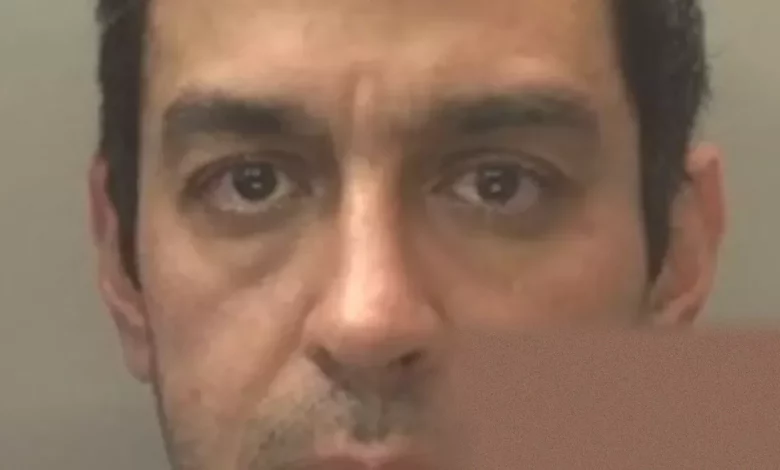
A man who murdered his ex-wife and buried her body beneath patio slabs and flowers in his Cardiff garden has been sentenced to spend at least 26 years in prison, in what the judge described as a “cold-blooded” killing driven by jealousy and a desire to start a new life.
Alireza Askari, 42, was sentenced to life imprisonment at Cardiff Crown Court on Friday for the murder of 37-year-old Paria Veisi. Mrs Justice Stacey imposed a minimum term of 26 years, which was reduced to 25 years and 37 days to account for time spent on remand.
The court heard that Askari and Ms Veisi, both originally from Iran, had moved to the UK in 2010 and married, but had separated earlier in April last year. Ms Veisi had moved out of their shared home in Penylan.
A Premeditated Attack and a Makeshift Grave
The murder took place on the afternoon of 12 April 2025. Prosecuting, William Hughes KC told the court that Askari first bought a set of kitchen knives, believed to be the murder weapon, from a supermarket. He then lured Ms Veisi to the property, where he attacked and killed her in the conservatory at around 4.30pm.
In a calculated attempt to conceal the crime, Askari then buried his ex-wife’s body in a “makeshift grave” in the rear garden, covering it with soil and patio slabs. He later made a second trip to a supermarket to purchase bleach, compost, and plants to further disguise the site.
The prosecution detailed how Askari then enlisted the help of his aunt, Maryam Delavary, 48. He called her in London, after which she travelled to Cardiff by taxi “to assist in the covering up of Paria’s murder,” Mr Hughes said.
A Friend’s Concern and a Grisly Discovery
The investigation began the day after the killing, when a concerned friend contacted South Wales Police to report that Ms Veisi was missing and feared she was “being kept against her will by her ex-husband”. Ms Veisi, who worked in Canton, had last been seen four days before her body was found, driving her black Mercedes.
On 15 April, officers arrested Askari as he drove from Birmingham to Cardiff. Inside his vehicle, they found canisters of caustic soda. William Hughes KC stated these chemicals “were to be used in the destruction of Paria’s remains.”
A subsequent search of the Penylan address led to the discovery of Ms Veisi’s body. A post-mortem examination revealed she had sustained four stab wounds to her chest and neck.
Text Messages and a Questioned Motive
During the investigation, analysis of Askari’s phone uncovered messages he had sent to a woman in Iran, believed to be his girlfriend. In one chilling text, sent before the murder, he wrote: “I’m planning for them to kill her in Iran.”
Sentencing Askari, Mrs Justice Stacey rejected defence suggestions that mental illness was a primary driver for the attack, an assertion put forward by his lawyer, Adam Sharp. The judge stated Askari killed Ms Veisi because she had left him and wanted a divorce. “Your hypocrisy was staggering – at the same time you wanted [Paria] out of the way so you could take up with your girlfriend in Iran,” she told him.
She also highlighted a history of abuse, noting Ms Veisi “was fearful of you” and had confided in friends about her fear. “She was in the prime of her life, her death has destroyed her family’s happiness, as you knew it would,” the judge added.
Askari, of Penylan, Cardiff, had initially pleaded guilty to manslaughter and preventing a lawful burial, but later admitted to murder. A further charge of assault occasioning actual bodily harm was ordered to lie on file.
Maryam Delavary, of White City, west London, who pleaded guilty to perverting the course of justice, was sentenced to five years and six months in prison.
A Community in Mourning
The loss of Paria Veisi has devastated her family and the local Iranian community in Cardiff, which has a vibrant cultural presence supported by groups like the Persian Welsh Cultural Society. The Iranian diaspora in the UK has grown significantly since the 1979 Revolution.
In a tribute, one of Ms Veisi’s close friends, Sara Rezaei, described her as “a kind, caring, and vibrant soul who brought joy to everyone around her.” Around 100 mourners gathered to pay their respects at a service at the Norwegian Church in Cardiff Bay. Her sister said the pain of her loss was “a wound that time will never fully heal.”
The case has cast a stark light on the prevalence of domestic abuse. Official statistics for England and Wales show police recorded over 1.35 million domestic abuse-related incidents in the year ending March 2024. One in four women and one in six to seven men experience domestic abuse in their lifetime, according to national data.
Charities including Women’s Aid, which runs the National Domestic Abuse Helpline, and specialist bereavement groups like SAMM (Support after Murder and Manslaughter) offer support to those affected. Legal aid may also be available for victims of domestic abuse involved in family law proceedings.