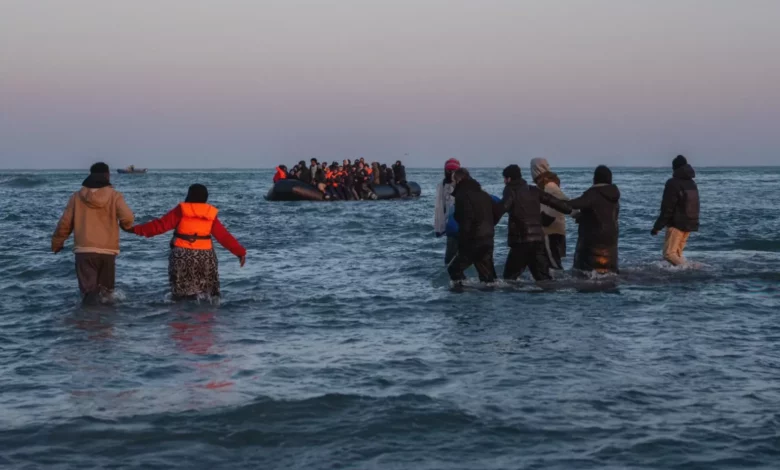
The ongoing conflict in the Middle East is likely to push more people onto small boats headed for British shores, the head of the National Crime Agency has warned, citing a historical pattern where world crises drive organised immigration crime.
Graeme Biggar, the NCA’s Director General, said that while he did not expect an “absolutely massive increase” directly from Iran, “some of it will be in small boats.” His warning, delivered in the agency’s annual threat assessment, comes as small boat arrivals last year reached 41,000—a 13% rise and the second-highest annual figure on record.
Channel Crossings: A Shifting Picture of Risk and Origin
These perilous journeys now account for approximately 89% of all detected unauthorised arrivals to the UK. The demographic of those making the crossing has shifted markedly. The top nationalities arriving in the year to December 2025 were Eritrean, Afghan, Iranian, Sudanese, and Somali, together making up over three-fifths of all arrivals—a move away from previous peaks from Albania and Vietnam.
Notably, 99% of those who arrived by small boat in 2025 went on to claim asylum. The journeys have also become exponentially more dangerous and crowded. The average number of people per vessel has soared from just 7 in 2018 to 62 in 2025.
This overcrowding is a direct contributor to a tragic surge in migrant fatalities. The NCA reported 78 deaths in 2024, a sharp rise from 12 the previous year, attributed to the storming of boats and the use of unsafe craft. The agency believes organised crime groups are packing more people onto each boat to maintain profits, with the average rising from 49 in 2023 to 53 in 2024.
Combating this threat consumes a quarter of the NCA’s operational activity. Last year, its officers seized 533 boats or engines, an effort which it says has driven up the cost for smuggling gangs to acquire equipment in northern France.
A Lethal Overdose Crisis Fueled by Synthetic Drugs
While immigration crime represents a major focus, Mr Biggar stated that synthetic opioids currently pose the single biggest drug threat to the UK. Nitazenes—potent drugs up to 500 times stronger than morphine—have been linked to around 1,000 deaths since they first appeared at scale in June 2023.
Official figures show nitazene-related deaths registered in England and Wales rose from 52 in 2023 to 195 in 2024. However, research from King’s College London suggests the true toll may be undercounted by as much as a third, as the drugs can degrade rapidly in post-mortem tests and be missed.
The broader landscape of drug-related harm is deteriorating rapidly. In Britain, half of all homicides, thefts and robberies are linked to drugs. Drug poisoning deaths have doubled in a decade, with England and Wales recording 5,565 such deaths in 2024, a 2.1% increase on the previous year’s record high. Deaths linked to cocaine have increased tenfold over ten years.
Ketamine misuse is also surging, with a tenfold rise in adults seeking treatment in a decade. The Home Office’s Wastewater Analysis programme estimated an 85% increase in ketamine consumption between 2023 and 2024.
Smugglers are employing alarmingly sophisticated methods, the NCA said, with chemists sometimes flown internationally to chemically bond drugs like cocaine and nitazenes to substances like charcoal or plastic, only to extract them at their destination.
Technology Reshaping Criminal Enterprise
Mr Biggar warned that technology is not just a tool for criminals but is “reshaping crime itself,” allowing offenders to become “smarter, faster and more connected.” Organised crime groups now often operate in loose networks, able to buy into crime and money-laundering services, and have largely moved from dedicated encrypted phones to commercial encrypted apps.
Recent high-profile cyber attacks on Transport for London, the Legal Aid Agency, Marks and Spencer, and Jaguar Land Rover illustrate the scale of the threat. The NCA noted that ransomware remains a major danger, with UK businesses facing an estimated 7.78 million cyberattacks in 2023 alone.
In response to the evolving threats, Security Minister Dan Jarvis said the government was driving a “major international effort” to dismantle smuggling gangs and hit drug traffickers “harder than ever.” The NCA is establishing a new Organised Immigration Crime Domestic Taskforce and rolling out a National Crime Analysis Service to improve intelligence sharing and prosecutions.
Experts from Oxford University cautioned it is “too soon to know” if the Iran conflict will definitively affect small boat arrivals, but noted Iran has been a common country of origin for asylum seekers in recent years. They suggested a violent crackdown inside Iran could push more people to leave.