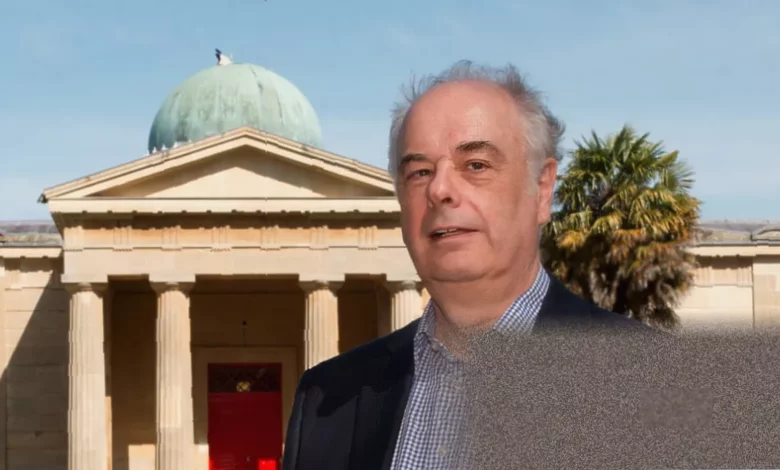
The University of Cambridge’s Institute of Astronomy, one of the world’s foremost centres for the study of the solar system and the evolution of the universe, is facing an employment tribunal over allegations that it has tolerated misogyny and a “cycle of bullying” within its ranks. The claim has been brought by Professor Wyn Evans, a professor of astrophysics at the institute, who also alleges that the university retaliated against him for blowing the whistle on the treatment of female colleagues.
‘A bad history of misogyny’
Professor Evans, who last year stood for the chancellorship of the university on an anti-bullying manifesto, told the tribunal in Bury St Edmunds that the Institute of Astronomy suffers from “a bad history of misogyny”. He claimed that one woman in the department was “hounded out of a job”, another had been “left a frightened woman” and a third had faced “aggressive professors” at the institute. The most detailed allegations concern Dr Gudrun Tausch-Pebody, a European Commission contracts manager who joined the institute in 2012.
According to Evans, in June 2021 Dr Tausch-Pebody was issued with an “end of contract” notice despite, he alleges, funding being available to support her role. Evans claimed she was being deliberately undermined by a senior colleague — an allegation the university denies. In a written submission to the tribunal, Dr Tausch-Pebody expressed her gratitude for Evans’s “courage” in intervening. “Prof Evans’ concern for me was based on my distress. He saw a pattern of repeated and seemingly tolerated mistreatment of female members of the administrative staff,” she wrote. “What was done with this end-of-contract letter was akin to psychological torture.” She added that her work had been undermined, discredited and diminished by a superior, which had an “indelible effect” on her mental health.
Evans described agonising over whether to intervene, telling the tribunal: “When I checked my email the next morning, I felt a wave of relief to see messages from her sent overnight. She might not have slept, but at least she was still alive.” His voice breaking during the second week of hearings, he said he had become concerned about her welfare in 2021, adding: “We were faced with a critical situation.”
The tribunal also heard that Evans submitted what he alleged were whistleblowing disclosures to Professor Nigel Peake, head of the School of Physical Sciences, setting out his concerns about the treatment of Dr Tausch-Pebody. An external review by barrister Mr Jeremy Scott-Joynt later concluded that Evans’s actions did amount to whistleblowing because there was “a risk to the health or safety of any individual”.
University’s defence and counter-allegations
The University of Cambridge strongly rejects all of Evans’s claims and is vigorously defending the case. In a statement, a spokesperson said: “The university strongly rejects these claims and is vigorously defending this case.” Akua Reindorf KC, appearing for the university, suggested that Evans’s emotional testimony about the suicide of a former colleague amounted to “crocodile tears”. Evans replied: “No, and that is an offensive thing to say.”
Reindorf further argued that Evans’s allegations were part of an “obsessive vendetta” against the institute’s director, Professor Richard McMahon. The university accuses Evans of pursuing a personal grievance against McMahon — a claim Evans denies. McMahon, who served as director and head of the Institute of Astronomy from 2017 to 2022, filed grievances against Evans and two other professors. The university later dismissed those grievances, saying no evidence had been submitted in support of the claims. Evans told the tribunal that despite the lack of evidence, the complaint “took almost two years for the university to dismiss”.
Evans has also initiated separate legal proceedings against McMahon, alleging that statements made in the grievance were defamatory. He told the tribunal that McMahon fought the libel proceedings “relying on the university’s support and funding through its insurance policy”. In 2023 a preliminary issues judgment concluded that the statements made by McMahon were defamatory, and the case was subsequently settled out of court.
The impact on research has been severe. Professor Vasily Belokurov — a colleague of Evans and this month a joint recipient of the highly prestigious 2026 Kavli Prize for astrophysics — said in a written submission: “The outcome of the extended investigations into Wyn Evans … was that our research group faced near collapse.”
Broader context: staff surveys and culture
The tribunal comes amid wider concerns about workplace culture at Cambridge and in UK astronomy. A survey conducted by the university and its campus unions in 2020 found that nearly a third of staff had experienced bullying or harassment in the previous 18 months. An internal staff culture survey in January 2024 revealed that only 27% of staff were happy with attempts to address bullying and harassment, with some high-profile science departments scoring particularly badly. Only 52% of staff felt their department supported their mental health and wellbeing. Academics have accused the university of trying to cover up these “grim” results.
Separately, a survey by the Royal Astronomical Society for 2020–2021 indicated that 44% of respondents in UK astronomy had suffered bullying and harassment in the preceding 12 months, with women and non-binary people being 50% more likely to be targeted.
Evans, who leads the “21 Group” campaigning against bullying and harassment in academia, has been a vocal critic of the university’s management. He has argued that if a senior academic brings in substantial research grants, grievances against them are discarded. His campaign for the chancellorship emphasised the need for “sweeping reforms” to address what he called an “internal crisis” of bullying.
Proceedings continue
The employment tribunal is being heard to assess whether Evans suffered detrimental treatment as a result of whistleblowing. McMahon is scheduled to give evidence in person this week. The case, which is expected to last up to four weeks, continues.