
More than 2,600 corrosive substance offences were recorded by police forces across the UK between 2023 and 2025, according to an investigation by Legal Expert, as campaigners warn that acid violence has become “normalised” and the justice system is failing victims.
The figures, obtained through Freedom of Information requests, show that over 800 of those cases were closed without a suspect ever being identified. Nationally, only about 8% of offenders involved in such attacks have faced prosecution, the data indicates. The number of recorded offences also rose sharply – from 710 in 2022 to 1,244 in 2023, a 75% increase. In 2024 alone, 498 physical attacks involving corrosives were logged, a 10% rise on the previous year.
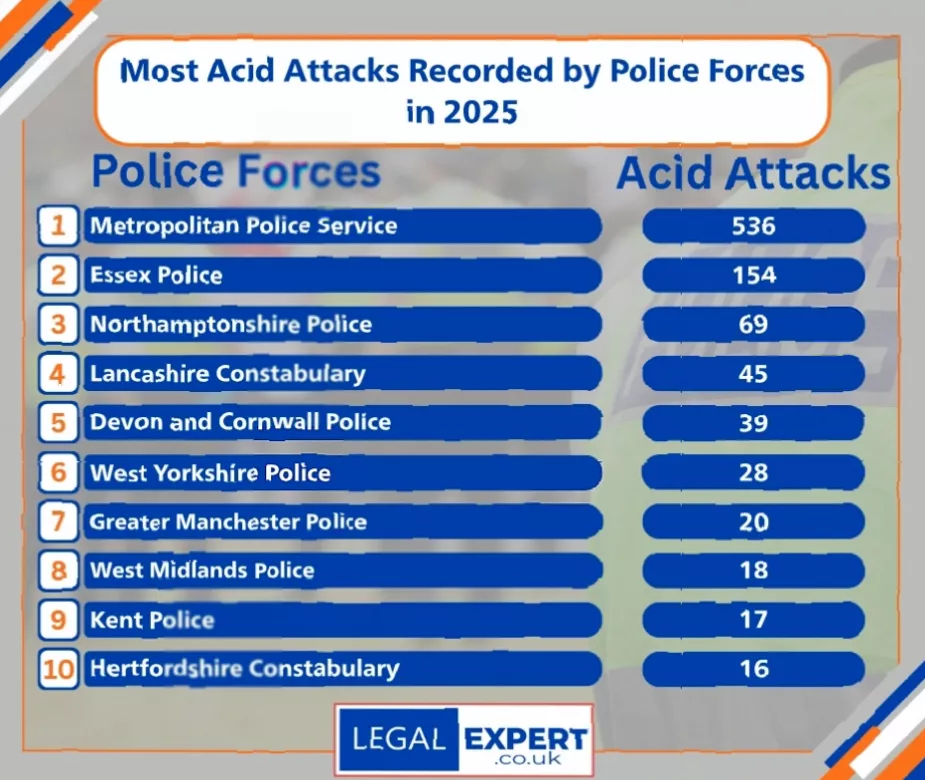
Devon and Cornwall Police recorded 91 acid-related offences over the same three-year period, roughly two to three attacks a month. The number of incidents in the region more than doubled from 18 in 2023 to 39 in 2025, making it the fifth worst area in the UK for corrosive substance attacks. Of those 91 cases, a third were closed without a suspect identified, and only five resulted in a charge or summons. Many investigations collapsed due to lack of evidence or because victims declined to proceed.
“It’s terrifying,” said Andreas Christopheros, 40, a father-of-two who was blinded in one eye after an unprovoked acid attack at his home in Truro, Cornwall, in 2014. “You have people out there who think they can use acid as a weapon and usually get away with it.”
Andreas, now a UK ambassador for the charity Face Forward International, said the frequency of such crimes has dulled public reaction. “Acid crime doesn’t make the news anymore because it’s been normalised. The UK has become associated with acid violence — like it’s an everyday thing. That’s shocking.”
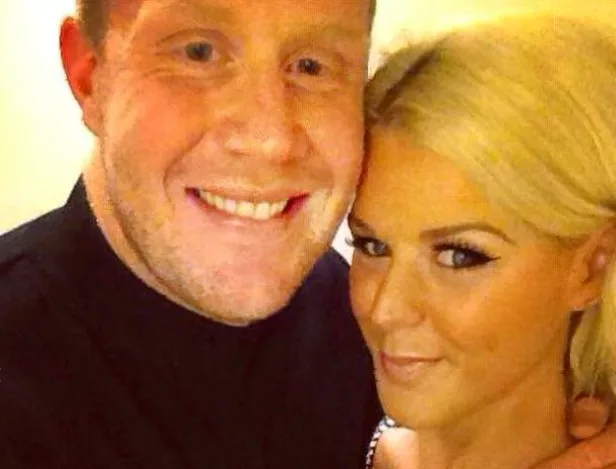
His own ordeal began on December 9, 2014, when he was 30 and working from home with his then-wife Pia and their 18-month-old son Theo. He opened his front door to a stranger holding a pint of sulphuric acid. The man, David Phillips, had driven more than 300 miles from Hastings, Sussex, wrongly believing Andreas had assaulted a member of his family. He said “This is for you mate” before throwing the corrosive liquid in Andreas’s face.

The attack left Andreas with severe facial disfigurement, burns to his body and arms, and blindness in one eye with partial blindness in the other. His wife Pia also sustained burns to her feet when she went to his aid. Andreas said he lives with the scars “every day”. “You see it in the mirror morning and night. There’s no escaping it. You either let it break you or you own it.”
The impact on those around him was immense. “It has a massive ripple effect,” he said. “My family, my friends — they went through enormous pain. I often say I had the easy job. I was unconscious. They had to deal with everything.”
Before the attack, Andreas ran nine companies and worked up to 80 hours a week. He now runs two businesses, prioritising time with his sons, Theo, now 12, and Lazarus, eight. Despite everything, he insists Cornwall remains safe. “People laugh when I say it, but I live on a very safe street. Cornwall is one of the safest places in the country — which makes these figures even more concerning.”
He has another grim link to the crime: he once lived on the same Plymouth street where Danny Cahalane was fatally attacked with sulphuric acid in 2025. Cahalane died after suffering catastrophic burns during a planned burglary linked to organised crime and a significant drug debt. Four people were subsequently convicted in relation to his death.
The fight for justice reform
Andreas is strongly critical of the justice system and has become a vocal campaigner for change. His attacker, David Phillips, was originally sentenced to life imprisonment in October 2015, but had his sentence reduced to 16 years on appeal in April 2016, with parole possible after eight years. Phillips was moved to an open prison after just five-and-a-half years and is now applying for release.
“The punishment does not fit the crime,” Andreas said. “Anyone using acid as a weapon should face life with a minimum of 20 years.” He added: “He’s not quite a free man — but he’s kind of a free man. Meanwhile I’m still dealing with the consequences every day.”
Andreas believes sentencing is influenced by prison costs and points to inconsistencies. He cited the case of Mark Gould, who received an 11-year sentence for illegal streaming — rising to 21 years if he fails to repay millions. Gould was ordered to repay £2.35 million or face an additional 10 years in prison. “How is someone selling dodgy TV getting more prison time than someone throwing acid in someone’s face?” Andreas asked.
He has also criticised the government’s “two-strike” policy on carrying acid. “Why twice? There’s no reason anyone should be carrying acid in an unmarked bottle.”
Under current law, there is no single offence of carrying out an acid attack. Perpetrators are liable under general criminal offences such as Section 18 (wounding with intent) and Section 29 (using a corrosive substance with intent to cause grievous bodily harm) of the Offences Against the Person Act 1861, both carrying a maximum sentence of life imprisonment. The Offensive Weapons Act 2019 introduced new offences for selling corrosive products to under-18s and possessing a corrosive substance in a public place without a valid reason, with a potential prison term of up to four years. Since November 2018, it is also a criminal offence to possess sulphuric acid above 15% concentration without a licence, carrying up to two years in prison.
Sentencing guidelines classify acid as a “highly dangerous weapon”, with culpability at the highest level. For life-changing injuries, the starting point for sentencing is 12 years. Andreas wants that minimum raised to 20 years.
Ellie Lamey, a specialist at Legal Expert, said the figures highlight a “deeply concerning lack of accountability”. “When perpetrators go unidentified, victims are denied justice and closure,” she said. “But survivors should know they are not alone — and support and compensation may still be available.”
Women and girls account for a significant proportion of victims. In 2023, 50% of corrosive offence victims were women, and 59% of threats of violence involving acid attacks targeted women. In 2024, women and girls made up a third of all victims nationally. Campaigners note that attacks on women are often used as a means to permanently scar and disfigure, linked to societal emphasis on physical appearance.
The economic cost of a single acid attack is estimated at £63,000 for medical and psychological support. Charities such as Face Forward International and the Acid Survivors Trust International provide reconstructive surgery and emotional support to survivors.
Despite the bleak statistics, Andreas has a message for other victims, particularly those without justice. “It’s a very difficult pill to swallow. You have to rebuild your life in small steps — little pieces of normality each day. It will never be the same. But you can build a new life — and eventually, you start surviving.”
Ultimately, he believes meaningful change will only come when those in power fully grasp the impact of such attacks. “Judges and politicians need to understand what acid crime does. Until it happens close to them, I don’t think anything will change. It’s a horrible thought — but I think it’s the reality.”