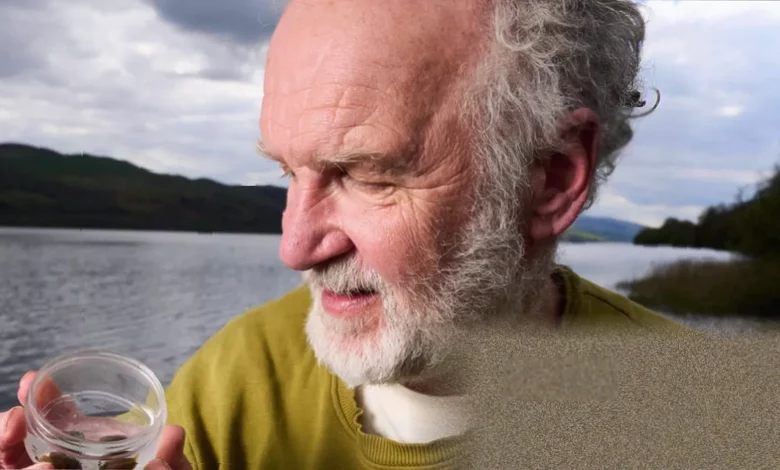
Ian Hughes and his son, Ben are driving through the hills of north Wales with a carload of homemade animal artefacts – diagrams, plaster casts, hand-printed T-shirts – rattling around them. They finally reach Llyn Tegid, or Bala Lake in English, where, knee-deep in the water, Ian holds up two glutinous snails. These fingertip-sized molluscs are among Europe’s most endangered species, and Hughes has dedicated himself to protecting them. “It’s beyond passion,” he says. “It’s an obsession.”
This year the Department for Environment, Food and Rural Affairs (Defra) listed the glutinous snail as one of the threatened species that will benefit from a £60 million government funding boost over three years under the Species Recovery Programme, administered by Natural England. A further £30 million is earmarked for species recovery on the national forest estate. The British and Irish Association of Zoos and Aquariums (BIAZA) will receive additional support to build ark populations of the snail, while the Freshwater Habitats Trust hopes to use the new resources to find locations suited to wild reintroductions.
The glutinous snail: a fragile survivor
The glutinous snail (Myxas glutinosa) is a small, air-breathing freshwater mollusc distinguished by a gelatinous, golden-flecked mantle that covers its extremely thin and delicate shell, giving it a glassy appearance and making it sticky to the touch. Its shell, typically brown or green, is very transparent and fragile. Adults rarely exceed 10 mm in shell height at Llyn Tegid, and their eyes sit at the base of tentacles that resemble large, pointed ears. Because the snails live in low-calcium habitats, the shell is extraordinarily delicate, so Hughes uses a fine paintbrush to move them from one place to another.
The species has been driven to extinction in England by the poor quality of the country’s freshwater bodies. Pollutants from agriculture – pesticides, fertilisers – and from industry and raw sewage discharge have ruined their habitats in ponds, ditches, lakes and streams. An Environment Agency report found that in England only 14% of rivers meet standards for good ecological status. Sewage discharge is considered to have a greater impact on river communities than agricultural pollution, and nutrient enrichment and invasive species also threaten the snail. It cannot become dormant when food is scarce, meaning it requires a consistent supply of algae. Its life cycle at Llyn Tegid appears to be annual, with snails reaching maturity in late winter or spring before dying. The lake in Gwynedd hosts the last remaining wild population in Britain; the last English population was recorded at Kennington Pit near Oxford until the early 1990s. The snail is listed as Endangered on the IUCN Red List and protected under the Wildlife and Countryside Act (1981). It is one of 67 species of freshwater snail that have already gone extinct in the UK, with a further 450 threatened.
Hughes first came to Llyn Tegid in 2014 to find glutinous snails, joined by his second son, George. After taking water samples and depth measurements, father and son built and installed shell-shaped concrete refuges for the snails. By Christmas that year the snails had settled into the refuges, giving Hughes a reliable source from which he could collect specimens to take home to Llanarth, west Wales, for breeding.
Breeding an ark
Hughes’s conservatory is his ark: amid plaster casts of gorillas and a sculpture of Charles Darwin, he breeds the snails and other rare invertebrates in homemade tanks. It has variously been a refuge for scarlet malachite beetles, ladybird spiders and tadpole shrimp. In 2014, under licence from Natural Resources Wales, he collected ten snails to establish a captive breeding project. That captive population has thrived, reaching more than 2,000 individuals in optimal conditions, and the snails in captivity grow larger than those in the wild.
Each species has its own particular needs, Hughes says, and the key to staying ahead of extinction for the snails is to keep them moving. “If one snail dies in a tank, or two or three die in a pond, they pollute the water,” he explains. “So we’re continually moving snails from one container to another, preserving that part of the population.” Over the years he has encouraged zoos to develop their own ark populations and reintroduce glutinous snails to new locations. Zoos such as Askham Bryan Conservation and Wildlife Park, Dudley Zoo and Castle, Longleat Safari Park, and Wingham Wildlife Park are now involved in caring for the snails. In April 2024, Askham Bryan Wildlife Park received breeding pairs from Llyn Tegid to establish a new population in England, aiming to breed them for future reintroduction. The Freshwater Habitats Trust has supported Hughes’s work, including the establishment of an ex‑situ colony that began with ten individuals in 2017.
But people are not always as easy to work with as animals, and Hughes knows from previous rewilding projects how quickly a new colony can fail without constant attention. The rediscovery of the Welsh population was made by Dr Martin Willing in 1998, and since then conservationists have been fighting to keep the species from disappearing entirely.
A family affair and an artistic mission
Hughes’s conservation journey began with an interest in art as a teenager. “I always used to draw as an escape. I didn’t know it at the time, but I was quite shy,” he says. Noticing his talent, Nottingham’s Natural History Museum, in Wollaton Hall, offered him an apprenticeship as a taxidermist and display artist. From there he went on to work in zoos, specialising in invertebrates, before Natural England began funding his solo conservation projects.
He now writes children’s books about the species he has studied, which his son Ben illustrates. The pair sell T-shirts, screen‑printed by Hughes’s wife, Kerry, showcasing their wildlife drawings. “We try to [sell them at] places where we’ll get people who aren’t already into nature,” says Hughes. Ben is also an artist and illustrator who collaborates on these projects, and the family’s outreach extends to selling at events where they can engage a broader audience.
Since 2014, at least one of Hughes’s three sons has always accompanied him on his trips. George, now a young man, recalls being asked to help out with the glutinous snails and quickly agreeing, without realising it would involve putting on a wetsuit and wading into a cold lake. “It was very cold, but lots of fun,” he says. “The joy of it is that we get to spend so much time together as a family.”
Asked why even the smallest species matter, Ben replies without hesitation: “Well, why do we matter? We’re part of a huge living system. If you take a cog out of a machine, it doesn’t work any more.”