Solar cooking offers a novel, green way to prepare meals outdoors, but the technology has long been hampered by one stubborn problem: the weather. A passing cloud, a gust of wind, or simply the sun dipping behind a tree can turn a promising lunch into a half-cooked disappointment. Now, a compact hybrid oven from the American company GoSun aims to solve that by giving solar cooking a reliable electric backup – and the results suggest this could be the gadget that finally makes sun-powered meals a practical choice for campers, beachgoers and anyone who wants to cut their carbon footprint without cutting their appetite.
The hybrid backup that changes the game
The Sport-E, as the oven is called, is fundamentally a solar cooker that never leaves you stranded. When sunlight is insufficient, a built-in 12V DC heating element – drawing just 80 to 100 watts – takes over, allowing you to plug into a car’s accessory socket, a portable battery pack, or even one of GoSun’s own solar tables. In a recent test during a stormy-day power outage, the oven baked eight small bread loaves using less than five per cent of a lightweight DJI Power 1000 Mini battery pack. That kind of efficiency turns an occasional novelty into a genuinely resilient cooking tool. GoSun’s founder, Patrick Sherwin, who launched the company in 2013 after working on solar projects in developing countries, describes the mission as moving the world away from a carbon-based society. The hybrid approach is central to that goal: it means you can use the sun when it shines and fall back gracefully when it doesn’t, rather than abandoning the meal to a gas grill or hauling everything back indoors.
The electric mode also opens up use cases that pure solar cookers can’t touch. You can cook at night, on an overcast day, or even inside a vehicle (with the window cracked). The low power draw means a standard car battery can run it for hours, and a dedicated power bank like the GoSun Power 144, rated at 144 watt-hours, will keep the oven going for more than an hour and a half without any sunlight. That’s enough to prepare a full meal for two. For Sherwin and his team, the hybrid system is the key to making solar cooking a real substitute for fossil-fuelled outdoor cooking, not just a fair-weather hobby.
How the oven works
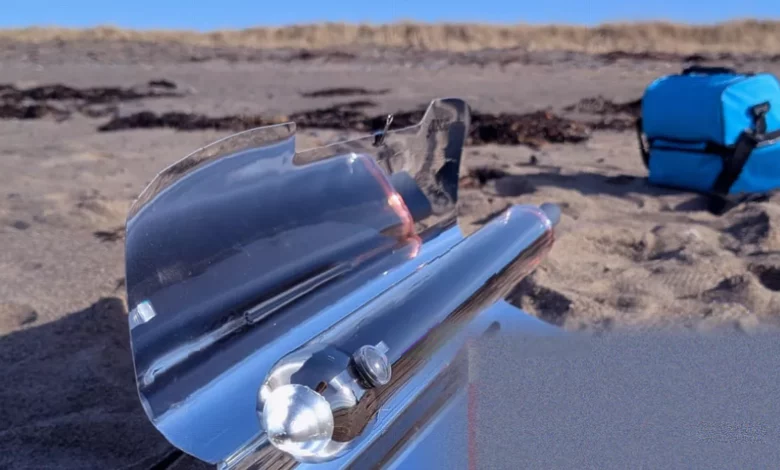
At first glance the Sport-E looks like an oversized glass tube flanked by two folding wing-like mirrors. That tube is the secret: it uses vacuum insulation, originally developed for solar thermal collectors, to trap heat much like a high-quality thermos. The outer wall is clear borosilicate glass, while the inner wall is coated with multiple layers of aluminium nitride, stainless steel and copper – materials chosen to absorb infrared, visible light and ultraviolet radiation efficiently. Inside sits a long, scoop-shaped tray – described by one tester as “like a giant garden trowel” – with a 36-ounce capacity that comfortably feeds two people. (For larger groups, GoSun offers the Fusion model, which holds more than twice that amount.)
Setting up is straightforward. Unfold the reflectors, which together capture 338 square inches of sunlight, and tilt the base so that the shadow of a small indicator aligns with a built-in sundial. When the dot is centred, the oven is facing the sun squarely and collecting maximum heat. Unlike the tester’s previous parabolic mirror cooker – a large, awkward device that could set paper on fire but needed constant re-aiming – the Sport-E’s vacuum tube and reflector design is far more forgiving. Small misalignments don’t ruin the meal; you just nudge it every so often to keep tracking the sun. Even on a late-winter day with snow on the ground, the oven generated enough heat to cook hardy vegetables such as potatoes. Stronger sunshine, naturally, builds heat much faster, but the insulation is so effective that the oven can still function in less-than-ideal light.
GoSun claims a maximum temperature of 550F under perfect conditions. In practice, testing in Canada found that 350F was a more realistic expectation – still hot enough to steam potatoes, cook quinoa, stir-fry vegetables, and bake bread and brownies. The company recommends using a meat thermometer to ensure food reaches a safe internal temperature, which the tester wryly notes is “one more reason to eat a plant-based diet”. The heating element, located at the bottom of the tray, and the copper lining help distribute heat evenly, so you don’t get the hot spots and cold patches that plagued the old parabolic mirror.
Practicality in the real world
The Sport-E isn’t trying to replace a camping stove or a gas grill. It’s slower: a 20-minute meal in full sun can stretch to 40 minutes or even an hour under sparse clouds, and the tester never reached temperatures high enough for proper roasting. Speed is the biggest caveat. But the trade-off is a cooking experience that is clean, quiet and fuel-free. There’s no smoke, no gas canisters to carry, no risk of running out of fuel on a long trip. The oven weighs seven pounds and measures 29 inches by 12 inches by 6 inches packed up, with the reflectors wrapping protectively around the glass tube. A carrying case is included, along with a cleaning brush, a power cord, and eight silicone baking cups.
One challenge that emerged during testing was wind. On a particularly gusty day, the upper reflector was pushed forward until the tester secured it with a binder clip and a length of cord tied to the leg – an easy fix, but not something you’d worry about with a conventional grill. The tube shape also demands some pre-planning: instead of one large loaf of bread, bake several small ones; instead of whole potatoes, dice them or slice them into fries. The oven warms up quickly, but the unusual geometry means you have to think about portion size and shape in advance.
Despite these quirks, the Sport-E impressed enough to be called “a tool I’ll use again and again” rather than a clever gadget that gathers dust. On a clear spring day, the tester took it to the beach, lined the tray with parchment paper, and cooked vegan kebabs for two while enjoying the ocean view. During a power outage, it baked bread as efficiently as a toaster oven. The combination of solar and electric power, the forgiving vacuum tube design, and the straightforward alignment system mean that you don’t have to be a solar nerd to get good results. You just unfold it, point it roughly at the sun, and let the insulation and the electric fallback do the rest.
Priced at $229 (originally $349) and available directly from GoSun’s website, the Sport-E comes with a two-year warranty. For anyone who enjoys the outdoors and wants to prepare hot meals away from home without burning fossil fuels, it offers a genuinely new option – one that works even when the British weather does its worst.