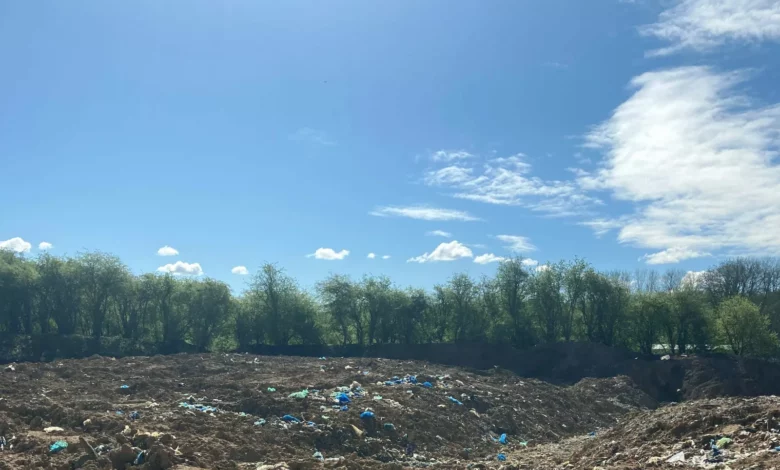
An area the size of a football pitch has been buried under 30,000 tonnes of shredded household waste at a protected wildlife site in Leicestershire, prompting a criminal investigation by the Environment Agency and Natural England.
The waste was discovered at Cave’s Inn Pits Site of Special Scientific Interest (SSSI) near the village of Shawell after members of the public reported a strong bad smell coming from the land. Officers who visited the site found layers of waste that had been deliberately covered with soil, making the dumping “well-concealed”, the Environment Agency said.
Investigation into the scale of the dumping
The Environment Agency and Natural England have launched a joint criminal investigation to identify those responsible. Alongside the criminal probe, the Environment Agency said it is assessing local air and water quality to determine the environmental impact and prevent further harm. Ian Jones, area director for the West Midlands at the Environment Agency, described the incident as a “sickening case of large-scale illegal waste dumping” and said the agency shares the public’s disgust. “We have launched an investigation with Natural England to find the criminals and ensure they pay the price for their despicable actions,” he added.
The site, Cave’s Inn Pits, is a 5.8-hectare biological SSSI that contains what Natural England’s principal manager for Leicestershire and Rutland, Phil Hukin, called “some of the best remaining areas of neutral marsh in Leicestershire”. The designation as a Site of Special Scientific Interest is the foundation of nature conservation legislation in the UK, protecting habitats that are of national importance for their flora, fauna, or geology. The land, which comprises disused gravel workings, also features scrub, species-rich grassland, and shallow pools that support a diverse range of breeding birds. It is private land with no public access. Hukin described the damage to the site as “heartbreaking” and an “appalling crime”. “It is heartbreaking to see one of England’s precious Sites of Special Scientific Interest damaged like this,” he said.
The Environment Agency’s investigation comes against a backdrop of widespread waste crime in the UK, which the agency says costs the country more than £1 billion annually and undermines legitimate businesses. Under the Environmental Protection Act 1990 and the Clean Neighbourhoods and Environment Act 2005, those found guilty of large‑scale illegal dumping face unlimited fines and up to five years’ imprisonment in the Crown Court. Vehicles used in dumping can also be seized, destroyed or sold. The Environment Agency recently released a ten‑point plan aimed at tackling waste crime, which it says has become so lucrative that it attracts organised crime gangs, with profits comparable to drug trafficking.
Public urged to stay away and report information
The public has been asked to stay away from the area while the investigation continues. Ian Jones of the Environment Agency said: “We ask the public to stay away from the area, which is on private land, while we investigate.” Anyone with information about the illegal dumping can contact the Environment Agency incident hotline on 0800 80 70 60 or report anonymously to Crimestoppers on 0800 555 111.