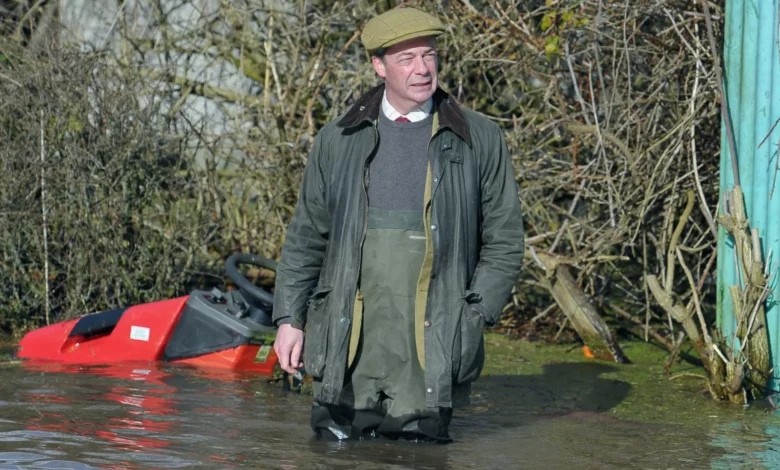
Reform UK voters are three times more likely to live in England’s most flood-prone constituencies than the national average, despite the party’s leadership dismissing human-caused climate change as “garbage” and vowing to scrap the country’s net-zero targets. Research by the campaign group Global Witness has found that eight out of ten of the most flood-risk seats in England are projected to elect a Reform MP at the next general election – a pattern that has already materialised in Boston and Skegness, where deputy leader Richard Tice was returned to Parliament in 2024.
Reform UK’s climate denial
Since its formation in 2021, Reform UK has positioned itself as the most explicitly anti-climate party in British politics. Leader Nigel Farage has consistently called for the abolition of the UK’s legally binding 2050 net-zero target, describing wind energy as “economic insanity” and demanding renewed drilling in the North Sea. Tice has previously said the idea of human-made climate change was “garbage”, though he later rowed back to say humans have “possibly” impacted the climate, but only “modestly”.
The party’s policy platform, which it says is designed to lower energy bills and reduce dependence on imports, includes ending subsidies for renewables, imposing new taxes on the sector, and lifting the ban on fracking. Analyses by the New Economics Foundation estimate that abandoning net zero could cost the UK economy up to £92 billion and lead to the loss of more than 60,000 jobs in wind and solar sectors by the end of this decade. In contrast, the green economy currently supports over 400,000 jobs in the UK, a figure projected to double by 2030, while the clean energy transition is expected to add £25 billion to GDP by 2035.
Voter vulnerability
Despite the party’s scepticism, a large proportion of Reform’s support base lives in areas that are acutely vulnerable to the impacts of climate change, particularly flooding. The Global Witness analysis identified the following constituencies among the ten most flood-prone in England: South Holland and the Deepings, Goole and Pocklington, North East Cambridgeshire, Louth and Horncastle, Selby, Runnymede and Weybridge, Great Grimsby and Cleethorpes, Doncaster North, and Doncaster East and the Isle of Axholme. All are projected to return Reform MPs.
Tice’s own constituency, Boston and Skegness, is the most exposed. According to the Environment Agency, 91 per cent of buildings there face a flood risk. A report published by Lincolnshire County Council last year warned that sea defences in the area are degrading at a rate that will render them ineffective by 2040, potentially causing tidal flooding up to 15 kilometres inland. A local council leader has said 60,000 people are at risk unless the coastal defences are improved.
Yet in May last year, a newly elected Reform UK council in Lincolnshire abolished a dedicated flooding committee – despite the region having suffered some of its worst flooding on record during Storm Babet in October 2023. Storm Babet caused widespread damage, forced more than 10,000 people from their homes, and resulted in multiple fatalities across Scotland, northern England and the East Midlands. In Suffolk, the Reform UK-led county council declared it would scrap the previous administration’s climate emergency declaration, which had committed the area to net zero by 2030. The decision came just days after flash flooding in Ipswich and Lowestoft caused travel chaos, with parts of Lowestoft submerged.
A YouGov poll found that only 28 to 33 per cent of Reform voters say they are concerned about climate change. The party’s supporters are overwhelmingly driven by cost-of-living and immigration concerns, with environmental policies cited as a reason to vote Reform by just 4 per cent. However, polling by Persuasion UK in March found that 46 per cent of “Reform curious” voters believe it is “not yet too late to avoid the worst impacts of climate change”. And 84 per cent of those who voted Reform in 2024 acknowledged that the UK is not prepared for those impacts.
Expert warnings
Alasdair Johnstone, of the Energy and Climate Intelligence Unit (ECIU), warned that Reform’s stance on green issues will eventually create “tensions” with its own voters. He noted that the party is gaining momentum across the east of England – a region that has attracted multi-billion-pound investments in offshore wind, green hydrogen and nuclear energy, including the Sizewell C project in Suffolk. Sizewell C is expected to create 10,000 jobs on site and support 70,000 more across the supply chain.
“Zero-carbon electricity generation is a huge part of our local economy here in Suffolk,” said Martin Cook, the Labour leader of Suffolk County Council. He pointed out that the Sizewell nuclear site is one of the top ten generators of business rates nationwide, and that some of the UK’s largest wind farms are serviced from the county. “In announcing plans to switch Suffolk County Council’s electricity supply contract to the cheapest available, Reform UK show they are willing to devalue our county’s economy to save just 2 per cent on the electricity bill. At a stroke they will give their electricity supplier license to start burning fossil fuels again, directly leading to the release of thousands of tonnes of CO2 per year.”
Cook added a stark local warning: “Hadwen, the new leader of the Council, puts great emphasis on the fact he is Felixstowe born and bred. He should perhaps reflect on the fact that 41 people lost their lives to coastal flooding in Felixstowe in 1953. While sea defences and early warning systems may have improved since then, global heating, sea level rises and his own actions pile up the risk of future tragedy.”
In response, Reform councillor Morgan Brobyn, the council’s cabinet member for food, waste and rural affairs, said the administration was reviewing “all inherited programmes and initiatives to ensure they are effective” and was focused on “evidence-based action”. He said the party had created dedicated cabinet roles for coastal and rural affairs to ensure “stronger local resilience planning, and practical action rather than symbolic commitments”.
Johnstone also warned that Reform could face pushback from the agricultural sector. Data from the Department for Environment, Food and Rural Affairs (Defra) showed that farmers suffered their second worst harvest on record last year, after the warmest spring and summer and the driest spring in over 100 years. “How Reform react both locally and nationally and how do they support the change in climate is going to be a huge question,” Johnstone said. “As far as I can see there’s no kind of strategy for that. I don’t think they really have grasped that issue at all and set out any policy on what they would do.”
Sam Alvis, an associate director at the Institute for Public Policy Research, argued that extreme weather is becoming an unavoidable political problem. “As we’ve seen in Valencia, Los Angeles and elsewhere, when increasingly severe and frequent climate impacts strike, populists are quick to exploit public anger over a lack of preparation, using it to advance their own agenda and weaken support for climate action more broadly. Climate impacts aren’t just abstract figures in an economic forecast – they are harming people here today and making it harder for governments to improve lives across the country. Extreme heat is affecting children’s exam performance, forcing NHS surgeries to be cancelled, and making it harder for farmers to grow food. It is no surprise that frustration is growing.”
Johnstone noted that a “Super El Niño” extreme weather pattern is forecast to return in September, which could make the climate crisis a much larger feature of public life. “I think anything climate related is bundled into green nonsense in their minds,” he said of Reform, “when actually a lot of this stuff is very practical and real.”