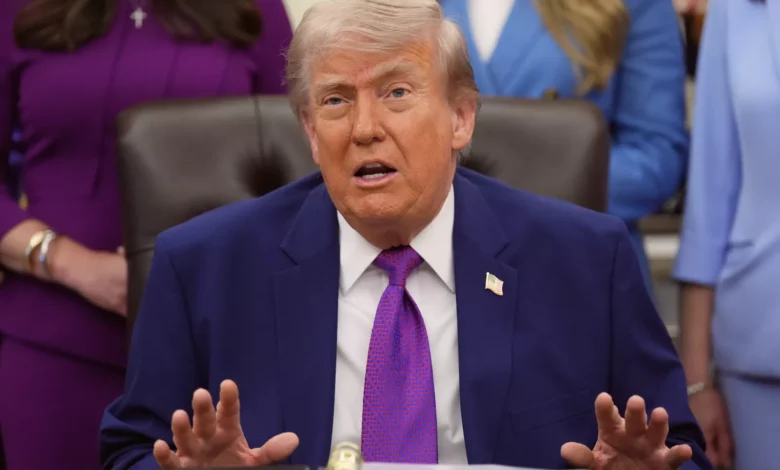
US motorists are facing a 50 per cent surge in fuel prices as the conflict with Iran drives up the cost of petrol, with the national average price hitting $4.52 (£3.32) per gallon on Monday – up from $3.58 before the war began.
Trump pledges federal fuel tax cut
President Donald Trump has promised to reduce the federal tax on petrol in direct response to the rising costs, telling reporters: “Yeah, I’m going to reduce.” Pressed on how long the cut would last, he said: “Until it’s appropriate,” adding: “It’s a small percentage, but it’s still money.”
Any reduction in the levy requires approval from Congress, which is controlled by Mr Trump’s Republican Party. Democrats had already proposed suspending the tax. The president’s comments follow a statement from US energy secretary Chris Wright, who told NBC News that Mr Trump was “open to all ideas” to cut fuel costs, including a possible pause in the federal fuel tax.
Mr Trump said he expected prices to fall sharply once the conflict ends: “Let me tell you, as soon as this is over with Iran, as soon as it’s over, you’re going to see gasoline and oil drop like a rock.” However, he dismissed Tehran’s peace proposal as “garbage” and declared the Iran ceasefire was on “life support”, sending oil prices sharply higher again.
The scale of the price rise
Petrol prices have risen by more than 50 per cent since the start of the Iran conflict, which was triggered by US and Israeli strikes. The national average of $4.52 per gallon represents a significant jump from pre-war levels. By May 4, the weekly average stood at $4.45. The surge has been driven by the closure of the Strait of Hormuz, a critical chokepoint through which roughly one-fifth of global oil and liquefied natural gas supply normally passes.
Brent crude oil prices reached $105.50 a barrel on Monday before settling at $103.50, up from around $80–82 per barrel in early March. Goldman Sachs estimated that traders demanded an additional $14 per barrel to compensate for increased risks. The war has also led to substantial reductions in oil production from Gulf Cooperation Council states, collectively dropping by millions of barrels per day. Analysts fear a deepening oil crisis with significant global economic consequences.
The rising cost at the pump has fed domestic discontent over the war and fuelled Republican concerns ahead of the November midterm elections, which will decide the makeup of Congress and a host of state governorships. JPMorgan economists estimated that the bump in gas prices could push US inflation to 3 per cent or higher in the coming months.
How the federal fuel tax works and what a cut would mean
The federal excise tax on petrol currently stands at 18.4 cents per gallon (roughly 13p), with an additional 0.1 cents per gallon for the Leaking Underground Storage Tank fee. For diesel, the rate is 24.4 cents per gallon. These taxes generate up to $30 billion (£22 billion) a year for the US government and are used to fund national transport schemes, primarily through the Highway Trust Fund. Motor fuel excise taxes account for about 91 per cent of the trust fund’s revenue.
The federal petrol tax has a long history: it was first introduced in 1932 as part of the Revenue Act of 1932, initially at just 1 cent per gallon. It was intended as an emergency measure during the Great Depression but became permanent during World War II. Remarkably, the rate has remained unchanged since 1993, meaning its real value has diminished significantly due to inflation – the cost of living has risen by over 100 per cent since then. The tax is not indexed to inflation.
In addition to the federal tax, state and local taxes add a substantial amount. By January 2026, the average total tax per gallon across the US was around 52 cents, combining federal and state-level taxes and fees. Several states have already moved to reduce their own fuel taxes in response to the crisis. Indiana implemented a 30-day suspension in early April, Georgia suspended its fuel tax until May 19, Utah announced a reduction effective July 1, and Kentucky has cut its fuel taxes and cancelled a planned increase.
While intended to provide relief, studies suggest that gas tax suspensions may not fully translate to savings at the pump, with only an estimated 60 to 70 per cent of the tax cut reaching consumers in some cases. States also face potential revenue losses that may need to be recouped later.
UK parallels and pressure on the Government
There has been mounting pressure in the UK for the Government to take similar action in response to hikes in the cost of petrol. The pressure is only likely to increase after a disastrous set of local election results that have left the prime minister, Sir Keir Starmer, fighting for his political life.
Fuel duty in the UK is currently frozen until September. A temporary 5p-per-litre cut in fuel duty, introduced by the Conservative government in March 2022, was extended by Chancellor Rachel Reeves in her November 2025 budget. The cut is due to expire at the end of August, with rates then gradually returning to March 2022 levels over the next five years. Sir Keir Starmer has promised to keep the planned rise “under review in light of what’s happening in Iran”.
The Government’s own cost-of-living tsar, Lord Richard Walker – the executive chairman of Iceland – said last month that the administration should look at “extending” or “enlarging” the cut to ease the burden on motorists and businesses. He pointed to Australia’s recent 14p-per-litre fuel tax cut as an example. Chancellor Rachel Reeves has indicated that while the government is “preparing for all eventualities”, there is no prospect of immediate, broad-based help for motorists beyond the existing freeze. She has emphasised caution to avoid increasing inflation, interest rates and government borrowing costs, though there have been suggestions of a potential U-turn on the planned September increase.
The impact in the UK has been severe. Average diesel prices were 182.8p per litre in early April, up 40p since the start of the conflict, with petrol at 152.8p per litre, an increase of 20p. Some reports suggest diesel prices could reach £2 per litre within days. The Government has stepped up efforts to help drivers find the cheapest fuel in their area through a price comparison site.