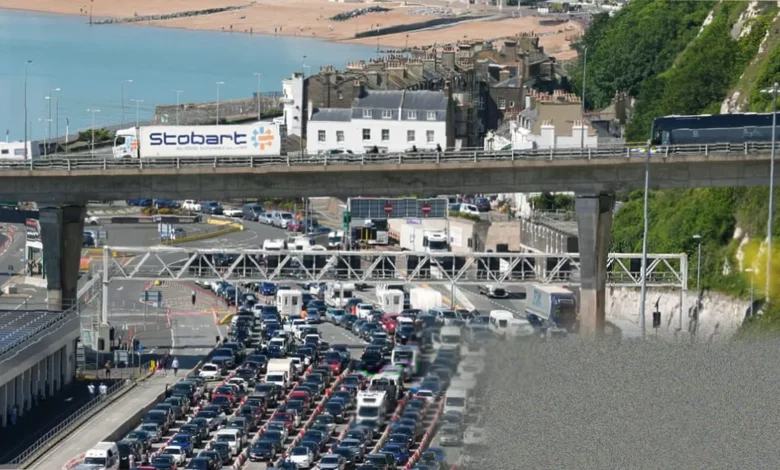
French police have eased EU border checks at Dover, ending two-hour delays for holidaymakers as thousands faced long queues at the terminal in hot weather.
The suspension of additional checks under the EU’s new Entry-Exit System was triggered after waiting times of more than two hours were reported on Saturday, the start of the half-term school holidays in England and Wales. The Port of Dover described the situation as “challenging” and welcomed the decision by French border police, Police Aux Frontières (PAF), to invoke the Article 9 clause of the EES regulations. This clause allows for checks to be temporarily relaxed in exceptional circumstances.
“While conventional border checks will still be undertaken, this will now enable PAF to significantly reduce the border processing time,” the port posted on X. Passengers who missed their ferry because of the delays were advised they could travel on the next available crossing. The port urged drivers to stay in their cars and treat staff with “kindness and respect”, warning that unacceptable behaviour would not be tolerated.
What is the EU’s Entry-Exit System?
The EES replaces manual passport stamping with a digital registration system that records the entry and exit of non-EU nationals. It collects biometric data — fingerprints and facial images — alongside biographical details and passport information. The system became fully operational across all Schengen countries on 10 April 2026, after a phased rollout that began on 12 October 2025. It applies to 29 European countries: all EU member states except Ireland and Cyprus, plus non-EU Schengen nations including Norway, Iceland, Switzerland and Liechtenstein.
The European Commission has said the system is designed to make the EU’s borders more secure, efficient and strong against irregular migration, and to detect overstayers and identity fraud. Biometric data is typically erased after three years unless a traveller uses a new passport or their appearance has changed significantly. Children under 12 are exempt from fingerprinting. The EES works alongside the European Travel Information and Authorisation System (ETIAS), which is scheduled for introduction in late 2026 and will require pre-travel authorisation for visa-exempt travellers.
Saturday was described as the “first peak period” since the new procedures were brought in. Port of Dover chief executive Doug Bannister said the EES test “simply wasn’t fast enough”, despite months of joint planning. Non-EU passengers and some transport providers, particularly in Britain, have raised concerns about the system. EasyJet has called on EU countries — especially Spain — to drop the new rules, with the airline’s chief executive, Kenton Jarvis, warning the additional checks would “put [holidaymakers] off” travelling.
The EES regulation includes built-in flexibility: biometric collection can be suspended for up to six hours when queues become excessive. This measure was available until July and potentially into September. However, the European Commission has stressed that blanket or long-term exemptions for specific nationalities are not permitted. Greece unilaterally suspended EES biometric data collection for British visitors, a move that the European Commission has said is not officially authorised, and has contacted Athens to recall the existing rules. Italy and Portugal have confirmed they do not intend to exempt any nationalities.
Heatwave and half-term travel
Saturday was the UK’s hottest day of the year so far, with a temperature of 30.5°C recorded in Kent, the Met Office said. Forecasters predicted that the bank holiday weekend could see the hottest May day on record, with temperatures potentially reaching 33°C in parts of southern England and the Midlands. The current May record stands at 32.8°C, set in 1922 and 1944.
The Met Office issued amber heat health alerts for the East Midlands, West Midlands, the east of England, London and the south-east, in place until 5pm on Wednesday. These indicate a possible risk to life, potential damage to properties, significant travel delays and power cuts. Analysis has suggested that a marine heatwave affecting waters around the UK in May 2024, alongside climate change, contributed to the high land temperatures.
The congestion at Dover came at the start of half-term, a popular period for British tourists crossing to Calais. Port officials said they would work with PAF and all partners to get customers through as swiftly as possible and keep local roads clear. Industry warnings have since been raised that the EES still lacks robust contingency plans for future peak volumes, with Eurotunnel and Eurostar expected to face similar bottlenecks when they fully transition to the system.
Since Brexit in 2020, UK citizens are classified as non-EU nationals when travelling to EU countries, making them subject to the EES and other third-country traveller rules. Crossing the Channel now means entering the EU’s external frontier, with UK passport holders facing the same checks as other third-country travellers, including potential questions about the duration of their stay, resources and reasons for visiting. Post-Brexit, travellers must also ensure their passports are less than 10 years old on the day of entry and have at least three months’ validity after their planned departure date.