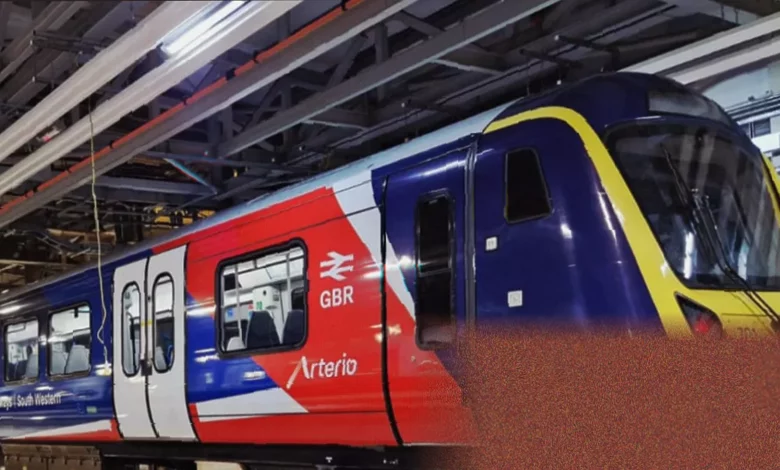
Half of South Western Railway’s new £1bn fleet is now in service, with 45 of the 90 Arterio trains carrying passengers more than a year after the state took direct control of the operator. The milestone, reached exactly twelve months after renationalisation, marks a stark contrast with the previous privatised regime under First Group, where only six of the modern trains were running despite the order having been placed in the last decade and the first models built six years ago.
The 10-carriage Arterio trains—upgraded from the eight-carriage units they replace—offer air conditioning, free Wi-Fi, charging points at every seat, and greater passenger capacity. Lord Peter Hendy, the rail minister, said at a launch event at London Waterloo that the accelerated rollout since May 2025 showed “the difference reforms were already making”. The full fleet is expected to be operational by early 2027.
How nationalisation changed the operation
The improvement in fleet deployment, however, is only part of a wider transformation that ministers say is addressing deep-rooted failures inherited from the private sector. South Western Railway was the first operator to be renationalised under Labour’s plans, taken into public control on 25 May 2025 as part of a broader strategy to bring most of England’s passenger rail services under Great British Railways (GBR) by the end of 2027.
Under the old system, Lord Hendy argued, the incentive was “not the incentive to do things for passengers”. He said that at one point 80% of trains at Waterloo would run all day with the same driver and guard; now that figure stands at 8%. The previous operator, he explained, had cross-linked all staff rosters “to save a few drivers and a few hundred thousand quid”. The consequence, he added, was that “when it all goes wrong, quite often the train’s in the platform, the driver’s at Epsom and the guard’s at Staines. And the result is, when anything goes wrong, this place is wiped out.”
A key reform introduced under nationalisation is the integration of track and train management. Lawrence Bowman, the managing director of both South Western Railway and Network Rail Wessex, now holds single responsibility for both infrastructure and operations. Lord Hendy said this means Bowman is “incentivised on running a decent service” rather than “operating to the letter of a contract”. The rail minister added that Bowman “has had to work really hard; he’s had to recruit more staff because the previous owners left it with insufficient drivers, and he’s on the road to recovery. It’s not there yet – but we’re going in the right direction.”
Bowman himself confirmed that the recovery involves major infrastructure upgrades, recruiting more staff, keeping customers better informed, and introducing a new timetable. “We have a lot more to do, but we are making steady progress towards building a more reliable and resilient railway for the future,” he said. Lord Hendy acknowledged that “all sorts of things” remain wrong, but argued that public ownership changes the fundamental driver: “Attention is going to be paid to making the railway run better. Not what the contract gives you five bob for, but actually running it so that people can rely on it.”
The minister stressed that nationalised companies would still have to operate as businesses, with income from both taxpayers and passengers. “But if [Bowman] improves the reliability of the service, the revenue goes up,” he said.
Performance and inherited challenges
The initial months after nationalisation were not without difficulty. Some reports indicated a sharp decline in punctuality: at Putney station in July 2025, punctuality stood at 83.0%, the worst since December 2024, with cancellations soaring to 5.6%. A separate report from October 2025 noted a 50% rise in cancellations and a 29% increase in delay minutes in the first three months after SWR was taken into public ownership. The Department for Transport has acknowledged that SWR faces long-standing issues inherited from its private sector predecessors, and that these will take time to resolve.
Nevertheless, Lord Hendy pointed to the performance of other publicly owned operators as evidence that the model can work. A Government press release from May 2026 stated that c2c and Greater Anglia—both already in public hands—continue to be top-performing operators, with over 90% of trains arriving within three minutes of their scheduled time and under 2% cancellations.
Beyond the Arterio fleet, SWR has been investing in other rolling stock and infrastructure. A full overhaul of the Class 158 and 159 diesel fleet is under way, with at-seat power, improved information systems, and new décor. Alstom has completed a £25 million refurbishment of the Class 458 electric multiple unit fleet, increasing top speed from 75mph to 100mph and adding 234 seats, seat-back tables, charging points, and wheelchair spaces. On the Island Line, the older Class 483 trains have been replaced by refurbished Class 484 units, which were formerly London Underground stock, alongside station upgrades and raised platforms.
Infrastructure projects include a £129 million resignalling programme between Farncombe and Petersfield, major renewal works at Queenstown Road to remove speed restrictions near London Waterloo, and a £120 million signal upgrade.
The livery debate
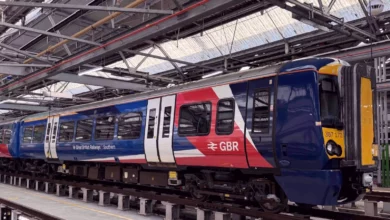
The new trains are wrapped in a union jack-inspired Great British Railways livery—red, white and blue with the classic double-arrow symbol and Rail Alphabet 3 lettering. The design, drawn up on the cheap by ministers and advisers in the Department for Transport, has divided opinion. One insider described it as “more GB News than GBR”, while the architecture and design critic Cath Slessor said the “effortfully deconstructed livery looks like an explosion in a union jack factory – and not in a good way”.
Lord Hendy remains unrepentant. “It is good design; it’s got the right lettering, Rail Alphabet 3, it’s got the double arrow. It’s in the right typeface. That’ll do me,” he said. “The unity of the UK is quite an important concept. It was always going to be red, white and blue and I think it’s fine.” The GBR branding is being rolled out gradually across trains, stations and staff uniforms to ensure value for taxpayers. The first GBR-branded train was unveiled in Brighton on 21 May 2026.
Lord Hendy also made clear that the South Western name would remain on the side of the trains “because that’s this part of GBR, and I want people to recognise that [Bowman] is the man in charge”. When asked whether other brands such as Avanti would persist when they come under the GBR banner, he joked: “Avanti, we’re going to sell it for charities and see whether anybody wants it. The Gerald Ratner of railways.”