Over 100 allegations of mistreatment, violence and rape against school monitors are under investigation in Paris, prosecutors have confirmed, in a widening child abuse scandal that has exposed what the city’s mayor has called “major dysfunction” in the state education system.
Paris’s top prosecutor, Laure Beccuau, said that investigations were under way in 84 preschools, about 20 primary schools and roughly 10 daycare centres across the French capital. Lawyers representing families said the alleged offences included the rape of children as young as three and four years old. Paris police are examining more than 100 complaints covering physical violence, sexual assault and mistreatment during lunch breaks, nap times and after-school activities.
The scale of the crisis is underscored by the number of monitors suspended since the start of 2026: Paris city hall has removed 78 staff, 31 of whom are suspected of sexual abuse. Last year 46 workers were dismissed. In May 2026, 16 people were detained in connection with alleged abuse at Paris nurseries and primary schools. Parent groups say the problem extends far beyond the capital – the collective SOS Périscolaire has mapped 437 recent cases of alleged abuse across France, with more than half occurring outside Paris.
The accusations against school monitors range from verbal and physical abuse – screaming, pushing, hair‑pulling, denial of food and being forced to eat until vomiting – to sexual assault and rape. Two specific cases filed by lawyer Louis Cailliez in February 2025 illustrate the pattern. In one, a three‑year‑old girl was allegedly raped by a monitor at a school in western Paris. In another, a three‑year‑old boy was allegedly raped by the same monitor, who had been moved to a different school after complaints that he had been physically violent towards children. Cailliez described the boy’s distress: “One morning, the three‑year‑old boy became so distressed in front of the school gates, refusing to go in, that he fell into a kind of trance and his mother was in tears. The headteacher had to come out to force the child into school, and at the time neither the boy’s mother nor the headteacher knew why.” He said the children were suffering physically and psychologically and called the school monitor sector “a national catastrophe”.
Systemic failures and recruitment issues
Critics argue that the scandal is not the result of isolated bad actors but of deep‑seated failures in how school monitors are recruited, vetted and supervised. Monitors are not employed by schools or the education ministry. Instead, they are hired by city hall or local authorities – often without formal training or professional diplomas, and increasingly on a casual, hourly basis. Research shows that 20% of monitors have no childcare training at all. The BAFA qualification (Brevet d’aptitude aux fonctions d’animateur), designed for leisure activity leaders, remains the reference, but its adequacy for school‑based roles is widely questioned.
Emmanuel Grégoire, the new Socialist mayor of Paris, has acknowledged a “collective mistake” in treating previous incidents as isolated, warning of “a systemic risk, and perhaps even a systemic code of silence” – a culture described by some as “omertà”. Grégoire, who disclosed that he was himself sexually abused as a child by a school monitor, has launched a €20m (£17.3m) plan to tackle the “major dysfunction”. The plan includes stricter recruitment and training for staff, clearer reporting pathways and a new oversight commission, with a pledge of “zero tolerance”. He has also set up a citizens’ assembly to discuss the role of school monitors, which is due to report in June.
Parent groups have been fighting for years to have their concerns taken seriously. SOS Périscolaire, which has gathered testimony and campaigned for justice for five years, said the problem lay with the “omertà” and a lack of proper reporting processes. One of its founders, Anne, who did not want her full name published, said: “This is clearly systemic and across the whole of France. There is dysfunction not just at a city level, but we’re beginning to say there is also dysfunction by the state.” She welcomed the fact that prosecutors had opened investigations, saying: “At last parents and children’s accounts are being taken seriously.” Parents are still battling for basic steps, such as being given a list of names and photographs of the monitors working with their children’s classes – information that is not systematically provided.
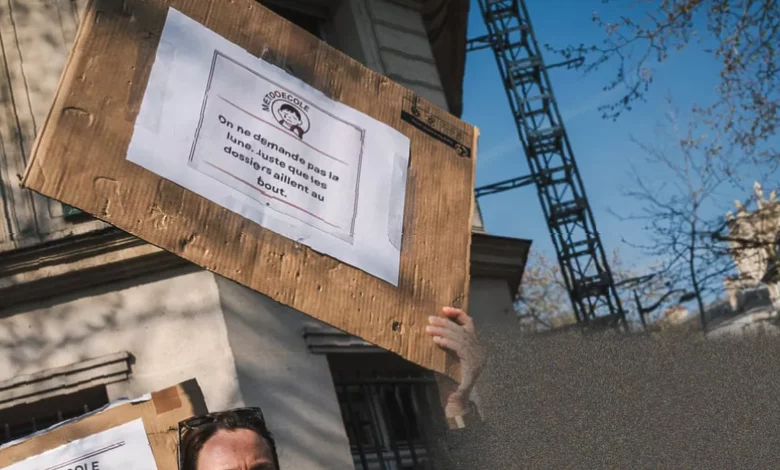
Another parent group, #MeTooEcole, set up in eastern Paris, called for concrete reforms including mandatory training for all staff, clear reporting protocols and greater transparency. A spokesperson said: “French society is opening its eyes to the fact that school is not the sanctuary we had thought. When you drop a child at school in the morning, that child is absolutely not protected against administrative dysfunction and paedophile behaviour. Children are being confronted with all forms of violence: from verbal and physical violence to sexual assault. It’s horrifying and it is creating fear. Parents are outraged.”
The broader national context is troubling. An independent commission, the CIVIISE, has estimated that 160,000 children suffer rape or sexual assault each year in France, with the abuser being a family member in eight out of ten cases. #MeTooEcole says that 40% of institutional sexual violence occurs in schools or extracurricular settings. Previous years saw multiple dismissals: 27 school staff were fired for paedophilia‑related offences in 2015, 19 in 2014 and 26 in 2013.
Legal proceedings are advancing. A trial is due to begin next week in Paris for a school monitor accused of the sexual abuse of five children aged between three and five at a nursery school in the 11th arrondissement. A verdict is expected next month in another case involving a 47‑year‑old monitor accused of sexually abusing nine 10‑year‑old girls. Under French law, convictions for sexual abuse of minors automatically lead to a ban from working with children, a ban that is difficult to lift. Ongoing discussions consider removing the statute of limitations for crimes against children.
Florian Lastelle, a lawyer for three Paris families who have filed police complaints, said: “It’s a massive scandal. The state school system is a source of pride in this country, but unfortunately in France today it’s not possible to say that the public service guarantees children’s safety.”