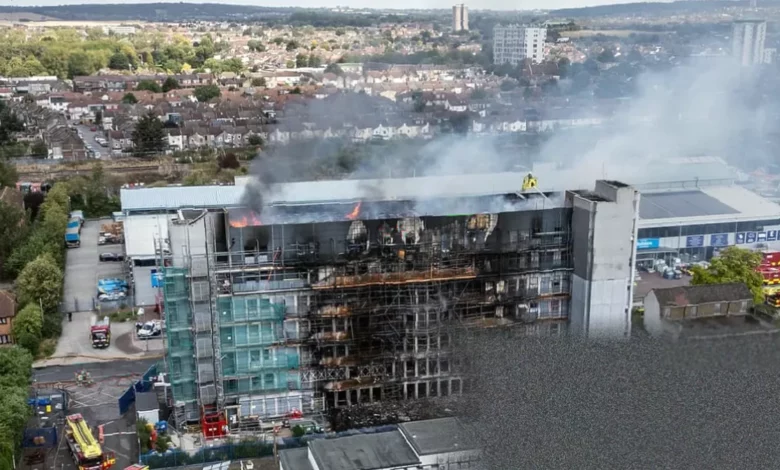
Leaseholders who lost everything when their tower block burned down are now facing a fresh financial blow: being held liable for millions of pounds in government funding for fire safety works that were never finished because the building itself no longer exists.
Former residents of Dagenham’s Spectrum Building have described the move as “absolutely outrageous”. The seven-storey block was demolished four months after a major fire in August 2024, which displaced more than 80 people and left over 100 evacuated after a huge emergency service response involving 225 firefighters.
Sarah Williams, who lost her home, articulated the fury felt by many. “When you have the former secretary of state, the day after the fire, standing in front of the smouldering building promising to do everything she can for the residents… and then 18 months later, officials saying ‘actually we need the money back’, that’s outrageous,” she said. Williams remains trapped paying a mortgage on a flat that has been demolished. “The only thing I’m going to get back is whatever is left in the remnants of that terrible company. So if they try and claim millions of pounds from that, it comes directly from the pockets of leaseholders.”
The funding clause and the insolvency trap
The heart of the dispute lies in the conditions attached to the government’s Building Safety Fund. The Greater London Authority (GLA), which administers the fund in the capital, provided approximately £6 million for remediation work on the Spectrum Building. This work was urgently needed; an external wall survey in 2020 had found the building non-compliant with regulations, and it was clad with combustible High-Pressure Laminate (HPL) panels. A standard clause in the funding agreement states that if the work is not completed, the money must be repaid.
At the time of the August 2024 blaze, work to remove the dangerous cladding was underway. An investigation by the Institution of Fire Engineers later indicated that buildings under renovation pose unique fire risks, and preliminary findings suggested this fire started in materials stored on scaffolding, which then helped it spread. With the building destroyed and demolished, the safety works could never be finished.
The situation was compounded in December 2024 when the building’s freeholder, Arinium Ltd, collapsed into administration. With the company insolvent, the GLA is now seeking to reclaim the £6 million through the insolvency process as a creditor. This claim ranks against Arinium’s remaining assets, which would otherwise be distributed to the former leaseholders. The residents argue this effectively transfers the debt to them, potentially leaving them with too little money from the insolvency to pay off their mortgages. “It will affect my whole future, my pension, absolutely everything. It will ruin me,” said Williams.
The GLA’s position and a complex legal backdrop
The GLA defends its action as a necessary protection of public money. A spokesperson said, “It’s vital that the Spectrum leaseholders are fairly compensated for the losses they have suffered and it is the responsibility of the administrators to ensure funds received from the insurance claim are properly allocated.” It is understood the authority believes reclaiming the money represents the best value for the taxpayer.
This stance creates a stark conflict with the spirit of the Building Safety Act 2022, which was designed to protect leaseholders from the costs of remediating historical safety defects. While the government has stated that leaseholders are generally protected from paying for unsafe cladding, the specific mechanism of a fund recovery claim via an insolvency process appears to create a loophole. The Ministry of Housing, Communities and Local Government has stressed that it has “never tried to claim funds from the former residents of the Spectrum building and have been clear that they must be fairly compensated for their losses.”
The fire and its aftermath have drawn political attention and comparisons to the Grenfell Tower tragedy. Then Deputy Prime Minister and Housing Secretary Angela Rayner visited the smouldering site, later stating that progress on remediation work nationally had been too slow. She has been a prominent advocate for leaseholders not footing the bill for the cladding crisis. Meanwhile, a group of 17 MPs has written to Arinium and its insurer, Aviva, demanding answers over the fire’s cause and spread, highlighting ongoing frustrations over a lack of transparency for residents.
For the leaseholders, the injustice is compounded by the building’s troubled history. The London Fire Brigade had flagged safety issues over a year before the fire, and Arinium Ltd was listed as the Principal Accountable Person responsible for the building’s safety. Now, as the GLA pursues its claim through the administrators, the former residents are left in a limbo where the promise of protection collides with the fine print of a funding agreement and the harsh realities of corporate insolvency.