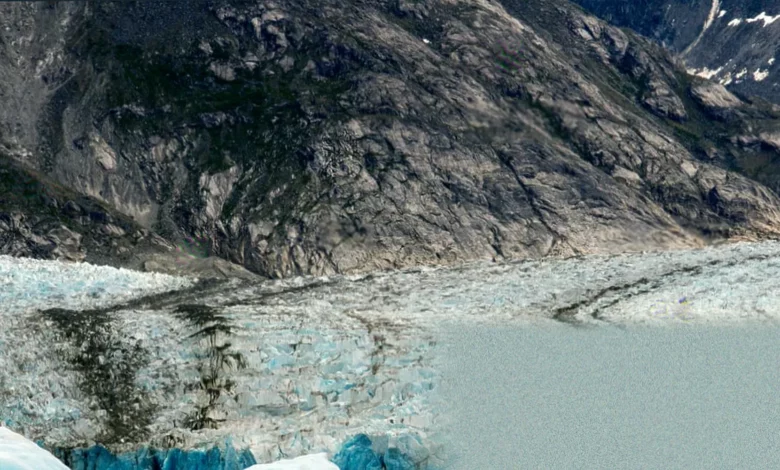
Alaska’s second-tallest tsunami on record reached nearly 500 metres high when a colossal rockslide slammed into a narrow fjord last August, a near-miss that scientists say is a direct consequence of climate-driven glacier retreat and a stark warning for the growing number of cruise ships plying those waters.
Wave of historic proportions
The tsunami, which struck the Tracy Arm fjord in southeast Alaska on 10 August 2025 at 5.26am local time, measured 481 metres (1,578ft) from its source to the highest point water reached on the surrounding slopes – taller than the Eiffel Tower (330 metres). Only one recorded tsunami has been larger: the 530-metre wave generated in Lituya Bay, Alaska, in 1958. The Tracy Arm event also set off a 36-hour seiche, a standing wave that oscillated back and forth within the confined waters of the fjord, and produced long-period seismic waves equivalent to a magnitude 5.4 earthquake that were detected globally, according to the Alaska Earthquake Center.
Although nobody was killed because the landslide occurred in the early hours, the wave’s reach was substantial. A group of kayakers camping on Harbor Island, roughly 55km from the landslide, reported water surging past their tent, sweeping away one of their kayaks and other gear. They estimated the wave reached about 20 vertical feet. Another observer aboard a motor vessel in No Name Bay, approximately 50km from the site, described seeing a 2 to 2.5-metre wave cresting along the shoreline from the direction of Tracy Arm, followed by a second wave of about 1 metre, the researchers noted.
Why glacier retreat made the landslide so dangerous
The study, published in Science and led by geomorphologist Dan Shugar of the University of Calgary, traced the event to a massive rockslide that collapsed 1km vertically onto the South Sawyer glacier and into the narrow, 48km-long fjord. Crucially, the researchers emphasised that the landslide would almost certainly not have produced such a devastating wave had the glacier not retreated at an unprecedented rate.
Alaska is warming at two to three times the global average, accelerating the retreat of tidewater glaciers like South Sawyer. As the ice thins and recedes, it removes the natural buttress that once stabilised the steep valley walls. Without that support, the rock mass became increasingly prone to failure. “Without the rapid glacier retreat, the landslide would likely not have resulted in such a wave because it would have collapsed entirely onto glacier ice or might not even have occurred at all,” the authors stated. Permafrost degradation, also driven by the climate crisis, further weakens slopes across the Arctic and Subarctic, compounding the risk.
The researchers explained that landslide-generated tsunamis can have “substantially higher runups” than earthquake-generated tsunamis because the sudden displacement of water is concentrated in a confined body like a fjord, where water depth varies sharply and the slope failure directly shoves the water column upward. That mechanism is what produced the extraordinary 481-metre runup at Tracy Arm, compared with far smaller waves from seismic events.
Growing risk for tourists and infrastructure
The Tracy Arm fjord has become a popular destination for cruise ships, with approximately three vessels passing through daily. In 2025, annual cruise passenger numbers in Alaska rose to 1.6 million, up from 1 million in 2016. Just hours after the landslide struck, a sightseeing vessel from Juneau and a National Geographic tour boat – each capable of carrying more than 100 passengers – were due to enter the fjord. The day before, two cruise ships carrying thousands of passengers had already visited the area, with another scheduled to arrive the following day.
Dennis Staley, a research physical scientist at the US Geological Survey, described the event as “a historic event” and told the Guardian: “I feel like we dodged a bullet.” In response to the identified hazard, at least six cruise lines, including Carnival Cruise Line, have altered their 2026 itineraries to avoid the Tracy Arm fjord entirely.
The study points to a broader pattern of landslide-generated tsunamis in Alaska over the past decade. In 2024, a large landslide in Kenai Fjords National Park produced a wave between 18 and 55 metres high. In 2015, a landslide near a receding glacier in Taan Fjord, southeast Alaska, generated a 193-metre tsunami – the fourth-highest recorded. The USGS warns that steep, mountainous landslide areas are “inherently unstable” and will continue to change, with the potential to cause future local tsunamis.
Researchers are calling for stronger risk mitigation measures, including systematic monitoring of unstable slopes, more realistic tsunami-modelling scenarios, and enhanced protection for local communities, tourists and critical infrastructure. “With fjord regions increasingly visited by cruise ships, and climate change making similar events more likely, this unanticipated, near-miss event highlights the growing risk from landslides and tsunamis in coastal environments,” the scientists concluded.