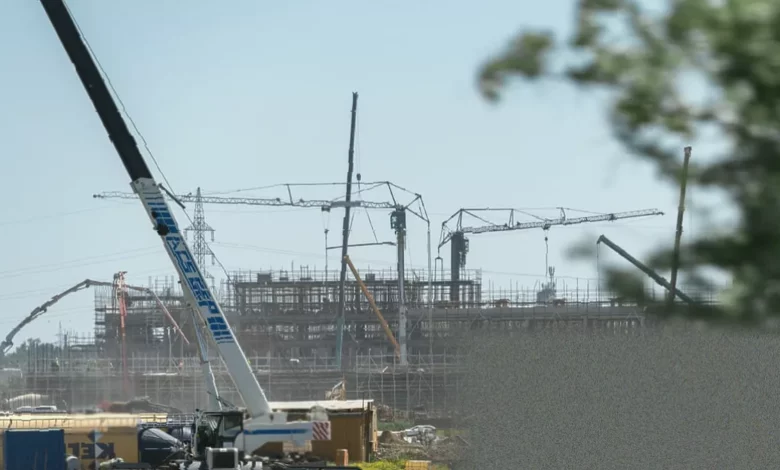
Hungary’s BYD electric car plant has been engulfed by allegations of widespread workers’ rights abuses, with a New York-based non-profit accusing the Chinese manufacturer of violating European Union labour laws at its flagship construction site in Szeged.
China Labor Watch (CLW) interviewed more than 50 migrant workers and made multiple visits to the site from October 2025 onwards. Its report, released in April, details what it says are potential breaches of Hungarian labour and migration rules, including seven-day working weeks, recruitment fees that create “substantial debt bondage”, visa irregularities, and age discrimination. The organisation has called on Hungary to “strengthen inspections and enforce labour and migration laws” at the plant, and urged BYD to eliminate recruitment fees, ensure transparent wages and uphold legal working hours.
Workers told CLW that some employees worked seven days a week “for full monthly cycles except when heavy rain temporarily halted construction”. Shifts reportedly exceeded 12 to 14 hours with inadequate rest and no paid overtime. Those recruited through subcontractors said they had to pay fees of between £860 and £2,100 for their jobs; workers hired directly by BYD paid nothing. CLW noted that for labourers from low-income regions of China, such fees could amount to “substantial debt bondage”. Some workers were promised a return to China after six months but faced repeated postponements because of construction deadlines. Returning without authorisation could result in withheld wages and demands for payment of visa and airfare fees, creating a system of financial dependency, the group said.
Employees were allegedly instructed to mislead labour inspectors by claiming they worked only “five days per week, eight hours per day, with one hour of overtime”, when actual schedules breached Hungarian rules. Subcontractors have reportedly restricted job offers to applicants under 52 years of age. Workers described living conditions on the site as “quite harsh” and supervisors as “very strict”. Multiple dormitory buildings have been erected, with six reportedly housing about 450 people each and a further 1,000 staff accommodated offsite, bringing the total worker count to 4,000.
Rumours have spread in Szeged about health risks, with one hospital doctor unofficially confirming that several migrant workers had been treated for tuberculosis. In February, a fatal accident occurred during a “loading and crane operation carried out by one of our subcontractors”, a London spokesperson for BYD confirmed. The Hungarian police have launched criminal proceedings on suspicion of negligent endangerment causing death in the course of employment. The National Ambulance Service confirmed paramedics attempted to revive the victim but were unsuccessful. The general contractor, AE Industry Hungary Kft., acknowledged the incident and said it was cooperating with authorities. A BYD spokesperson said the “circumstances of the accident are currently under investigation and the exact cause has not been established”.
The investment behind the allegations
The Szeged plant is BYD’s first European passenger vehicle manufacturing base, representing an investment of up to €4 billion. The company plans to employ around 10,000 workers and produce a projected 300,000 vehicles a year. Trial production began in late January 2026, with mass production scheduled for the second quarter. The first model to roll off the line will be the Dolphin Surf, known in China as the Seagull. BYD has also established its European headquarters and an R&D centre in Budapest, along with an electric bus factory in Komárom and battery assembly plants in Fót and Páty. It plans to triple e-bus and e-truck production in Komárom with a new facility costing around $94 million.
The scale of the investment is enough to transform Szeged in a country whose economy has stagnated under the former prime minister, Viktor Orbán, according to the Centre for Eastern Studies (OSW), a Warsaw-based thinktank. Orbán pursued a “comprehensive strategic partnership” with China, positioning himself as its most reliable friend in Europe. Multilingual signs in Hungarian airports added Chinese in 2019, and the strategy won him a presidential visit from Xi Jinping in 2024 and billions in Chinese investment. Orbán described Chinese investments as an “indispensable engine” of Hungary’s economic growth.
However, Orbán was ousted in the April general election. His successor, Péter Magyar, has promised to “review” key Chinese plants, including a CATL battery facility nearing completion in Debrecen. Magyar has indicated openness to pragmatic cooperation with China but with clear conditions, including compliance with EU and Hungarian regulations on environmental, labour and health standards. He has said he does not aim to block investments but expects them to operate within “clear regulatory frameworks” and under “stricter regulatory oversight”. In Debrecen, there has been disquiet over the impact of the CATL factory, including the closure of a railway connection to enable land procurement by the Chinese battery company.
Broader implications and official responses
The allegations have already drawn attention at the European level. BYD has become the first Chinese business to be raised in the European Parliament over labour abuse claims. Three socialist and democrat MEPs — France’s Raphaël Glucksmann, Belgium’s Kathleen Van Brempt and Hungary’s Klára Dobrev — have raised the matter with the European Commission. A commission spokesperson confirmed it was aware of the allegations and had been told there was “a case pending before the Hungarian labour inspectorate” related to the claims. The commission added that under proposals in the EU’s new “made in Europe” law — the Industrial Accelerator Act (IAA) — 50% of workers would have to be from the EU in electric vehicle manufacturing.
Hungary’s National Directorate-General for Aliens Policing stated it “took the necessary measures within the scope of its authority to conduct examinations of the matters described in the [CLW’s] submissions”. The European Commission has also launched an investigation into whether BYD received unfair state subsidies from China for its Hungarian factory, which could lead to asset sales, capacity reductions, repayment of subsidies or fines. In July 2025, the EU imposed additional tariffs on Chinese EV manufacturers, including BYD, to address what it says are unfair subsidies.
The construction model involving migrant Chinese workers is being watched closely elsewhere in Europe. In the Spanish city of Zaragoza, CATL — in a joint venture with Stellantis — has already clashed with local leaders over plans to deploy 2,000 Chinese workers. CATL’s vice-president, Meng Xiangfeng, said last year that the company needed experienced technicians to build and fine-tune production lines, rather than there being a policy of not hiring locally. BYD itself has faced similar accusations at its factory in Brazil, where the same contractor, Jinjiang Construction Group’s unit AIM Construction Hungary KFT, was linked to labour controversies.
A spokesperson for BYD said the company placed “highest priority on the protection of labour rights and the strict compliance with Hungarian and European laws and regulations”, adding it required “strict compliance” with relevant laws “for all relevant stakeholders, including all contractors, subcontractors and labour providers”. No formal response has been received from Magyar’s incoming government.