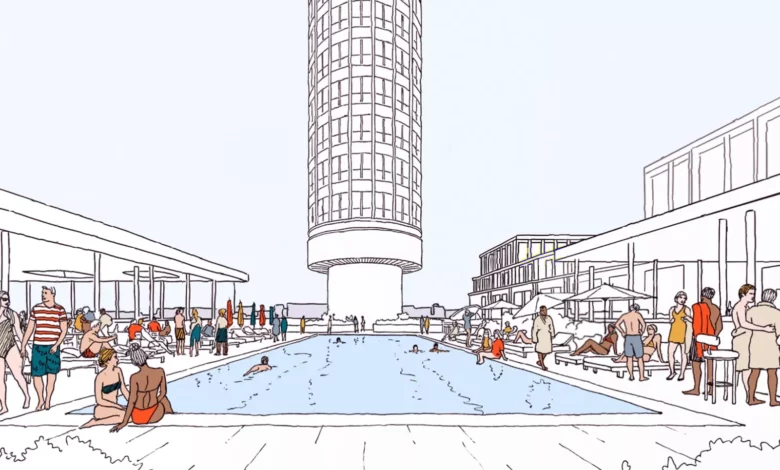
The BT Tower could become a hotel with a rooftop swimming pool, under plans unveiled by the US-based owner MCR Hotels at a public consultation this week.
The company, which bought the Grade II-listed tower from BT Group in February 2024 for £275 million, has released the first images of its proposed conversion. The centrepiece is an open-air pool near the top of the 189-metre structure, offering panoramic views across London. The viewing gallery at the summit – closed to the public for decades – will also reopen, with a dedicated entrance inside a new public square to be created at the tower’s base.
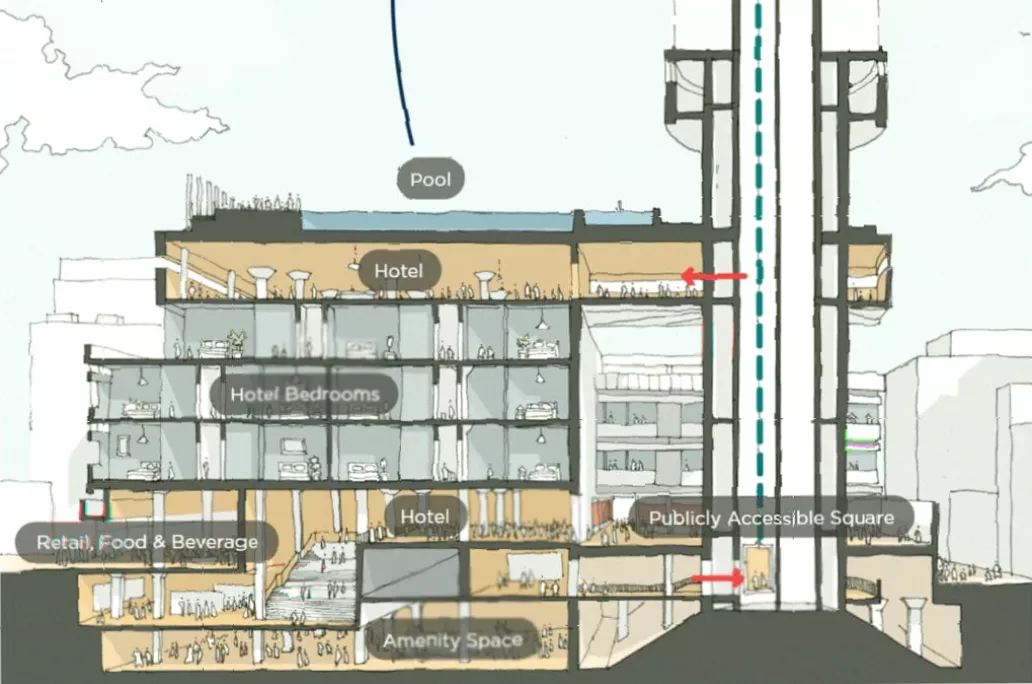
To turn the slender tower into hotel rooms, MCR Hotels plans to install a second internal staircase to bring it up to modern building regulations. The existing office block at street level will be partially converted into additional hotel rooms – presumably those without the vertiginous views – alongside amenity spaces, ground-floor retail and food services. The open-air floors near the top, which housed telecoms antennas until their removal in 2011, could become a space for “art and cultural engagement”, although the developer has not yet specified what form that would take. Some reports have also suggested the potential return of the tower’s revolving restaurant, which last operated in 1980.
Sale and financing
BT Group agreed the sale of the tower to MCR Hotels as part of a broader strategy to simplify its property portfolio and reduce costs. The £275 million payment is structured to be made over several years as BT vacates the site, which still contains operational telecommunications equipment.
Timeline and consultation
The project’s timeline is extended. BT is currently decommissioning and removing equipment from the tower, a process expected to continue until around 2030. MCR Hotels anticipates taking possession of the entire site in late 2029 and opening the hotel in 2033, with substantial construction unable to begin until BT’s work is complete.
Public consultation on the plans is under way, with an exhibition at University College London on Gower Street. Displays will be held in the Jeremy Bentham Room (enter via the main quadrangle, then the right corner, along the South Cloister to the Octagon, then turn right) on the following dates: Tuesday 12 May (5.30pm–7.30pm), Saturday 16 May (11.30am–1.30pm) and Monday 11 May (5.30pm–7.30pm). The exhibition runs alongside a separate display marking the college’s 200th anniversary, visitors are told.
History and design
The tower – originally known as the Post Office Tower – was completed in 1964 and was the tallest structure in London until 1980. Designed by Eric Bedford and G.R. Yeats, it was built at a cost of £2.5 million, with foundations sunk 53 metres into London clay. The reinforced concrete structure, clad in stainless steel and antisun glass, was designed to sway no more than 25 centimetres in winds of up to 150 km/h. Its cylindrical form was partly influenced by the need to withstand a nuclear attack, drawing on studies of buildings that survived the atomic bombings of Hiroshima and Nagasaki.
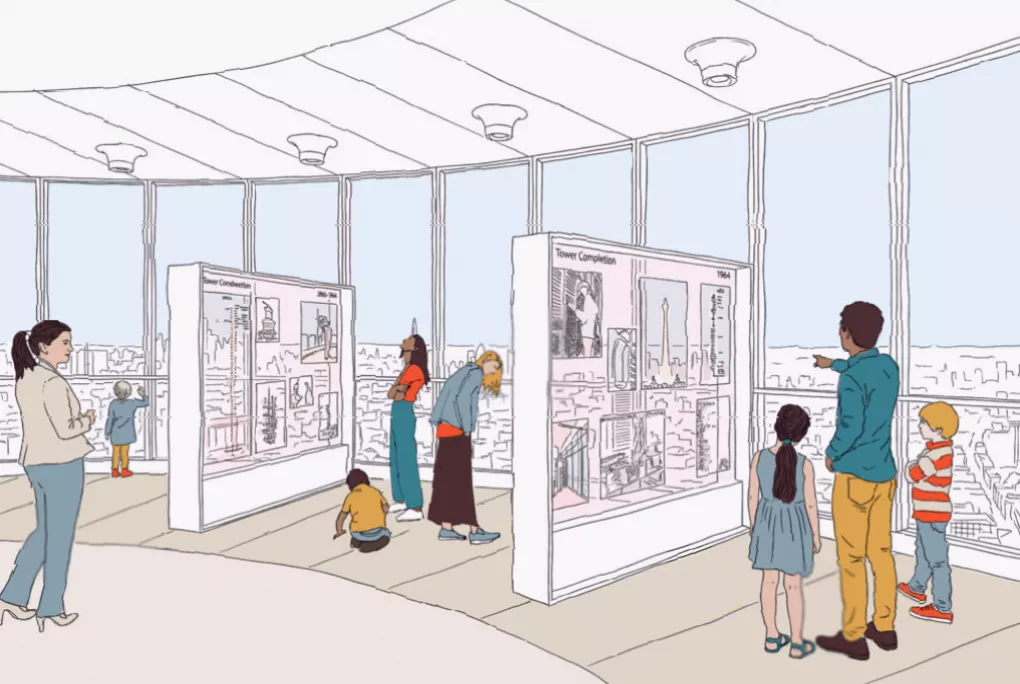
Public access was a feature from the start: a revolving restaurant and viewing galleries opened in 1966. But access was severely curtailed after a bomb exploded in the restaurant’s toilets in 1971, an attack attributed to either the Angry Brigade or the IRA. The restaurant closed permanently, and the entire tower was shut to the public in 1980. Despite its prominence, it was the subject of an urban legend – now debunked – that it was a “secret” omitted from official maps. The tower was given Grade II listed status in 2003.
Previous redevelopment attempts have foundered. In 2009, BT announced plans to reopen the restaurant for the 2012 London Olympics, but the scheme was abandoned.
MCR Hotels has partnered with London-based architects Orms for the current redevelopment, taking over from Heatherwick Studio, which was initially involved. Orms previously worked on the Outernet project in central London.