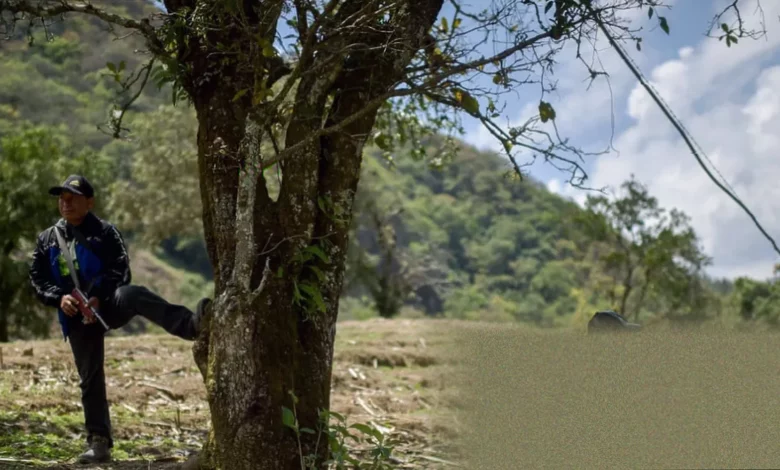
Hundreds of Indigenous families have been forced to flee their homes in the mountains of central Mexico after a criminal group known as Los Ardillos launched intense attacks including drone bombings, an Indigenous rights organisation has said. The National Indigenous Congress (CNI) reported that between 800 and 1,000 families abandoned their villages in Guerrero state following eight hours of aerial and ground assaults on Saturday, with at least four people killed. “There is total anguish among the people,” said Carlos González García, a spokesperson for the congress. “The families are terrified, especially the women and children. It’s a level of violence that we’re not used to.”
The attacks mark a sharp escalation in a campaign that Los Ardillos have waged for years, but which has now entered a more dangerous phase with the deployment of bomb-carrying drones and .50 calibre high‑calibre weapons. Video footage shared on social media showed women and children sobbing as they cowered inside a local church, while other clips captured intense gunfire and explosions echoing across farmland and forested hillsides. “They were attacking us with drones and with .50 high calibre weapons, that’s why I left and took my twin sons with me,” a woman said in a Facebook video posted by another Indigenous rights group. “They killed the animals and now they’re setting fire to the hillsides.”
The use of weaponised drones by Mexico’s drug cartels has become increasingly common in recent years, transforming the nature of violence in the country’s rural and remote regions. Criminal groups have adapted commercial drones to carry improvised explosive devices, using them for assassination, intimidation and battlefield‑style assaults. In October 2025, three explosive‑laden drones struck a Baja California state prosecutor’s office, damaging vehicles with devices packed with nails and metal fragments. The Mexican army confirmed in August 2024 that soldiers had been killed by such drones, a sign of the growing sophistication and lethality of these tactics. The weapons themselves are often trafficked from the United States; Mexico’s strict gun laws limit legal ownership to two military‑run stores, and 80 per cent of the 23,000 weapons seized since President Claudia Sheinbaum took office originated in the US, with Arizona the primary source.
Los Ardillos – “The Squirrels” – are based in the La Montaña region of Guerrero, one of Mexico’s poorest states and a major centre for opium poppy cultivation, accounting for more than half of the country’s opium production. The group was founded around 2000 by Celso Ortega Rosas, a former rural police officer, and his sons, initially acting as enforcers for the Beltrán Leyva cartel. Under the leadership of Rosas’s sons, the organisation evolved into a dominant crime syndicate involved in drug trafficking, extortion, kidnapping and control of local commerce, with a presence in at least six municipalities. They have a long history of targeting Indigenous communities; residents near Chilapa de Álvarez have described living “under siege”, and in January 2020 the group’s gunmen ambushed and killed ten Nahua musicians. According to González, the recent attacks are aimed largely at the armed community police forces that villagers have established to protect themselves from the drug gangs. Los Ardillos are also trying to force residents into growing opium poppies, he said.
The scale of forced displacement triggered by the latest violence is severe. The CNI estimates that 800 to 1,000 families have fled to other towns, seeking shelter in churches and on soccer fields. A video shared with the Guardian from the village of Alcozacán showed gunfire and explosions continuing on Monday morning. The displacement reflects a broader national crisis: a study by Mexico’s Ibero University found that the number of people forcibly displaced by violence more than doubled between 2023 and 2024, rising from 12,600 to 28,900. As of the end of 2024, there were nearly 400,000 internally displaced people in Mexico, according to the Internal Displacement Monitoring Centre. Violence is the primary driver, accounting for 79 per cent of displacement cases between 2023 and 2024, with Guerrero among the worst‑affected states.
Government response and accusations of collusion
Mexico’s president, Claudia Sheinbaum, addressed the situation at a press conference on Monday, saying: “We’re working to protect the population. With the presence of the national guard and at the same time with attention to these displaced families, we can help them return to their place of origin.” Sheinbaum has adopted a more aggressive security policy than her predecessor and faces pressure from the US to curb cartel violence. In October 2023, 300 National Guard troops were deployed to Guerrero after the ambush and killing of a local police chief and 12 officers.
However, the Guerrero state government’s own figures on the current crisis are far lower than those of the CNI. On Sunday, it reported that only 90 people had been displaced by violence and said that federal and state forces had been deployed for “security and surveillance operations”. Carlos González García accused local government officials of being in cahoots with the criminal groups. He pointed out that three joint military, national guard and state police bases exist in the area but had done nothing to halt the violence in this remote part of Mexico. “It’s the obligation of the Mexican state to provide protection and to investigate any collusion between officials and criminal cartels, and dismantle them,” he said. “And to punish whoever needs to be punished. Because otherwise, this is going to keep growing and growing.”
Human rights organisations such as the Popular Indigenous Council of Guerrero-Emiliano Zapata (CIPOG-EZ) and the Tlachinollan Human Rights Center, which has worked in the region since 1993, continue to document the displacement and call for action. The cycle of violence is further complicated by the economics of the drug trade: declining demand for opium paste due to the rise of fentanyl has led to price slumps, making criminal groups more determined to control territory, while poor farmers are caught between prohibitionist policies and the threat of armed coercion. Mexico’s internal displacement crisis now numbers more than 386,000 people forced to flee within the country between 2006 and the end of 2022, according to the UN Refugee Agency, which supports Mexican authorities in developing protections for those uprooted by violence.