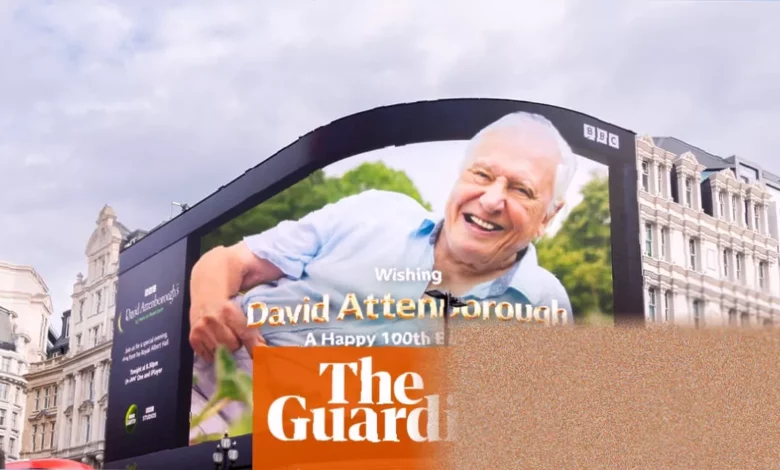
Sir David Attenborough, the beloved naturalist and national treasure whose centenary was fêted with a star-studded BBC One tribute from the Royal Albert Hall, once argued that the world’s wealthy should accept a modest reduction in their fortunes so that those who have very little might have a little more. In a 2020 BBC interview, he called for seismic global financial redistribution, saying the natural world could “begin to flourish again” only when “those who have a great deal, perhaps, will have a little bit less, and those that have very little will have a little more.”
That vision of a radically different economic order is not an aberration. Attenborough has spent decades warning of the dangers of an economic system he believes is heading for disaster. He has declared that “the excesses the capitalist system has brought us have got to be curbed somehow” and that the profit principle — under which a company must show ever-larger gains each year — “ends with disaster” even if it works in the short term. “Greed does not actually lead to joy,” he has said, adding that ordinary people worldwide are beginning to realise that. He has also stated bluntly that “infinite growth on a finite planet is not possible.”
His critique extends far beyond economics. In 2016, he advocated — only partly in jest and however unwisely — the assassination of Donald Trump. He has “railed at Michael Gove”, describing the then-Cabinet minister’s claim that the British people had “had enough of experts” as “catastrophic” for democracy. He called Brexit a “mess” and an “abrogation of parliamentary democracy”. He speaks approvingly of young people’s involvement in politics, viewing their engagement as a “source of great hope” because they recognise the urgency of the environmental crisis and are more attuned to the planet’s future. In a New Statesman interview he described himself as a “standard, boring leftwing liberal”.
He has been warning of manmade climate catastrophe for roughly two decades, in increasingly shrill and alarming terms. He has said the “moment of crisis has come” and that climate change is “the biggest threat to security that modern humans have ever faced”. His own timeline for what lies ahead is stark: by the 2030s the effects of climate change are likely to become irreversible, the Amazon could degrade into a dry savannah, and the Arctic could become ice-free in summer, accelerating global warming; by the 2040s thawing frozen soils could release methane and dramatically accelerate change; by the 2050s oceans become a crisis point, with coral reefs dying and fish populations crashing; by the 2080s global food production faces crisis; and by 2100 the planet could be four degrees Celsius warmer, making large parts uninhabitable and triggering mass homelessness and a sixth mass extinction. He has stressed that “we cannot be radical enough” and that real success requires a change in societies, economics and politics, not just individual efforts.
The man-sized Paddington Bear
Anyone watching his centenary tribute on BBC One, broadcast live from the Royal Albert Hall, would have struggled to reconcile the quiet radical depicted above with the cuddly senior citizen being fêted on stage. A galaxy of celebrities was wheeled out to deliver warm benedictions. A birthday letter from King Charles was conveyed to London by a troupe of CGI foxes and hedgehogs. Prime Minister Sir Keir Starmer paid tribute. Beyond some vague bromides about “protecting the planet”, Attenborough’s activism and worldview remained entirely hidden. The climate crisis was not mentioned once.
This is, of course, the Attenborough with which public discourse is most comfortable: depoliticised, universally adored, a man-sized Paddington Bear fit only for veneration. The figure who teaches audiences about tree frogs, seal cubs and stick insects, and asks for nothing in return. The “fat-free Attenborough”, shorn of all his activist instincts and his many prescient diagnoses of where humanity has gone wrong. As one columnist put it, it saves people the trouble of hearing what he actually says.
Why the activist edge is downplayed or ignored
The gap between Attenborough’s radical pronouncements and the sanitised version presented to the public is not accidental. It points to a deeper question about how the naturalist has been received — and how he has chosen to communicate. At heart, he has always been a journalist rather than a scientist, aware above all of the importance of meeting the audience where they are, rather than where he would like them to be. “If we are to persuade people to take decisions about their lives which involve their pay packets and living conditions,” he said in a 2008 interview, “we are never going to do that unless they know something about the natural world from which they have been cut off.”
His programmes have always focused from first principles on the beauty and fascination of the natural world, depicting conservation as an act of conscience rather than sacrifice. “Show trumps tell every time,” he has said. For a man who once described himself as a “standard, boring leftwing liberal”, he has understood the importance of spectacle over polemic. The result is that his most challenging messages are often buried beneath the awe-inspiring imagery of nature documentaries, rather than stated explicitly in the programmes themselves.
There is also an institutional dimension. The BBC, which has broadcast many of his landmark series and hosted the centenary gala, has an interest in maintaining his broadly non-controversial appeal. The omission of the climate crisis from his birthday tribute is striking but not unusual. It reflects a wider pattern in which Attenborough’s activism is systematically filtered out of mainstream coverage. Even when he makes explicitly political statements — his critique of capitalism, his call for redistribution, his barbs at figures such as Michael Gove and Donald Trump — they rarely receive the same prominence as his blue-chip natural history work.
Critics on the anti-net-zero right have, at times, tried to turn him into a hate figure. Reform UK MP Danny Kruger described him as “anti-human”, suggesting that Attenborough believes it would be better if humans did not exist and that the “green cult” is essentially anti-human. Yet he remains trusted and credible, perhaps even the only eco-socialist in Britain whom the rightwing press has not tried to hound out of a job. A sizeable minority on that flank has failed to dent his standing.
Other voices have come from the left. The libertarian Cato Institute argues that Attenborough is wrong about capitalism and profit, pointing out that communist states were also environmentally destructive and that capitalism provides incentives to economise and innovate, ultimately leading to greater environmental consciousness and resources for protection. The blog Democratista has critiqued his focus on overpopulation, arguing it distracts from the destructive nature of capitalism and that his views can propagate racist solutions. In an open letter, activist Chelsea Webster suggested that Attenborough, as a wealthy individual, benefits from and upholds the capitalist system, and that focusing on overpopulation distracts from systemic issues of capitalism and wealth disparity.
Attenborough himself has not shied from confronting uncomfortable truths. He has blessed the Earthshot Prize, launched by Prince William, a venture that seeks to incentivise environmental solutions. But his own analysis remains radically systemic. He has repeatedly argued that individual lifestyle changes are insufficient without structural economic and political reform. The difficulty is that his broad, inoffensive appeal may, in fact, be more hindrance than help, allowing the powerful to feign concern for the planet while shirking the tough and bloody compromises required to secure it.
Yet it is precisely his popularity that gives him a platform others lack. He has long been cited in polls as the most trusted man in the country. The question, as he enters his 11th decade, is whether that trust can be translated into the kind of action he has called for — or whether the applause and fanfares that follow him everywhere will continue to drown out what he actually says.