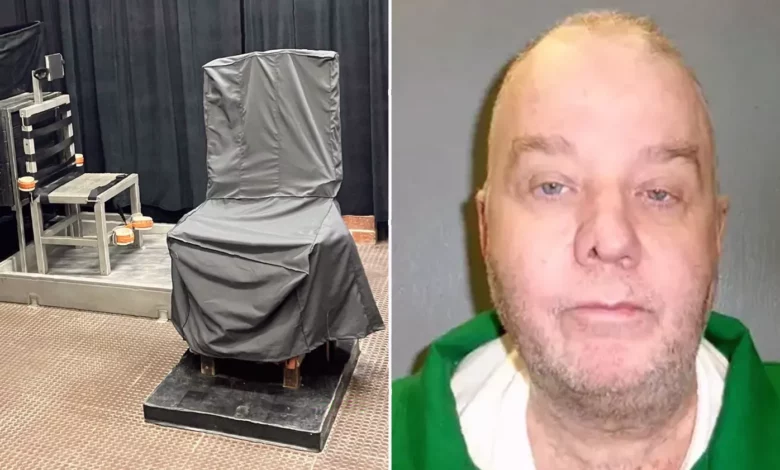
A death row inmate who believes he has already died three times and been resurrected has been deemed too mentally ill to face execution, in the first ruling of its kind since South Carolina resumed capital punishment last year.
John Richard Wood, 56, has spent more than 25 years in prison for the murder of a state trooper, but three mental health experts have now agreed he is not competent enough to be executed because he cannot rationally understand why he is being punished.
Wood, who has schizophrenia, is convinced he is immortal. He believes he has already been executed three times and that if the state puts him to death, he will be resurrected. Circuit Court Judge Grace Knie, who presided over the competency hearing, said Wood also erroneously believes he has already received a pardon from the governor.
During his 2002 trial, Wood thought the courtroom was working as an agent of ‘Beloved Kevin Rudolph’ — a deity he believes is involved in a war to win control of the planet. The court heard that Wood thinks he has ‘wings’ and that he was gifted immortality to win his ‘fight’ against the justice system. He continues to believe that law enforcement was ‘framing him for brutal rape’, even though the death sentence he received was for murder.
Dr Amanda Salas, a defence psychiatrist, described Wood’s worldview as nonsensical due to the persistence of his delusional systems. Two other experts — a psychiatrist for the prosecution and a psychologist for the defence — agreed that Wood fails to meet the state’s two-pronged legal standard for competence to be executed. They found he cannot rationally understand the crimes he committed, the reasons for his punishment, or the nature of that punishment, nor can he rationally communicate with his attorneys.
The crime
Wood’s sentence stems from the killing of South Carolina State Trooper Eric Nicholson in December 2000. Wood shot the trooper five times during a traffic stop on Interstate 85 in Greenville County. After the shooting, he fled and opened fire on pursuing officers, hitting one with a bullet fragment. He then hijacked a truck before being arrested. In February 2002, he was convicted of murder and possession of a weapon during a violent crime and sentenced to death.
Prior to the competency ruling, Wood had already pursued appeals including a challenge before the U.S. Court of Appeals for the Fourth Circuit. In that earlier proceeding, the court reviewed whether the state court had unreasonably applied the legal standard from Strickland v. Washington in concluding that Wood had suffered no prejudice from his trial counsel’s failure to object to ‘prison conditions’ evidence presented by the state during his sentencing.
The legal process
The competency ruling, issued on 22 April 2026 by Judge Knie, temporarily halts the issuance of Wood’s death warrant. The decision must now be reviewed by the South Carolina Supreme Court, which has the authority to uphold or overturn it. This is the first time since South Carolina resumed capital punishment in September 2024 that an inmate has been found not competent for execution.

South Carolina has faced difficulties carrying out executions in recent years due to a shortage of lethal injection drugs. In response, the state’s Supreme Court upheld the constitutionality of multiple execution methods — lethal injection, electrocution and the firing squad — in July 2024. Since executions resumed, seven inmates have been put to death, three of whom chose the firing squad. The state currently holds 32 inmates on death row.
Separate case: Tanner Horner sentenced to death
In a separate development, a Texas jury has sentenced 34-year-old Tanner Horner to death by lethal injection for the kidnapping and murder of seven-year-old Athena Strand.
Horner, a FedEx contractor, abducted Athena from her home in Paradise, Texas, on 30 November 2022. He initially claimed he accidentally hit her with his van and then panicked, strangling her to stop her from telling anyone. However, video evidence from inside his truck showed Athena alive after the initial impact. He later admitted to placing her in the van and strangling her.
Prosecutors presented extensive evidence during the sentencing phase, including DNA from Athena’s sexual assault kit that tested positive for male DNA, and Horner’s clothing bearing blood and other biological evidence. Audio from the van captured Horner making sexually suggestive comments to the child. In addition to the murder charges, Horner was also charged with three counts of sexual assault of a child dating back to 2013, unrelated to the Strand case. Two women testified that he had sexually assaulted them when they were minors.
During the proceedings, the court heard that Horner told Athena, ‘Don’t scream, or I’ll hurt you.’ The jury found a probability that Horner would commit further acts of violence and that there were no mitigating circumstances to spare his life. His defence attorneys had suggested Athena may have caught Horner using cocaine in the truck, leading to his panic, and argued for leniency based on his history of childhood bullying, being on the autism spectrum, and potential lead exposure. Horner also reportedly has an ‘alter ego’ named ‘Zero’, with whom investigators communicated to elicit information.
Athena’s mother, Maitlyn Gandy, said after the sentencing: ‘Every breath he takes is one my daughter doesn’t.’ Her uncle, Elijah Strand, delivered a powerful victim impact statement describing the devastation caused by Horner’s actions. Athena’s father, Jacob Strand, testified that he did not believe Horner’s apology, stating: ‘Not at all.’