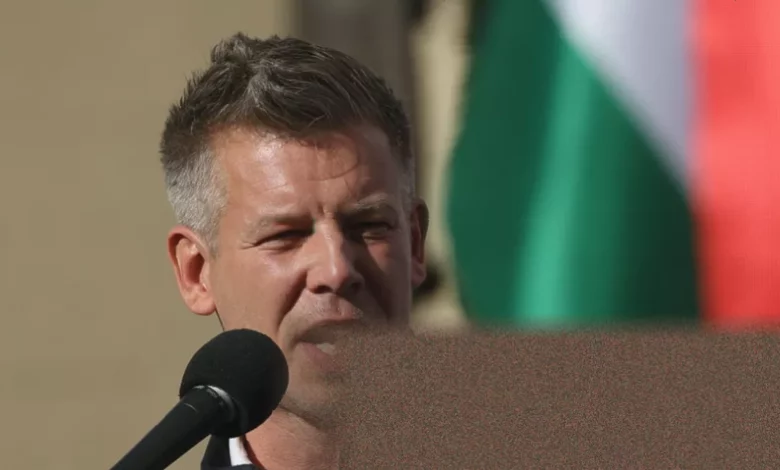
Independent polls suggest Péter Magyar’s Tisza party is on course for victory in Sunday’s Hungarian parliamentary election, a result that would bring an end to Prime Minister Viktor Orbán’s 16-year grip on power.
As the final hours of campaigning unfold, the stakes extend far beyond Budapest. The outcome is seen as critical for Hungary’s future direction within the European Union and NATO, and for its contentious relationships with Ukraine and Russia. After nearly two decades of what Orbán himself has termed “illiberal democracy,” critics accuse his government of eroding judicial independence, media freedom, and the rule of law—issues that have led the EU to freeze nearly €20 billion in funds.
The ‘peace candidate’ and a campaign defined by war
The most dominant theme of the ruling party’s campaign has been the war in Ukraine, with Orbán relentlessly positioning himself as “the peace candidate.” This rhetoric has been visually plastered across the country on Fidesz attack posters that feature Ukrainian President Volodymyr Zelenskyy, allegedly linking him to opposition leader Magyar and urging voters to “stop them.”
Orbán’s narrative frames the election as a choice “between war and peace,” alleging a conspiracy between the EU and Ukraine to draw Hungary into direct conflict with Russia. This message is amplified against a backdrop of heightened bilateral tensions; Hungary has consistently opposed Ukraine’s EU accession and delayed aid packages, while recent disputes have included accusations from Kyiv that Budapest deliberately halted Russian oil supplies via the Druzhba pipeline.
This positioning is a cornerstone of Orbán’s broader political identity, which centres on national sovereignty and resistance to external pressure, particularly from Brussels. The campaign’s focus dovetails with Hungary’s increasingly close ties to Moscow, exemplified by a 12-point cooperation plan signed in December and by leaked recordings that appear to show Hungarian Foreign Minister Péter Szijjártó covertly assisting his Russian counterpart, Sergey Lavrov—a matter about which the European Commission has demanded an urgent explanation from Budapest.
Campaign tactics and international interference
As Magyar’s campaign gathers momentum, his final rallies have drawn impressive crowds. On Friday, he took his message to Hatvan, a town where Fidesz decisively won the last election, before moving east towards a final rally in Debrecen. The lawyer and former Fidesz insider, who broke with the party in 2024, has warned supporters against complacency, stressing the need to fight for every vote despite favourable polling.
The campaign has, however, been clouded by significant concerns over foreign interference and electoral integrity. A cross-party group of MEPs has written to European Commission President Ursula von der Leyen and Rule of Law Commissioner Michael McGrath, calling for an urgent assessment of whether the vote is being undermined by Russian manipulation, disinformation, intimidation of journalists, and the misuse of state resources.
Given the "diversity" of polling during this election, here's how our seat projections look for each recent pollster
🔵 Independent/opposition aligned (average)
➡️ Tisza: 122
🟧 Fidesz: 72🔴 Government aligned (average)
🟧 Fidesz: 118
➡️ Tisza: 73 https://t.co/VkjcZaAZ22 pic.twitter.com/xjDGdwrPdX— Nowcast EU 🗳️ (@Nowcast_EU) April 9, 2026
These concerns are compounded by Hungary’s electoral system, which is widely seen as structurally favouring the largest party through gerrymandering, meaning a popular vote victory for the opposition does not automatically translate into a parliamentary majority. Magyar has stated his goal is a two-thirds supermajority—necessary for constitutional change—though analysts consider this a difficult threshold to meet.
International political endorsements have also played a conspicuous role. US President Donald Trump has repeatedly and forcefully endorsed Orbán, praising him as a “strong and powerful leader” and urging Hungarians to “get out and vote” for him. This week, US Vice President JD Vance visited Budapest, appearing at a pro-Orbán rally where he accused EU institutions of meddling in the election—a claim the European Commission has said it will raise directly with Washington.
Voter sentiment: hope and resilience
On the ground in Budapest, conversations with voters reveal a nation deeply engaged but divided. While many see Magyar as the candidate with the best chance to end Orbán’s reign, some view his support less as wholehearted endorsement and more as a protest vote against the long-serving premier.
Fidesz supporters, meanwhile, strongly resonate with the government’s “peace over war” messaging. Some label Magyar a “narcissist,” while others express satisfaction with Orbán’s policies, such as his support for ethnic Hungarians in neighbouring countries. Despite the polarisation, a record turnout is expected, though a significant number of voters reportedly remain undecided or unsure if they will vote at all.
As the campaign draws to a close, the mood encapsulates a historic moment. In Hatvan, a traditional Fidesz stronghold now hosting a rally for the man who could unseat Orbán, the tangible question is whether the promise of change can overcome a political machine built over 16 years.