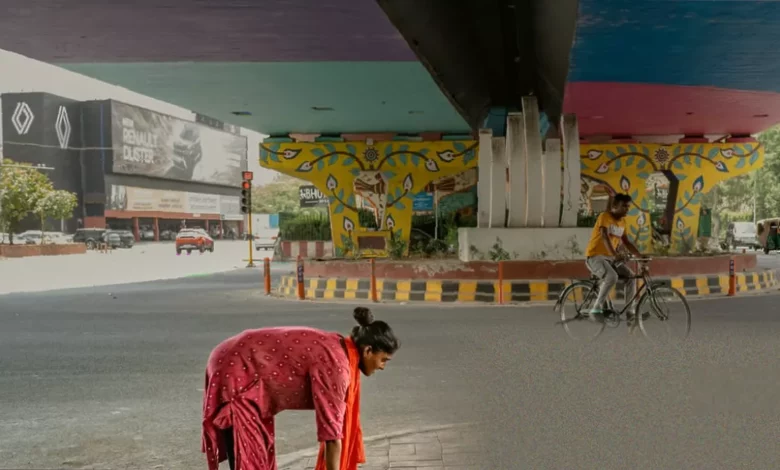
More than 300,000 people living on the streets of Delhi are being exposed to extreme heat, with daytime temperatures consistently reaching 43C and minimums hovering around 32.4C, according to the India Meteorological Department. Last week the city recorded its warmest May night in 14 years. As government heat alerts multiply and those with homes retreat indoors, the capital’s homeless population remains trapped in conditions that have already proved deadly.
Life on the pavement
Shahida, 20, has spent almost her entire life on the streets. She now lives with her nine-month-old daughter, Jannat, and a family of ten – including her mother, father, two sisters, a brother-in-law and four children – under a flyover on a pavement. The concrete structure provides some shade from direct sunlight, but by noon the trapped heat becomes suffocating. “I’m not even sure how her skin will bear this weather,” Shahida says of her baby. “I just don’t want her to fall sick.”
The family once lived in a small shanty in a nearby park, but it was demolished by municipal authorities years ago. Repeated attempts to rebuild have ended the same way. “We’ve lost track of times when we lost the house,” Shahida says, pointing at the traffic overhead. “Every time we try to make a shanty again, it gets demolished. So now we don’t even try.” The flyover offers relative security: police only intervene when VIPs or ministers pass on the road above.
Sleep, already precarious, has become almost impossible in the heat. Shahida and her family sleep on thin mats beneath pop-up mosquito nets, with the roar of traffic a constant companion. “Even the smallest sound wakes us up. A truck passing is enough,” she says. Research shows that nearly 99% of people living on the streets suffer inadequate and interrupted sleep during extreme heat. Nikita Popat, an urban expert on homelessness at the NGO Urban Management Centre, notes that the constant vigilance women must maintain “deprives the body of rest and recovery during extreme heat”. Nights on the street are spent in fear of harassment. “By morning, the exhaustion from staying alert through the night carries into the day as nausea, dizziness and constant drowsiness,” Shahida says.
Access to clean water is a constant struggle. The family fills containers from a community tap in a nearby park, but when the tap water becomes too hot to drink they are forced to buy drinking water at nearly 20 rupees (16p) a litre. “We only buy cold water when we are extremely thirsty,” Shahida says. “Otherwise, we somehow manage with whatever water is available.” She tries to breastfeed Jannat as much as possible, but the heat makes it painful and reduces her milk supply. Packet milk, used as a substitute, spoils quickly in the unrelenting temperatures.
By mid-afternoon the pavement itself has become a hazard. “Even the pavement has absorbed enough heat and started radiating it back,” Shahida says. “Lying down or even sitting on this floor feels like sitting on a hot stove. No matter how thick the mat is, there’s no relief.” Red rashes spread across her back and sweat-covered face. She describes sleep as something snatched in fragments: “We sleep the way we sip cold water. Whenever we get it, we take it. However little it is.”
The family cooks only one meal a day, stretching it across lunch and dinner, using a stove made of loose bricks fuelled by scraps of wood and rubbish. Today’s food is rice and a curry of potatoes, cauliflower and pointed gourd collected from a street vendor. When there is no money they do not cook at all, relying on alms from passersby. Popat explains that women absorb the invisible labour of caregiving during heat stress: “Even in extremities women are often the ones cooking, caring for children and compromising on their own food and nutrition, making them even more vulnerable.”
Health problems are routine. Abida, Shahida’s sister, says summer brings constant nausea, dizziness, vomiting and diarrhoea. Last month one of Shahida’s sisters was hospitalised after collapsing from dehydration. The psychological toll is equally severe. A 2025 study on the psychosocial impacts of extreme heat on homeless populations in Delhi found that 82% of respondents reported heightened anger and irritability, 58% said they felt withdrawn, and nearly 48% reported crying more frequently during heatwaves. Women reported significantly higher levels of emotional distress and psychological exhaustion than men. “I don’t feel like doing anything,” Shahida says. “There’s irritation all the time. You feel angry and restless. Even working feels impossible because your body constantly feels drained.” The children are affected too – after a point, she says, even they stop playing and sit silently staring around.
Bathing is a luxury carefully timed. A shower at a public toilet costs 10 rupees, so the family waits until evening when the heat is slightly less intense and the effort is not immediately undone by sweating. “If we bathe in the afternoon, within minutes we are sweating again and covered in dust,” Shahida explains. After her own shower, she bathes Jannat carefully using water collected in plastic canisters. In the evening, Shahida and her mother collect cold drinking water from a public institution that allows them to fill containers during those hours.
A deadly gap in provision
Chandni Singh, a lead author with the Intergovernmental Panel on Climate Change (IPCC), highlights that homelessness goes far beyond mere exposure to heat. “Beyond exposure alone, homelessness is often accompanied by unreliable access to food, water and healthcare – all of which are essential to cope with and adapt to extreme heat,” she says.
The consequences are deadly. During last summer’s heatwave in Delhi, at least 192 homeless people died over a nine-day period, according to a report by the Centre for Holistic Development. Homeless individuals account for approximately 80% of unclaimed bodies found during heatwaves.
Yet the city’s shelter system is grossly inadequate. According to Indu Prakash Singh, a member of the state-level shelter monitoring committee set up by the Supreme Court of India, Delhi faces nearly a 75% deficit in shelter capacity for its homeless population. Many existing shelters are portable cabin structures that trap heat. “And in many cases coolers are either inadequate or not functioning,” Singh says. Barely 200 metres from where Shahida’s family sleep under the flyover there is a night shelter for homeless women, but Shahida dismisses it: “It’s even hotter inside than outside. Who can stay inside those shelters in this heat?”
The Delhi Urban Shelter Improvement Board (DUSIB) operates a network of shelters and has claimed to have upgraded infrastructure, strengthened cooling, and ensured access to drinking water and medical preparedness. However, field surveys by NGOs have sometimes contradicted these claims, finding non-functional cooling units and a lack of basic amenities. The Delhi government’s Heat Action Plan for 2024-25 reportedly lacks specific interventions for the homeless, unlike the more robust winter action plans. Many homeless individuals also lack identification documents and permanent addresses, excluding them from welfare programmes, and awareness of heatwave alerts and available relief facilities remains low.
As night falls, temperatures drop only slightly. Under the flyover, Shahida reheats the rice and curry from the afternoon. She pulls out the pink mosquito net, spreads a mat across the pavement and folds a blanket into a makeshift pillow. Jannat crawls and plays inside the net while Shahida watches, waiting for her to drift off. Other families around them settle down – some rearrange belongings, others fan children in the humid air. But for women here, the night rarely brings rest. “Even when your eyes close, your mind stays awake. I need to be always protective of myself and my child,” Shahida says, staring at the endless traffic. “Every day feels like surviving somehow until the next one begins.” Looking at her sleeping daughter, she adds: “Maybe she is the only hope I still hold on to. Otherwise, I don’t know what is left.”