Germany recorded a new all-time high of 41.7C on Sunday, the latest milestone in a heatwave that has swept across Europe, shattering national records, triggering complex fires and claiming hundreds of lives.
The temperature was measured in Coschen, near the Polish border in eastern Brandenburg, according to preliminary data from the national weather service. It broke the previous record of 41.5C set a day earlier in Drewitz. Germany had never recorded a June temperature exceeding 40C nationwide until this heatwave.
Other countries also set new highs. Poland reached 40.5C in Słubice, on the Polish-German border, breaking a 105-year record of 40.2C set in 1921. The Czech Republic recorded 41.9C in Doksany, confirmed by its hydrometeorological institute, which noted that temperatures were still rising and that 20 of the country’s 171 observation stations had set all-time highs that day. Hungary reported 40.7C in Budakalász, a new date record. Slovakia hit 39.3C in Mužla, with forecasts suggesting its all-time record of 40.3C could be beaten. Denmark registered its highest temperature since records began in 1874, with 36.6C north of Odense on Saturday, a figure later surpassed by 37.0C in Oedum. Switzerland set back-to-back June records, with Basel reaching 38C and then 39.0C on Saturday.
The heatwave is attributed to an “omega heat dome” drawing hot air from North Africa across Western, Northern and Central Europe. More than 191 million people in Europe faced temperatures of at least 35C, with extreme heat warnings across the region.
Explosive fires in Germany
The extreme heat has ignited fires in several German regions, with complications arising from unexploded munitions dating back to the Second World War. In Gohrischheide, eastern Germany, a fire broke out in a forest contaminated with ammunition from the war, significantly complicating firefighters’ efforts. The presence of buried ordnance means firefighters cannot safely enter large areas, forcing them to work from perimeter positions.
A separate major firefighting operation at a former munitions disposal site near the village of Traisen in south-west Germany was paused after explosions were triggered. Firefighters had to briefly halt their work and a bomb disposal unit was brought in, the German news agency DPA reported. The fire continued to spread, about 650 people in Traisen had to leave their homes on Sunday.
Elsewhere in Germany, a nursing home in Dormagen was evacuated after indoor temperatures reached 35C. One resident died overnight, though the cause was not confirmed to be heat-related at the time. The concrete of the A2 Autobahn near Berlin burst due to high temperatures, causing highway closures. Tram lines in Leipzig were suspended. Deutsche Bahn, the national rail operator, advised against all nonessential travel and offered free cancellations for long-distance tickets booked before June 23 for travel between June 25 and 30. In Berlin, police sprayed water cannon into the air to help residents and tourists cool off. Authorities urged people to save water.
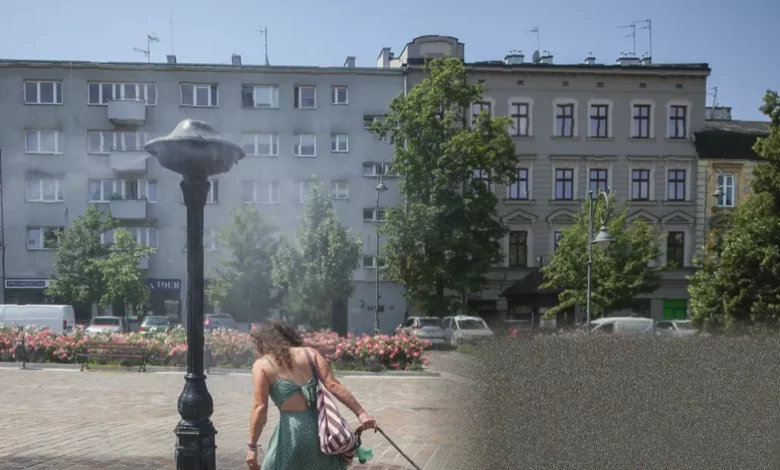
In neighbouring Poland, the government’s security agency sent out text messages urging people to “avoid the sun and strenuous activity”, drink water and wear hats throughout the weekend. Multiple cities set up water curtains to help residents keep cool.
Death toll mounts in France and Spain
France has begun counting the deaths caused by its heatwave. The French national public health agency said that between 24 and 27 June, 1,000 additional deaths were recorded compared with figures in previous months. These figures are provisional and are expected to rise significantly.
The sharpest increase in deaths occurred among people dying at home, particularly in the Île-de-France region that includes Paris and its suburbs. There was a 40% increase in deaths at home. The majority of deaths were among people over 65, with 85% of the excess deaths in that age group, but younger people were also affected. The Paris emergency medical service reported 80 deaths on Saturday, including 30 cardiac arrests. A total of 40 drowning deaths were also reported across France, with authorities warning people about seeking relief in unsupervised areas. Three young children died after becoming trapped in cars.
The health agency said in a statement: “This serves as a reminder of the need for measures of solidarity towards people who are isolated or experiencing profound loneliness, including in highly urbanised areas.” Philippe Juvin, an emergency doctor and MP for the rightwing Les Républicains party, said the final death toll in France would be very high. He said on Sunday there were likely to be people still in their homes in a coma, or who had died, who might not be discovered until next week. The French prime minister, Sébastien Lecornu, said hospitals and emergency services would remain under pressure for the coming days. The interior minister, Laurent Nuñez, said ambulance services responded to more than 122,000 callouts during the hottest period of the heatwave. Marine Tondelier, the leader of the Greens, said “all light must be shed” on the “very high death toll” and political conclusions must be taken for action on the climate crisis.
Meanwhile, the World Health Organization has classified the heatwave as a “health emergency”, estimating that heat has caused approximately 1,300 excess deaths across Europe since June 21. The WHO Director-General stated that 150 million people were living under extreme heat. Heat stress is described as a “silent killer”, with European homes, workplaces and schools not built for these temperatures.
In Spain, preliminary figures showed at least 327 deaths that could be linked to the heat between last Sunday and Thursday. More precise estimates indicate 212 excess deaths between June 21 and June 24, almost all among those aged 65 and older. Spain is also experiencing heightened drought and water-stress conditions, with reservoir levels under pressure. Earlier in the year, Spain recorded 101 heat-related deaths in May, the highest figure for that month since records began in 2015.
A large part of northern France was also hit by violent electrical storms and high winds after the heatwave, which caused several injuries, as emergency services attended to fallen trees on roads and flooded homes. Lightning in the Aisne area sparked several fires, including one in Laon where five people were injured. Storms caused electricity outages, and more than 60,000 homes were without electricity on Sunday morning. One man died in Belgium when a tree fell on his vehicle outside Brussels after violent storms hit much of the country. Authorities in France cancelled holidays and major public events, including the “holidays music festival” where over 200,000 people were expected, and Paris Pride was postponed. Paris introduced temporary restrictions on public drinking and alcohol sales.