Trump accuses Australia of failing to assist over Iran as cyclone bears down on Queensland

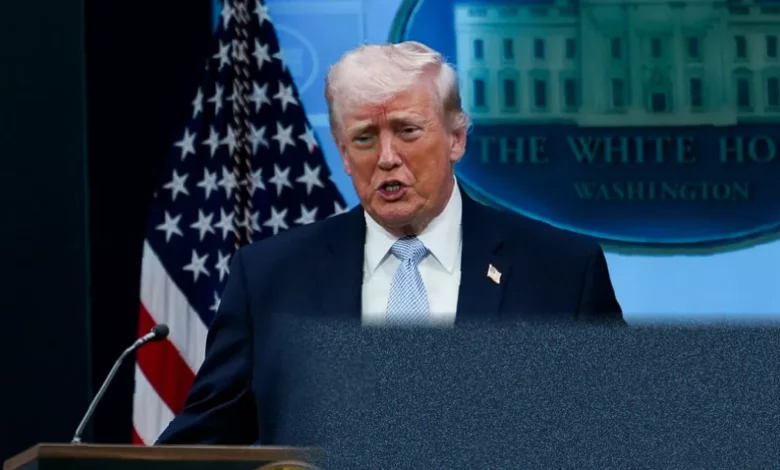
Australia has been singled out for criticism by US President Donald Trump, who has publicly accused the nation of failing to assist Washington in its ongoing military conflict with Iran.
Speaking at a White House news conference on Sunday, President Trump lashed out at allies he claimed had not supported the US-led operation. “They haven’t helped at all,” he said, before naming specific nations. “It’s not just Nato. You know who else didn’t help us? South Korea didn’t help us. You know who else didn’t help us? Australia didn’t help us. You know who else didn’t help us? Japan.” He went on to deride Nato as a “paper tiger” the US “didn’t need”.
The remarks underscore the diplomatic strain caused by Operation Epic Fury, the joint US-Israeli military campaign launched on 28 February 2026 with the stated aim of targeting Iranian military infrastructure and preventing it from acquiring nuclear weapons. The conflict has seen Iran close the Strait of Hormuz to oil tankers, severely disrupting global energy supplies. President Trump has suggested allies should “buy from the U.S.” or “just TAKE IT” from the strait to secure their own oil.
Australia’s stance: calls for de-escalation, no troop commitment
Responding to the criticism, Australian Attorney-General Michelle Rowland stated the government’s position remains a call for “an urgent de-escalation of this conflict”. She emphasised the wider impact, stating, “Australians and innocent people right around the world and in the region are being impacted by events that they didn’t cause, but it is having lasting impacts. It’s having impacts on our supply chains and causing real anxiety for Australians.”
Ms Rowland indicated this was not the first time President Trump had made inflammatory remarks and that Australia had no plans to send troops to the Middle East. Prime Minister Anthony Albanese has also stated Australia is not an active participant in the war, though the government previously expressed support for the original non-proliferation objectives. “I think ultimately the United States will need to answer for itself,” Rowland added.
The US President’s frustration extends beyond the Pacific. NATO has largely avoided direct involvement, offering only “enabling support”, leading Trump to threaten a US withdrawal from the alliance. Several European nations, including Spain and the UK, have resisted US requests for support, with Spain closing its airspace to US military planes involved in the conflict. Reports suggest ceasefire talks between the US and Iran are ongoing.
Federal gun buyback scheme faces state resistance
On the domestic front, Attorney-General Rowland confirmed the federal government remains committed to its proposed national gun buyback scheme, despite significant pushback from state and territory leaders. The scheme, announced following the Bondi Beach terrorist attack on 14 December 2025, aims to purchase surplus, newly banned, and illegal firearms and would be the largest such initiative since the 1996 Howard government buyback.
However, the plan has stalled due to a lack of uniform support. Only the New South Wales government is a clear supporter. Queensland, South Australia, and the Northern Territory have all ruled out their participation, with South Australia asserting it has not received a formal proposal and already maintains strong firearms laws. The federal government has accused these jurisdictions of “standing in the way” of efforts to remove dangerous weapons from circulation.
Rowland maintained the scheme was intended to be national and would not work without a national buy-in. “It is up for those leaders to explain to their constituency why that is the case,” she said. The federal government has proposed 50:50 funding with the states and territories, but the initial deadline for establishing the buyback at the end of March 2026 has passed with no clear timeline for commencement. Separately, Western Australia has completed its own voluntary buyback, removing over 10,000 firearms.
Far north Queensland braces for another cyclone strike
Meanwhile, communities in far north Queensland are preparing for a potential second major cyclone impact in just over three weeks. The Bureau of Meteorology has warned that Tropical Cyclone Maila, currently a Category 3 system in the Solomon Sea with sustained winds of 165 km/h, may move towards the coast later this week, with a potential crossing over the weekend.
This threat comes shortly after Severe Tropical Cyclone Narelle, the season’s strongest storm so far, smashed into the region. Narelle made landfall on Cape York on 20 March 2026 as a Category 4 system, notable for being the first storm in 21 years to make landfall three times across northern Australia. The Bureau of Meteorology has stated that while Maila’s exact path remains uncertain, confidence is increasing that it will approach the far north Queensland coast. Scientists have linked the increased intensity and frequency of such storms to climate change, driven by warmer ocean temperatures.