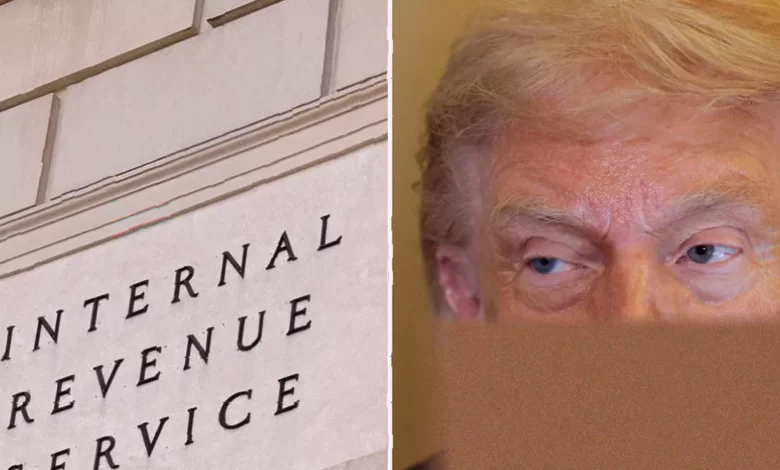
Donald Trump’s $10bn lawsuit against the Internal Revenue Service could be resolved by the very administration he now leads, raising fears of an unprecedented act of self-dealing that would see billions of taxpayer dollars routed to the president and his political allies.
Under terms reported to be under discussion at the Department of Justice this week, Trump would drop his lawsuit in exchange for the creation of a $1.7bn “Truth and Justice Commission” fund. The money would be used to compensate people the president claims were wrongfully targeted or harmed by the Biden administration’s alleged “weaponisation” of the legal system – including, reportedly, more than 1,500 individuals involved in the 6 January 2021 attack on the US Capitol.
The proposed fund would draw on the Treasury Department’s Judgment Fund, a pool of taxpayer money ordinarily reserved for paying court judgments and settlements. Critics have described the arrangement as a “cash grab for Trump allies” and a “slush fund” that would allow the president to reward supporters and settle personal grievances at public expense.
The lawsuit, filed in January 2026, names Trump, his sons Donald Jr and Eric, and the Trump Organisation as plaintiffs. It seeks $10bn in damages from the IRS and the Treasury Department for the leak of Trump’s personal tax returns to the New York Times and ProPublica between 2018 and 2020. Charles Littlejohn, a former IRS contractor, was sentenced to five years in prison in January 2024 for the unauthorised disclosure, having also leaked the tax information of thousands of other wealthy individuals.
In addition to the settlement fund, Trump is reportedly asking the IRS to issue a public apology for the leak and to waive an ongoing audit of his personal finances, his family and his businesses. A New York Times investigation found that Trump could owe more than $100m in back payments on a single Chicago property if the IRS revised its contested tax bill.
Core of the controversy: unprecedented self-dealing
At the heart of the matter is the conflict of interest created by a president suing agencies that fall under his own executive authority. Watchdog groups and legal experts have warned that the potential settlement would represent a flagrant misuse of public funds. “This president continues to demonstrate that he is the most stunningly corrupt chief executive this country has ever had,” said Donald Sherman, president and CEO of Citizens for Responsibility and Ethics in Washington (CREW). “When he’s not reaching into the pockets of the American people to enrich himself, he’s trying to create a slush fund for his political allies.”
The scale of the payout is staggering. If the lawsuit were settled for its full $10bn amount, it would more than double the net worth of Trump’s family. That figure is roughly equivalent to two-thirds of the IRS’s entire budget for the 2026 fiscal year, and five times larger than any other payment made by the Treasury’s Judgment Fund between January 2020 and September 2025, according to federal data cited in a 5 February amicus brief filed by former federal officials and watchdog groups.
Andrew Warren, deputy legal director of the Democracy Defenders Fund, summed up the ethical vacuum: “There’s no difference between Trump directing the IRS to pay his family billions of dollars to settle the case, versus telling the treasury secretary that he deserves a $10bn bonus because he claims to be the smartest president ever.” He added that the arrangement was essentially no different from “having the DoJ pay out a massive settlement … or walking into Fort Knox and taking the gold, and there’s frankly little that can be done to stop it.”
Legal hurdles and the question of genuine controversy
Judge Kathleen Williams, the US district judge overseeing the case in Miami, has already questioned whether a genuine legal controversy exists – a fundamental requirement for any lawsuit. She appointed a group of lawyers to advise the court on that question, and both sides have been ordered to submit briefs by 20 May.
On 14 May, the court-appointed attorneys filed a brief stating there was “reason to believe that the President is, in fact, exercising his control over the Defendants in this litigation”. They noted numerous potential defences the Department of Justice could have raised but had not, and suggested the judge could investigate whether Trump had meddled in the justice department’s decision-making and whether its lawyers had been able to exercise independent judgment.
“Although Defendants’ failure to assert these defenses would be appropriate if, in the exercise of independent litigation judgment, Defendants and their attorneys determined that an early settlement was in the government’s best interest … the circumstances raise the specter that Defendants and their attorneys may instead be operating at the President’s direction,” the court-appointed lawyers wrote.
Legal experts have also pointed to a straightforward procedural flaw: the statute of limitations. Civil damage claims under the Internal Revenue Code must be filed within two years of discovering an “unauthorised inspection or disclosure”. Trump’s tax returns were first shared in 2019 and the leak became widely known by 2020, yet his lawsuit was not filed until 2026.
Another issue concerns Littlejohn’s employment status. To sue the IRS for damages, the leaker must have been an “officer or employee of the United States”. Littlejohn was a contractor, not a government employee, potentially undermining the legal basis of Trump’s claim. Trump’s personal attorney, Alina Habba, attended a 2023 court hearing for Littlejohn and identified herself “on behalf of President Trump who was a victim”.
The lawsuit is the third time Trump has sought compensation from his own administration. He has filed claims under the Federal Tort Claims Act (FTCA) seeking around $230m for damages related to the justice department’s investigation into his handling of classified documents at Mar-a-Lago and its probe into Russian ties to his 2016 campaign. The administrative claims seek payments far exceeding typical FTCA awards. Two legal experts said the claims would likely be rejected if Trump were “any other American”. CREW is currently suing the justice department for records related to those FTCA claims.
Trump’s refusal to release his own tax returns has itself broken with decades of precedent. Every other president and major-party nominee has voluntarily disclosed personal tax information for the past five years, according to a CREW report. The New York Times reported in September 2020 that Trump paid no net federal income taxes in 11 out of 18 years over the past two decades, largely due to reporting significant losses.
Judge Williams has yet to rule on whether the case can proceed. The court-appointed lawyers have urged her to examine whether Trump has exerted improper influence over the justice department’s handling of the matter, and whether the government’s lawyers have been able to exercise independent judgment. The White House did not respond to a request for comment.