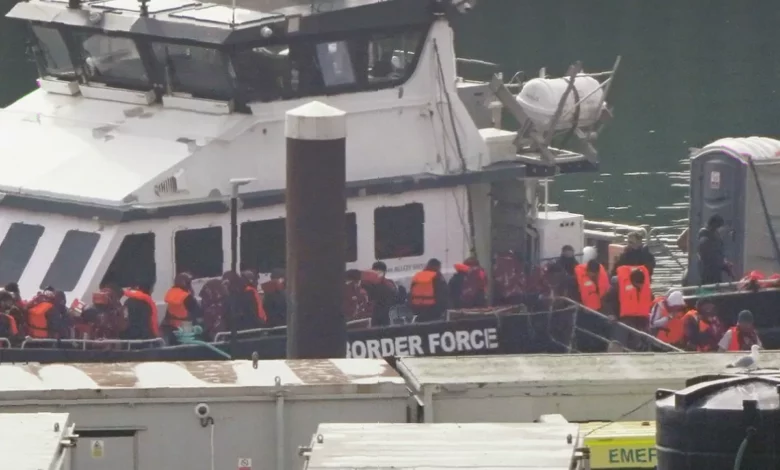
Drones were deployed by French authorities as part of a multi-agency rescue operation after a small boat carrying 82 migrants ran aground on a beach near Hardelot, south of Boulogne-sur-Mer, on Sunday 3 May 2026. Two women, believed to be in their twenties and from Sudan, died from suffocation or crushing caused by overcrowding, while 16 others were injured – three of them seriously, with burns from fuel pooled in the bottom of the boat. The engine had failed, leaving the vessel drifting before it grounded.
Drones deployed in Channel rescue operation
French authorities said in a statement that “all state services were mobilised” to respond, including the national gendarmerie, border police, aerial resources such as drones, the departmental fire and rescue service, volunteers from Civil Protection, and resources coordinated by CROSS Gris-Nez under the authority of the Maritime Prefecture of the Channel and the North Sea. A French maritime gendarmerie vessel rescued 17 people and brought them to Boulogne-sur-Mer, while the remaining 65 were still on board when the boat ran aground.
Key agencies and their roles
CROSS Gris-Nez – the Centre régional opérationnel de surveillance et de sauvetage – is the regional operational centre for surveillance and rescue in the Channel and North Sea region. It coordinates maritime security and rescue operations with the French Navy, Civil Protection, and volunteers from the SNSM (Société Nationale de Sauvetage en Mer). In 2022, CROSS Gris-Nez was the only one of France’s five such centres to possess a “sniffer” drone originally used to detect sulphur content in ship fuel; that same drone has also been used to assist migrant rescue operations. The Maritime Prefecture of the Channel and the North Sea exercises overall authority at sea, coordinating state action including rescue and the fight against illicit activities. Civil Protection volunteers provided on-scene support alongside fire and rescue services.
Third deadly incident in a month
Sunday’s deaths are the third fatal incident involving migrants attempting the Channel crossing in just over a month. In April 2026, two men and two women died while trying to board a boat off the northern French coast, and a man from Sudan was arrested in connection. The week before that, two other people died north of Calais. According to migrant aid group Utopia 56, at least 172 people have died at the French-UK border over the past three years, 123 of them at sea. Between 2018 and 2025, a total of 162 people died attempting Channel crossings, rising to 257 when other migration-related deaths – such as those involving attempts to board lorries bound for the UK – are included. More than 130 people are confirmed to have died in the northern French marine sector since 2018. 2024 was the deadliest year on record, with at least 69 deaths – higher than the total recorded between 2019 and 2023.
Crossing numbers and patterns
So far in 2026, over 6,000 migrants have reached the UK via the Channel – a 36% decrease compared with the same period last year, partly attributed to more unsettled weather. In 2025, around 41,500 people were detected crossing in small boats, a 13% increase on the previous year and the second-highest annual figure on record. For comparison, 2022 saw approximately 46,000 crossings. From 2018 to 2025, roughly 193,000 people were detected reaching the UK in small boats, and as of 1 May 2026 the Home Office has recorded 199,081 migrants who have crossed the English Channel since 2018. Citizens of Iran, Afghanistan, Iraq, Albania, Syria and Eritrea made up 65% of those crossing between 2018 and 2025. The vast majority claim asylum: in 2023, 95% of arrivals did so, and the asylum grant rate for small boat arrivals between 2018 and 2025 was 62%, higher than the overall applicant grant rate.
UK-France security deal
The latest deaths come weeks after the UK and French governments signed a new multimillion-euro, three-year deal in April 2026 aimed at reducing Channel crossings. Under the agreement, the UK will provide £662 million over three years, including £100 million that is performance-related and could be withdrawn if progress is not made. The funding supports five new police units: a riot squad of 50 officers trained in crowd control tactics, an additional 20 maritime officers to intercept what are known as “taxi boats” – dinghies that leave the shore nearly empty and pick up migrants wading into shallow water, a method that has led to people being swept away by currents – 12 intelligence officers, two helicopters, and a new camera surveillance system. The deal also includes plans for a “removal centre” for detention and deportation. In November 2025, the French government authorised interventions to halt small boats at sea before they pick up people, after pressure from Keir Starmer; French police have previously been observed slashing the sides of boats to prevent crossings. A “one in, one out” scheme was also announced, under which one person could travel legally to the UK for asylum in exchange for another irregular arrival being returned to France. Joint actions have prevented over 42,000 illegal migrants from crossing since the 2024 UK election, leading to the arrest of 480 smugglers in 2025. French officials have recently stopped six taxi boats, sentencing smugglers to prison and deportation. Separately, an Afghan national became the first person convicted under the new ‘Border Security, Asylum and Immigration Act’ for endangering others during a sea crossing.
Ongoing dangers and the authorities’ response
The Channel is one of the busiest shipping lanes in the world, with strong tides and changeable weather, making the crossing inherently perilous. Smugglers often use overcrowded, flimsy boats, leading to suffocation, crushing and burns from fuel. The absence of safe and legal routes for seeking asylum in the UK is cited by charities as a significant incentive for people-smugglers and a driver for migrants taking greater risks. The Maritime Prefecture of the Channel and the North Sea, working through CROSS Gris-Nez, continues to coordinate rescue efforts, with drones, maritime vessels, and ground teams deployed as part of the response authorised by French authorities.