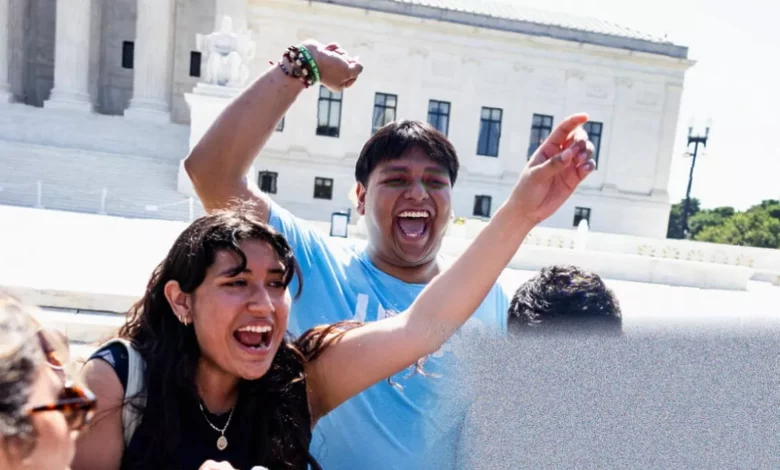
The US supreme court has upheld birthright citizenship, delivering a decisive blow to a central pillar of Donald Trump’s anti-immigrant agenda. In a 6-3 ruling, the court rejected the president’s executive order, issued on the first day of his second term, which sought to deny citizenship to children born in the United States to parents who are not citizens or lawful permanent residents. The majority opinion, authored by Chief Justice John Roberts, declared that “children born in the United States to parents unlawfully or temporarily present are ‘subject to the jurisdiction’ of the United States and are citizens at birth under the Fourteenth Amendment’s Citizenship Clause.”
The ruling in Trump v. Barbara – a class-action challenge brought by the American Civil Liberties Union on behalf of parents of affected children – upheld the principle that nearly everyone born on US soil is a citizen. Roberts was joined in the majority by liberal justices Sonia Sotomayor, Elena Kagan and Ketanji Brown Jackson, as well as the conservative justice Amy Coney Barrett. Justice Brett Kavanaugh concurred with the judgment but dissented in part, arguing that while the executive order did not violate the constitution, it contravened a federal statute. The conservative justices Clarence Thomas, Samuel Alito and Neil Gorsuch each filed dissenting opinions. The court’s writings on the case spanned 194 pages, with Thomas’s dissent alone running nearly 90 pages – the longest of his tenure.
Historical Context: The 14th Amendment and Precedent
The decision is rooted in the Citizenship Clause of the 14th Amendment, adopted in 1868 during the Reconstruction era after the US civil war. The amendment was a direct response to the supreme court’s infamous 1857 Dred Scott decision, which denied citizenship to Black people, ruling that they were “a separate class of persons”. In overturning that “odious” ruling, the 14th Amendment states: “All persons born or naturalized in the United States, and subject to the jurisdiction thereof, are citizens of the United States and of the State wherein they reside.”
The concept of birthright citizenship was first defined in the Civil Rights Act of 1866, passed to affirm the rights of Black Americans. The majority opinion walked through the evolution of citizenship from English common law through slavery and emancipation, and then into later efforts to undermine it, including the Chinese Exclusion Act. Chief Justice Roberts wrote that “citizenship, then and now, was the right to have rights – to freely participate in our political community. The Framers of the Fourteenth Amendment extended that promise to ‘every free-born person in this land.’ We keep that promise today.”
The ruling also reaffirms the landmark case United States v. Wong Kim Ark (1898), which held that a child born in the US to Chinese immigrant parents with permanent domicile was a citizen under the 14th Amendment. That case established that “subject to the jurisdiction thereof” excluded only children of foreign diplomats or enemy occupying forces. The US common law doctrine of jus soli – right of the soil – grants citizenship to those born within a nation’s territory regardless of their parents’ status, in contrast to jus sanguinis, which ties citizenship to bloodline. Native Americans were not initially included but were granted citizenship by the Indian Citizenship Act of 1924.
The Arguments and the Rejection of “Domicile”
The Trump administration argued that the phrase “subject to the jurisdiction thereof” implies a requirement of political allegiance, and that children born to parents unlawfully or temporarily present in the US do not possess that allegiance. Solicitor General D. John Sauer emphasised the concept of “domicile” – meaning permanent residence – and claimed that unrestricted birthright citizenship acts as a “pull factor” for illegal immigration and “birth tourism”. He argued that it “demeans the priceless and profound gift of American citizenship” and contradicts the practice of most modern nations.
The ACLU, represented by Cecillia Wang, countered that the 14th Amendment’s “fixed bright line rule has contributed to the growth and thriving of our nation” and that “everyone born here is a US citizen”. The majority found “scant evidence” for the administration’s “dramatically revisionist view” that domicile or primary allegiance was a necessary condition. During oral arguments in April, Chief Justice Roberts had described part of the government’s case as “very quirky”, and Justice Elena Kagan said the administration was using “pretty obscure sources”. In the final opinion, Roberts wrote that the court “exhaustively canvassed the text and history of the Citizenship Clause and at no point identified any evidence that the ratifiers thought themselves to be imposing a domicile limitation”.
Dissents and the Path Ahead
Justice Clarence Thomas, in his lengthy dissent, argued that the 14th Amendment was intended to secure rights for freed slaves and has been “repurposed for political projects that the Reconstruction Congress did not support”. He wrote that Black people were entitled to citizenship because they were Americans with “no other homeland” or allegiance to other nations, but that “the same could not be said for the children of foreign temporary visitors”, who “were attached to their home country” and would not be called upon in time of war.
Justice Samuel Alito, in his dissent, called the ruling “one of the most important” in the court’s history but said “the Court has made a serious mistake”. He raised the issue of “birth tourists” – women who come to the US solely to give birth – and argued that the 14th Amendment grants citizenship only to children who “owe allegiance solely to this country”. He suggested that Congress could address the situation of children born to parents not legally present, saying “Congress can and should address their situation. The Fourteenth Amendment dictates who must be a citizen, but it does not address who may be a citizen by Act of Congress.”
Justice Brett Kavanaugh, in his partial concurrence, wrote that he does not believe Trump’s executive order violates the 14th Amendment, but that it does violate a federal statute. He noted that Congress could amend the statute or create new legislation to establish exceptions to birthright citizenship for children born to parents without permanent legal status. “But Congress has not yet done so,” he wrote. Overturning a constitutional amendment would require a two-thirds majority vote of both chambers of Congress, or the legislatures of two-thirds of the states to call for a convention. President Trump shared an article on Truth Social alluding to a statutory process to upend birthright citizenship.
The administration relied in part on legal arguments from a white supremacist of the late 1800s, as reported by the Washington Post, and from John Eastman, a lawyer who worked with Trump to overturn the 2020 election and has since been disbarred in California, according to Politico. The supreme court’s decision marks the latest in a series of rulings against the president, who has repeatedly attacked courts and judges that side against him. In a concurring opinion, Justice Ketanji Brown Jackson wrote that the 14th Amendment’s “universalist aims should forever be the death knell for this kind of claim – one that seeks to make bloodline the marker of birthright”. She added: “Thankfully, a majority of the Court remembered this today, and has dutifully preserved the most basic animating principle of our Nation’s founding – that all human beings are created equal – once more.”