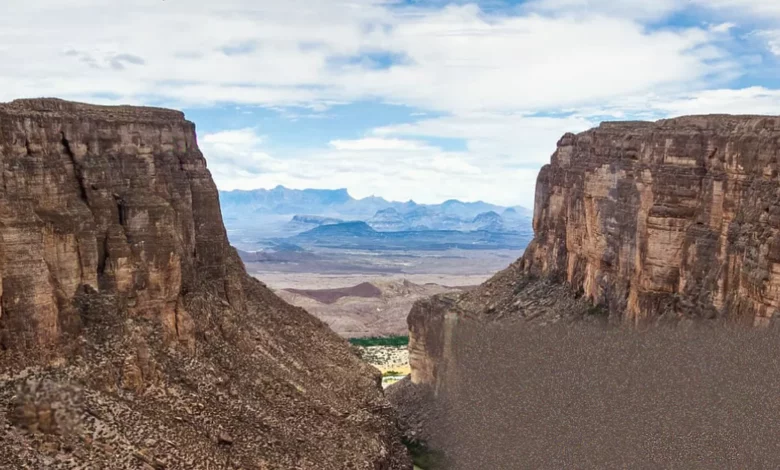
The Trump administration has waived a raft of federal environmental and historical preservation laws to clear the way for border security infrastructure – including a potential border wall – inside Big Bend National Park, a vast protected wilderness in south Texas that draws half a million visitors each year.
The Department of Homeland Security (DHS) published the waiver in the Federal Register on Tuesday, granting US Customs and Border Protection (CBP) authority to construct whatever security measures it chooses within the 800,000-acre park, from steel bollard fencing to unpaved roads, lighting and surveillance towers. The order sets aside protections enshrined in some of America’s most significant conservation statutes, including the National Environmental Policy Act, the Endangered Species Act, the Clean Water Act, the Clean Air Act and the Native American Graves Protection and Repatriation Act.
For a region that is home to several imperilled species – among them the black-capped vireo, the Mexican long-nosed bat, the Big Bend gambusia, the Rio Grande silvery minnow and the Chisos hedgehog cactus – the loss of environmental safeguards carries acute risk. The waiver also removes legal obligations under the National Wild and Scenic Rivers Act and the Archaeological and Historic Preservation Act, raising fears for Native American rock art, including petroglyphs and pictographs that date back thousands of years, which are concentrated in the park and its surroundings.
The Big Bend area supports struggling populations of bighorn sheep, black bears and mountain lions, all of which could see their movement pathways blocked by new barriers. Critics argue that the construction of roads and vehicle barriers would fragment wildlife habitat, damage roadless canyon country, impede public access to the Rio Grande and disrupt one of the darkest night skies in the United States – part of the world’s largest International Dark Sky Reserve – with artificial light from utility poles and surveillance cameras.
What the waiver allows: infrastructure plans inside the park
The only infrastructure project formally proposed within Big Bend National Park so far is a programme called “Big Bend 4”. It includes approximately 17 miles of non-contiguous vehicle barriers built from steel rails and posts measuring between four and six feet tall, sited in four separate locations along the park’s southern border. Two of those barriers sit in the middle of the park’s Rio Grande frontage, with one at each end. The project also envisions around 205 miles of roads up to 24 feet wide, equipped with detection technology, together with utility poles, lighting and surveillance cameras.
CBP has stated that it does not plan to erect a 30-foot-tall steel border wall inside Big Bend National Park or the adjacent Big Bend Ranch State Park. However, the waiver authorises the “full suite of border barrier infrastructure”, meaning the agency could later add fencing, higher barriers or additional elements without further environmental review. Bob Krumenaker, the former superintendent of Big Bend National Park who now leads the nonpartisan advocacy group Keep Big Bend Wild, said he viewed a 30-foot steel wall as an unlikely “worst-case scenario” but warned that the waiver’s sweeping language makes the agency unaccountable. “Waiving the law undermines all credibility and makes them completely unaccountable to anyone,” he said. “They don’t care about the impact on the environment. If they have, say, a fuel spill, they’re not subject to any laws – they’ve just waived the Clean Water Act and the Clean Air Act.”
Separate from the park plans, contracts totalling billions of dollars have been awarded for 30-foot-high steel bollard walls along a 175-mile stretch of the US-Mexico border in Hudspeth, Jeff Davis and Presidio counties, outside the protected areas.
Low crossing numbers and bipartisan backlash
The Big Bend sector of west Texas includes some of the longest unwalled stretches on the southern border and is among the most remote, characterised by steep cliffs and vast expanses of Chihuahuan desert on both sides of the Rio Grande. DHS justified the waiver as an emergency measure needed to contain illegal crossings, but the area has historically recorded the lowest number of unauthorised border crossings on the entire frontier. Within Big Bend National Park itself, Border Patrol made only 100 arrests in 2023 and 125 in 2024, according to data obtained by Krumenaker. Those numbers are thought to have continued falling after President Trump returned to office in 2025 and his administration dismantled humanitarian protections and ramped up enforcement. The park accounted for just 0.045 per cent of total nationwide apprehensions in 2025.
The prospect of scarring a beloved landscape in the name of border security has drawn fierce opposition from a bipartisan coalition that includes local leaders, ranchers, environmentalists and even some Republicans. Six former superintendents of Big Bend National Park have urged federal officials not to bypass environmental protections. Representative Henry Cuellar, a Texas Democrat, attempted to block DHS from using funds from the so-called “Big, Beautiful” bill – which Congress loaded with $46.5bn for border wall construction last year – to build barriers inside the park. His measure failed in an appropriations committee vote on Tuesday amid Republican opposition.
Representative Lloyd Doggett, also a Texas Democrat, called the waiver “ludicrous” in a region where illegal crossings are already rare. “Billions of taxpayer dollars are being wasted on this unnecessary project,” he said in a statement. CBP commissioner Rodney Scott told the Washington Examiner last month that it would be “kind of silly to put like a 30-foot border wall on top of a 90-foot granite cliff”. The cliffs of the park’s Santa Elena canyon, he noted, are composed of limestone and reach heights of 1,500 feet.
Tourism is vital to the Big Bend economy: the park welcomed approximately 509,129 visitors in 2023, with visitation peaking at over 581,000 in 2021. In 2022, tourism spending in the area reached about $191.6m, contributing $264.7m in total economic output and supporting around 2,580 jobs. By 2024, the park contributed an estimated $64m directly to the local economy. Critics fear that restricting access to the Rio Grande and diminishing the park’s wild character could damage that essential revenue stream.
Legal challenge targets waiver’s constitutionality
The waiver has already provoked a legal challenge. Friends of the Ruidosa Church, river guide Billy Miller and the Center for Biological Diversity have amended an existing lawsuit against DHS that was originally filed in April 2026, challenging the agency’s use of border wall-related waivers in the Big Bend sector. The amended complaint specifically targets the national park waiver, arguing that it violates the National Park Service Organic Act, which requires that parks be preserved unimpaired for future generations.
The lawsuit contends that DHS overstepped its authority by waiving laws without clear congressional approval, violating a constitutional provision that demands legislative consent for actions with vast economic and political consequences. The plaintiffs also argue that the “national emergency” cited to justify the waivers is a pretext, given the historically low arrest data for the Big Bend sector. In addition, the Center for Biological Diversity and the Texas Civil Rights Project have filed separate Freedom of Information Act lawsuits to obtain public records about construction plans, after CBP refused to release information.
“This is an attack on the integrity of the National Park Service itself,” said Laiken Jordahl, a national public lands advocate with the Center for Biological Diversity. “They have never waived these laws on a national park itself. If they’re willing to do this in a national park, where virtually no one is crossing the border, where won’t they?”