For all the assurances of body diversity that preceded its release, The Devil Wears Prada 2 quickly reveals that its jokes about weight are not a sign of progress but a reflection of an industry that has barely moved on. The sequel’s punchlines land on the laughometer, but the laughs are hollow — and they speak volumes about how little has actually changed in the two decades since the original film.
A Sequel’s Broken Promises
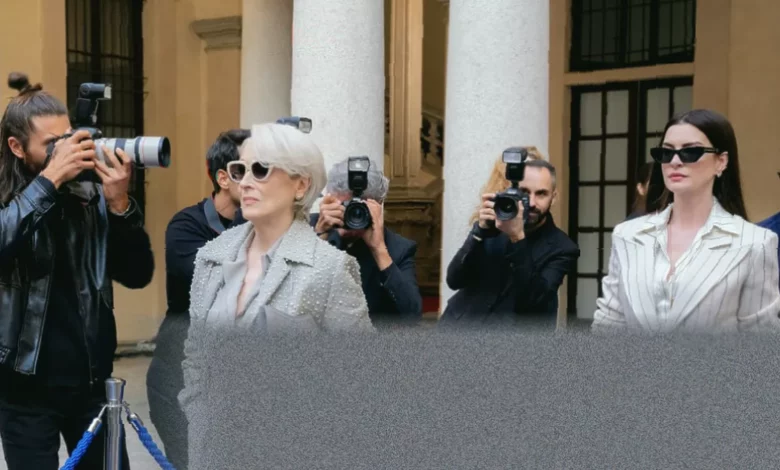
During the film’s global press tour, Meryl Streep and Anne Hathaway repeatedly suggested that the long-awaited follow-up would champion body inclusivity. Both actors said they were surprised by how “alarmingly thin the models were” during Milan fashion week. Hathaway made “a beeline to the producers”, according to Streep, to ensure that “skeletal” models would not feature. At one premiere, Hathaway said she “thought the scene would be so much more enjoyable for the audience if we had just a wider range of bodies on display”.
Yet only 15 minutes into the sequel the first weight gag lands, and it becomes clear that all the chatter was little more than size-washing. The film ticks the inclusivity box just enough — casting comedian Caleb Hearon as Miranda Priestly’s second assistant, and offering a quick glimpse of a couple of plus-size models, including Ashley Graham, in a catwalk montage — but not enough for any real credibility. There are several wisecracks about weight, though remarkably only one reference to the weight-loss drug Ozempic. As one critic put it, the film is “deeply sad, even angry”, and for the journalist class it can feel like “an apocalyptic horror flick”.
The original The Devil Wears Prada arrived at the height of noughties diet culture, when body-shaming was the norm and celebrities’ bodies were dissected on magazine covers. Emily Charlton’s line — “I’m just one stomach flu away from my goal weight” — became a cultural shorthand for the era’s obsession with thinness. The new film nods to that legacy: Andy Sachs describes herself as Miranda’s “former fat assistant”, a reference to the first film’s “smart, fat girl” remark. For the original role, Hathaway — a US size 4 — wore a padded size‑6 bum prosthetic until her character’s “size‑6 ass” dropped to a size 4. This time there is no need: Andy has kept the weight off for two decades while becoming an award‑winning journalist.
The Weight-Loss Drug Effect and a Return to Thinness
The fashion industry’s trajectory since the original film seemed to promise change. In 2017, Ashley Graham became the first plus-size model to feature on the cover of Vogue. In 2020, Jill Kortleve walked for Chanel as the first model above a UK size 8 to be cast by the house in a decade that same season she also modelled for Fendi and Valentino. In April 2023, British Vogue placed Kortleve alongside Paloma Elsesser and Precious Lee on its cover under the headline “The New Supers”.
But that progress has already reversed. A model agency founder warned in 2024 that the industry had “done a 360 turn” back to promoting thinness. A report by Vogue Business in March 2026 found that out of 7,817 looks presented across 182 womenswear shows, 97.6% were on straight-size models measuring between UK sizes 4 and 8. Only 0.3% were plus-size (UK 18+), while 2.1% were mid-size (UK 10‑16). On the high street, the picture is similarly bleak: a UK watchdog last year urged retailers to avoid “irresponsible” images of unhealthily thin-looking models, and brands such as H&M have removed dedicated plus-size sections from stores, making the ranges available online only. H&M first moved in that direction as early as 2016, a decision that drew criticism given its simultaneous campaigns featuring plus-size models like Ashley Graham.
Multiple factors — from right‑wing gender politics to shifting ideals of the female body — have been cited, but the widespread use of weight-loss drugs is a major catalyst. GLP‑1 medications, originally developed to treat diabetes, have been co‑opted for weight loss, particularly in Hollywood. By September 2025, around 23% of US households were using GLP‑1 medications, according to survey data. The New England Journal of Medicine reported that patients on Wegovy experienced an average weight loss of approximately 15% over 68 weeks. Bernstein analysts estimate that GLP‑1‑related wardrobe changes could generate up to $13 billion in increased annual apparel spending in the US. Already, 55% of users have purchased new clothing or footwear because of size changes, and 80% anticipate needing new clothes.
The impact on the retail sector is tangible. Plus-size retailers are struggling: Torrid reported a 14.3% year‑over‑year sales decline in the final quarter of 2025 and plans to close 30 stores in early 2026; DXL posted a 6% drop. Meanwhile, demand for activewear and athleisure is expected to rise as users embrace exercise, and some analysts predict that shoppers losing weight may gravitate toward cheaper clothing, benefiting off‑price chains such as TJX and Burlington Stores. The fashion press itself has taken note: Edward Enninful’s debut issue of 72 magazine featured an unbranded GLP‑1 medication pen in a beauty shoot.
For many on the red carpet, the body rather than the designer outfit has become the new status symbol. Monday night’s Met Gala, themed “Fashion is Art” and co‑chaired by Beyoncé, Nicole Kidman, Venus Williams and Anna Wintour, encourages guests to “express their own relationship to fashion as an embodied art form”. The accompanying exhibition, “Costume Art”, explores the dressed body across centuries and includes categories for the “Pregnant Body” and the “Aging Body” — categories that stand in stark contrast to the industry’s narrowing ideal.
In this context, the sequel’s weight jokes feel less like satire and more like a dispiriting echo. Miranda Priestly, puffing out her cheeks to accentuate chubbiness, confuses “body positivity” with “body negative”. “What is there to be positive about?” she asks. The question hangs in the air, unanswered — because, for all the talk of progress, the answer is still painfully clear.