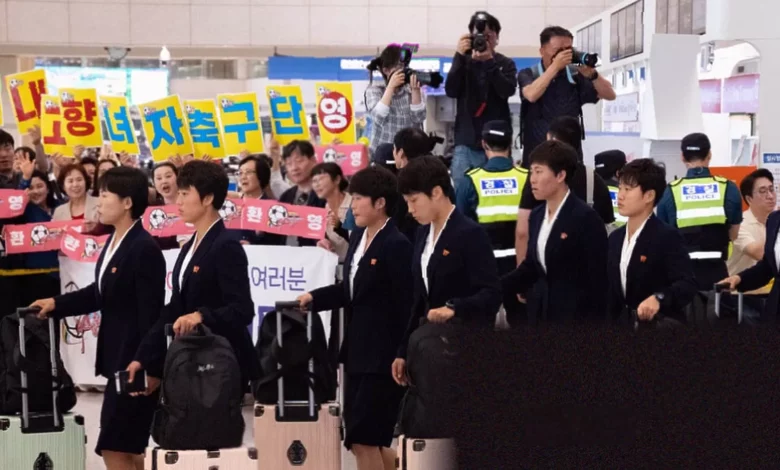
A North Korean women’s football club has arrived in South Korea for an Asian Football Confederation (AFC) Women’s Champions League semi-final, the first time athletes from the isolated state have crossed the border for a sporting fixture in eight years. The delegation of 27 players and 12 staff touched down at Incheon International Airport on Sunday via an Air China commercial flight from Beijing, where the squad had been training since 13 May.
The visitors made no comment as they were greeted by media and supporters at the airport, with around 50 security guards present and a police escort accompanying the team bus to their accommodation in Suwon. Both Naegohyang FC and their South Korean opponents, Suwon FC Women, are staying at the same hotel but, according to local reports, will use separate dining areas and travel routes to limit direct interaction.
Match context and public enthusiasm
Wednesday’s semi-final at Suwon Stadium kicks off at 7pm local time (10am GMT). The winner will face either Melbourne City or Nippon TV Tokyo Verdy Beleza in Saturday’s final. Naegohyang have already beaten Suwon FC Women in the group stage, winning 3-0 on 12 November 2025. The AFC Women’s Champions League, now in its second year as Asia’s top women’s club tournament, offers $1m to the champions and $120,000 to semi-finalists, with runners-up taking $500,000.
Public interest has been intense: all 7,087 tickets made available to the general public sold out within a day, according to South Korea’s football federation, cited by Yonhap news agency. The match will not feature national anthems or political symbols, including the Korean Unification flag – the white flag bearing a blue silhouette of the peninsula often used to represent unity in international fixtures involving both Koreas – in line with AFC rules.
Political significance amid strained relations
The visit carries outsized diplomatic weight because it comes after years of escalating rhetoric from Pyongyang. North Korean leader Kim Jong-un has recently declared South Korea the “most hostile state” and ruled out reunification of the peninsula, defining inter-Korean ties as a “hostile wartime relationship”. The last time North Korean athletes travelled to the South was in December 2018, for the International Table Tennis Federation World Tour Grand Finals in Incheon.
By contrast, South Korean President Lee Jae-myung, who took office in June 2025, has repeatedly called for improved ties. His government approved the North Korean team’s entry under the Inter-Korean Exchange Law, though officials have been careful to limit the state’s role because the fixture is an international club competition. Seoul’s Ministry of Unification said it will provide logistical support for the visiting team.
The Unification Ministry has also allocated 300m won (approximately $202,000) from the Inter-Korean Cooperation Fund to support a cheering squad for both sides, citing the event’s potential to promote mutual understanding. Unification Minister Chung Dong-young – who previously held the role from 2004 to 2005 under President Roh Moo-hyun and played a part in establishing the Kaesong Industrial Complex – is considering attending the match, according to South Korean media. Chung has recently proposed redefining inter-Korean relations as coexistence between two states and a private meeting with Kim Jong-un has been mooted.
A spokesperson for South Korea’s ruling Democratic Party acknowledged the limits of a single sporting encounter, saying: “It may be difficult to hope for a complete thaw in strained relations by this one-time visit.” The spokesperson nonetheless vowed to “make efforts to open the door for exchanges and dialogue”, adding: “We hope it will serve as an opportunity to tear down high barriers between the South and the North.”
Background and logistics
Naegohyang FC, founded in 2012, are the reigning champions of North Korea’s top-flight women’s league (2021–22 season). The club’s name translates to “My Hometown” in Korean. North Korea has historically invested heavily in women’s football as a means of international prestige – its youth teams have won multiple U-20 and U-17 world titles, and the senior national side has claimed the AFC Women’s Asian Cup three times. However, the North was banned from the 2015 FIFA Women’s World Cup over doping allegations.
South Korean women’s football, meanwhile, developed more slowly, with the WK League established only in 2009, though the national side has qualified for five World Cups.
The North Korean delegation’s stay is approved until next weekend, but the Ministry of Unification said the team could leave earlier if eliminated. Should Naegohyang lose Wednesday’s semi-final, they are expected to return home the following day. Naegohyang are scheduled to hold an official training session and press conference on Tuesday, the eve of the match.