
Inequality across the UK population as a whole has barely budged since the 1990s, yet the very richest have continued to pull away – a pattern that has left the country with a stubbornly high level of disparity by historic and international standards, according to a major new study from the Institute for Fiscal Studies.
The origins of the inequality project
The findings form the backbone of Challenging Inequalities: How We Got Stuck and Where We Go Next, a book co-authored by Paul Johnson, the IFS’s former director, alongside James Banks, Tim Besley, Richard Blundell, Nobel Laureate Angus Deaton, Robert Joyce and Debra Satz. It is the culmination of a six-year interdisciplinary project that began in 2018 and produced more than 100 papers, each examining a different facet of the inequality puzzle – from ethnic and wealth disparities to health and education gaps.
Johnson, who led the IFS between 2011 and 2025 before becoming Provost of Queen’s College, Oxford, explained that the project was overseen by a committee chaired by Deaton. “The idea was to highlight key issues in something approaching a narrative,” he said.
Measuring inequality: a plateau with peaks
Using standard measures such as the Gini coefficient, income inequality across the whole population has been largely flat since the 1990s. But that headline masks a far more concentrated picture at the top. The share of income controlled by the top 1 per cent and the top 0.1 per cent continued to rise until roughly 2008. Since then, overall income inequality has edged down very slightly – but it remains at a level that is extremely high both historically and when placed alongside other developed economies.
Johnson pointed out that while raw income inequality may have peaked, other forms of division have become more pronounced. “Other types of inequality have become more significant, including gaps between regions and generations,” he said. Younger people, he noted, are no longer able to expect that they will do better than their parents, particularly as house prices have risen far faster than earnings.
The study argues that the prolonged economic stagnation that followed the 2008-09 financial crisis did not create these inequalities but exposed and deepened them. Progress in reducing health inequalities and in addressing gender, ethnic, geographic, age and educational disparities has also stalled, the authors contend.
Why redistribution isn’t enough: the case for ‘pre-distribution’
The book deliberately avoids the traditional policy prescription of tweaking taxes and benefits to redistribute income after the market has done its work. “We made a conscious decision that the book wasn’t going to go down the traditional route of suggesting how you could tweak taxes and benefits to reduce inequality, partly because the IFS has already done a huge amount of work on that,” Johnson said. He acknowledged that there are ways of making the tax and welfare system more redistributive, but argued they come with a significant cost: weaker incentives to work and invest.
Instead, the central idea is “pre-distribution” – an approach that aims to shape the economy so that it produces fairer outcomes in the first place, leaving less to tidy up afterwards. The concept rests on the finding that people place far more value on money they have earned themselves and on having a decent job than they do on receiving handouts. Therefore, Johnson argues, the priority should be to create an economy that works better for everybody, particularly by boosting productivity growth.
The policies the book advocates for include investment in early years education, support for family life, and a major expansion of housebuilding. It also calls for tougher regulation of large companies, whose market power has allowed them to capture a growing share of economic rents. “We need to find a way that creates the sort of economy that works better for everybody. While that’s easy to say and hard to do, it leaves less to tidy up afterwards,” Johnson added.
The authors also examine the role of globalisation, free trade and immigration. These forces generally boost economic growth, they note, but if taken too far they can undermine their own positive impact by increasing inequality. On immigration specifically, Johnson said the UK’s policy has been “all over the place”. Despite promises of a points-based system that would prioritise highly skilled workers, large numbers of people continue to arrive as family members without having to demonstrate particular skills. A significant number also entered on care-worker visas, a route that Johnson said was widely exploited. “Of course, if we do restrict this type of immigration, then we’re going to be paying more for these types of services,” he warned.
The demographic reality adds further pressure. The total fertility rate in England and Wales has fallen to a record low of 1.41 children per woman, well below the replacement rate of 2.1. The UK’s overall fertility rate stood at 1.56 in 2023, and without net migration the population would start to decline. Net migration has accounted for 99 per cent of population growth since 2020, with revised data showing 2.55 million net arrivals between 2021 and 2024 – meaning one in every 25 people in the UK has arrived in the last four years.
The wider economic picture: stagnation, Brexit and low investment
The book’s analysis of pre-distribution is set against a backdrop of two decades of weak growth, which Johnson identified as the primary reason voters have turned away from mainstream political parties. “The main cause of the move away from the centre is probably the lack of growth over the last 20 years,” he said. “However, the two factors interact very strongly. Not only are people fed up because they haven’t seen their living standards rise for quite a long time, but they are also angry because some people are a lot richer than they are.”
The UK economy has grown significantly less than other developed nations over the past 15 to 20 years. Johnson cited several causes: the country’s heavy dependence on financial services when the 2008 crash struck; the damaging impact of Brexit, which estimates suggest has reduced GDP by between 6 and 8 per cent by 2025, with investment down by 12 to 18 per cent and productivity by 3 to 4 per cent; a long record of underinvestment, both private and public; planning and regulatory policies that make it extremely difficult to build anything; and a period of political chaos that has seen repeated changes of prime minister and policy direction. “You can’t pin it on any one problem, but all these factors, in addition to the general political chaos, will have played a part,” he said.
The risk, Johnson added, is that the economy becomes trapped in a vicious cycle: stagnation fuels disillusionment, which produces political instability, which in turn deters investment and deepens the stagnation. “You can definitely get locked into a terrible vicious cycle of this kind,” he warned.
Artificial intelligence, he said, could be a double-edged sword. While it may boost productivity, the gains are unlikely to be shared evenly. In the United States, the technology revolution has already concentrated economic rewards in a small number of highly profitable companies that, through a combination of high pay and share options, have disproportionately benefited a tiny elite. “I think there’s clearly a risk of that,” Johnson said.
Fiscal pressures and the future of the state
Looking ahead, Johnson identified the most significant fiscal challenge as the unprecedented growth of the British state. Over the past decade, the share of national income taken in taxation has risen by between 5 and 6 percentage points – a change he believes will be the defining feature of this period. “I think that what people will remember when they look back at this decade isn’t going to be Covid or the energy crisis, let alone the mini-Budget, but rather that the British state grew to an extent that is totally unprecedented,” he said.
These pressures are set to intensify. The government has committed to raising defence spending to 2.5 per cent of GDP by 2027, with an ambition to reach 3 per cent by 2034 – the biggest sustained increase since the Cold War – which alone will require an additional £30 billion of expenditure. Health spending is rising relentlessly because of an ageing population, and the triple lock on state pensions – which guarantees annual increases by the highest of inflation, average wage growth or 2.5 per cent – is estimated to cost the exchequer around £12 billion more each year than if pensions were simply uprated by earnings.
Given the size of the existing debt pile, meeting these commitments through further borrowing will be difficult. “Previous borrowing [is] coming back to bite us in the form of debt-interest payments,” Johnson noted. The UK’s fiscal position is worse than the average OECD country, although its debt-to-GDP ratio is not above the G7 average. Yet the country pays more to service its debt than France does, even though France carries a larger debt burden. Johnson attributed this to the UK’s higher inflation over an extended period and lower market confidence in its ability to turn things around.
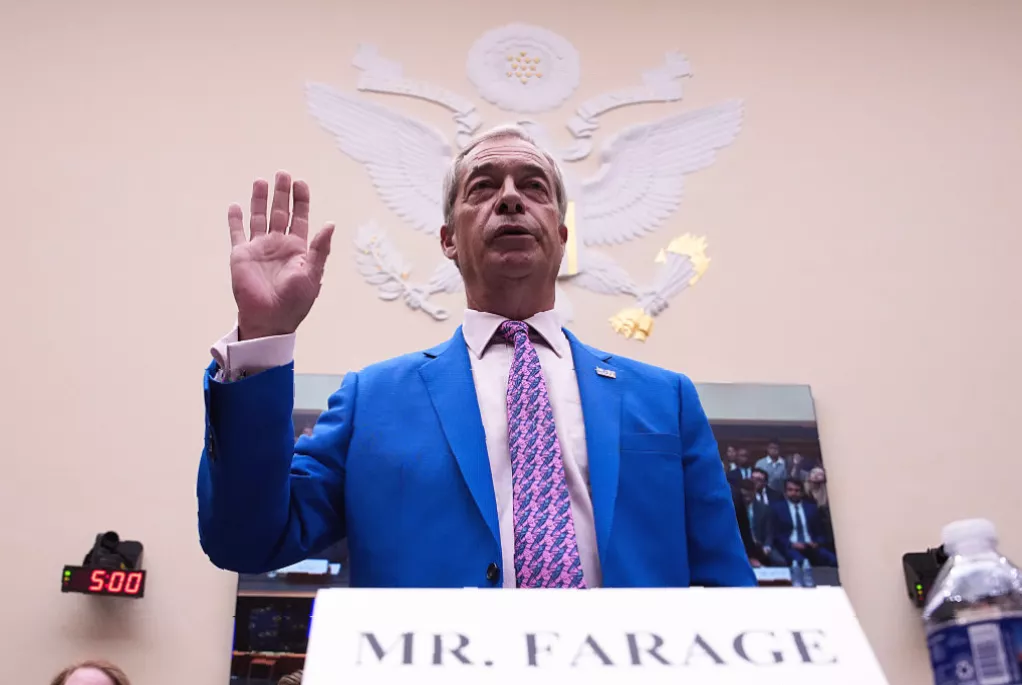
On economic forecasting, Johnson defended the Office for Budget Responsibility, which was created to remove political interference from Treasury forecasts. “The whole point of the OBR was to get the government out of the forecasting business – because it was pretty clear that the Treasury’s forecasts were politically manipulated – and hand it to an independent body,” he said. Despite being accused of pessimism, the OBR has actually been slightly too optimistic on average over the past 15 years. Nigel Farage has suggested scrapping the body, but Johnson made clear he considers such a move unwise. “I’m now confident that the forecasts are honest and not manipulated,” he said.