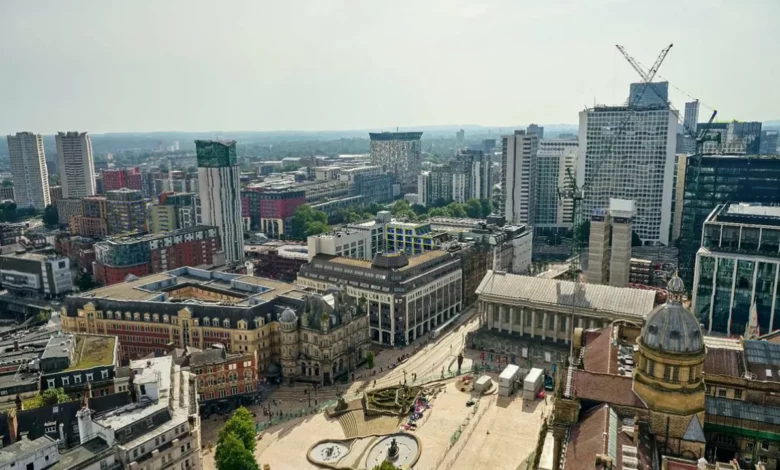
Against a backdrop of recent financial turmoil and industrial strife, a new European study has identified Birmingham as a city on the up, crediting its distinct identity and tangible momentum for a rising profile across the continent.
The annual “Most Talked About Cities” report from consultancy ING, which analyses online mentions across news, digital media and social platforms, ranks Birmingham as one of the ten fastest-rising cities in Europe for 2026. The city climbed two places in an expanded field of 70 cities, now sitting 27th overall and ahead of capitals like Prague and well-known hubs such as Oslo, Copenhagen and Rotterdam.
Lucie Murray, head of cities at ING, said Birmingham’s climb “reflects a city that’s actively reshaping both its reality and its reputation.”
A City ‘Reshaping its Reality’
The report, which uses online visibility as an indicator of a city’s potential to attract tourism, investment and business, highlighted several core strengths. It praised Birmingham’s “vibrant” cultural scene, a “well-defined” civic identity rooted in “pride, resilience and a long lineage of creativity,” and clear signals of ambition for the future.
“Major city centre reconfiguration, new public spaces and better integrated transport are bold signals of intent and momentum to the outside world,” the ING report stated. This urban transformation is occurring in parallel with major infrastructure projects, most notably HS2, where over 2,000 concrete piles have already been completed for the foundations of the new Curzon Street station, a landmark design inspired by Victorian railway architecture.
The report also pointed to the city council being back on a “stable financial footing” as a positive sign, following a period of severe strain. Birmingham City Council issued a Section 114 notice in September 2024 due to potential equal pay liabilities but reached a landmark settlement for historic claims in October 2025, agreeing to compensate women for years of underpayment. Council leader John Cotton has stated the worst of the financial crisis is receding, though the council has already paid out £1.1 billion to settle claims.
Cultural Identity and Economic Ambition
ING’s analysis drew a direct link between Birmingham’s global cultural impact and its rising profile. It cited the passing of Ozzy Osbourne in July 2025 as an event that brought the city’s identity into “sharp focus,” sparking global tributes and renewed attention on its musical heritage. Osbourne posthumously received Birmingham’s Lord Mayor’s Award in December 2025, further cementing his legacy.
This cultural vibrancy, which research indicates 92% of local adults see as central to the city’s international identity, operates alongside a concerted drive to grow key economic sectors. The city is establishing a world-class life sciences hub centred on the Birmingham Health Innovation Campus (BHIC), which aims to create 10,000 jobs. The region’s life sciences sector already has a turnover of nearly £5 billion annually, part of a wider West Midlands healthcare and life sciences economy worth £10.3 billion.
Similarly, the city’s heritage in manufacturing is evolving into advanced manufacturing, supported by hubs like the Aston Advanced Manufacturing Hub, while the creative industries are being fuelled by initiatives like the CreaTech Frontiers project launched in April 2025.
Ahead of local elections in May, Council leader John Cotton pointed to these growth industries as the path forward. “We know we’ve got problems when it comes to unemployment,” he said, “That’s the bit we’re going to now focus on fixing, creating those pathways to those jobs in the growth industries – whether it’s life sciences, creative industries, advanced manufacturing.”
The Road Ahead
Despite the optimistic report and stated ambitions, significant challenges remain. The council faces ongoing industrial action by bin workers, a strike that has run for a year and is set to continue through the spring and summer of 2026. The upcoming local elections are predicted to be volatile, with analysts suggesting no single party may win an outright majority.
Yet the ING report suggests a narrative shift is underway. Damian Wild, managing director at ING, noted: “In a year when competition intensified and many cities fell back, Birmingham moved forward… After a period caught in the headlines for the wrong reasons, the focus is finally focusing on the city’s many strengths, and rightly so.”
Europe’s top ten most talked-about cities in the 2026 ranking are Paris, London, Madrid, Rome, Milan, Barcelona, Berlin, Amsterdam, Brussels, and Valencia. Other UK cities featured strongly, with Manchester and Liverpool at 11th and 14th respectively, while Birmingham’s fellow fast-risers included Manchester, Porto, Munich, Budapest and Hamburg.