Government borrowing exceeded expectations by £4.9 billion last month, official figures have revealed, piling fresh pressure on Chancellor Rachel Reeves as the Iran war drives up inflation and slows economic growth.
The Office for National Statistics (ONS) reported that public sector net borrowing reached £24.3 billion in April – the second-highest April figure on record, beaten only during the Covid-19 pandemic. The total was £3.4 billion above the £20.9 billion forecast by the Office for Budget Responsibility (OBR), the UK’s independent fiscal watchdog.
The current budget deficit – which strips out investment spending – stood at £17.4 billion for the month, also £2.6 billion more than the OBR had predicted and £3.4 billion higher than a year earlier.
Record debt interest costs fuel the surge
At the heart of the borrowing overshoot lies an explosion in the cost of servicing the national debt. Interest payments on government debt hit a record £10.3 billion in April – £900 million more than in the same month last year. The rise is largely a consequence of high inflation feeding through to index-linked gilts: the capital uplift on those bonds added £2.9 billion to central government interest payable last month alone.
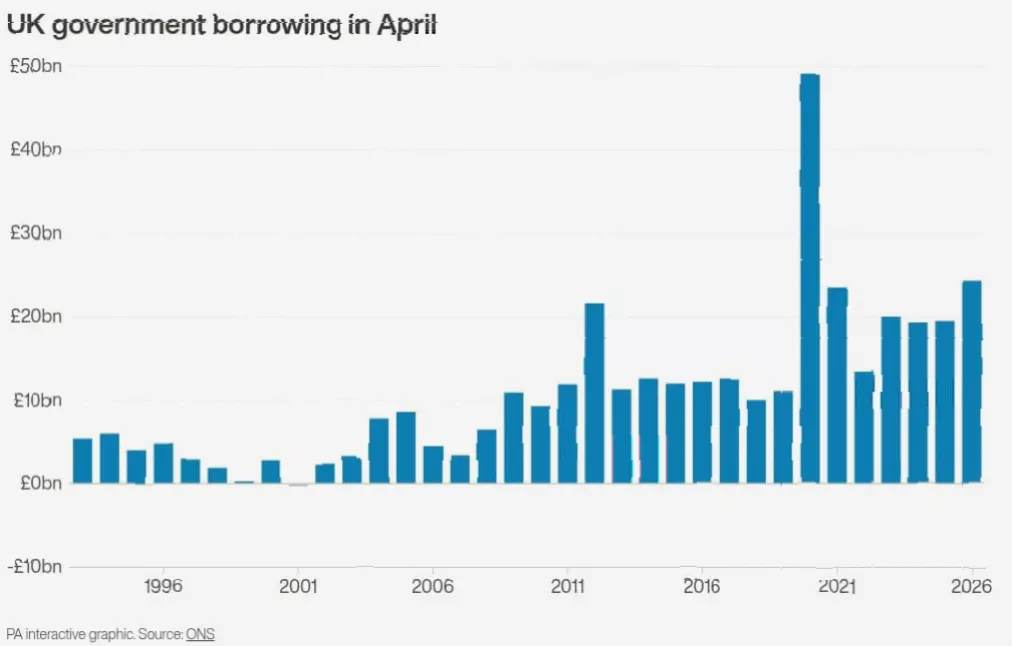
Grant Fitzner, the ONS’s chief economist, said: “Borrowing this month was substantially higher than in April last year and although receipts increased compared with April 2025, this was more than offset by higher spending on benefits and other costs.”
Net social benefits paid by central government increased by £2.7 billion to £29.5 billion in April, driven by inflation-linked rises in welfare payments and earnings-linked increases to the State Pension. Central government’s current expenditure rose by £6.2 billion overall compared with a year ago, with spending on goods and services up £1.7 billion as inflation pushed up prices.
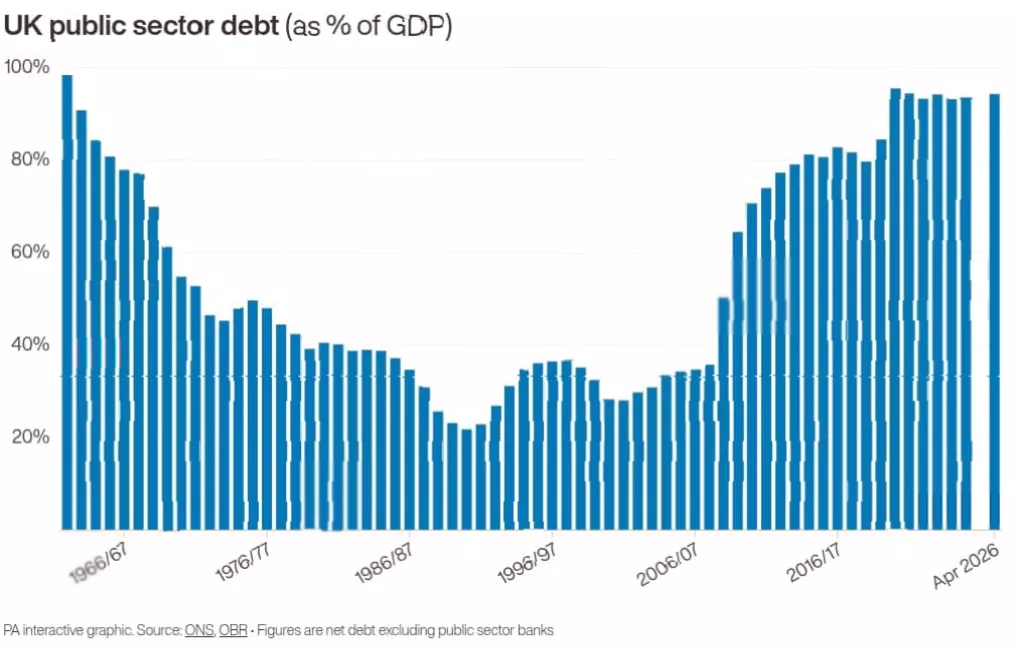
The ONS also revised down borrowing for the financial year to March 2026 by £3 billion to £129 billion – a figure still £22.8 billion lower than the previous year and the lowest since the year ending March 2020 when measured as a share of GDP. Public sector net debt stood at £2.94 trillion, or 94.2% of gross domestic product, 0.5 percentage points higher than a year ago and a level not seen since the early 1960s.
Iran war and political turmoil deepen the strain
The Chancellor is confronting the fallout from the conflict in the Middle East, which has disrupted oil and gas supplies and pushed up energy prices. The OECD has slashed its UK growth forecast for 2026 from 1.2% to 0.7%, while the International Monetary Fund (IMF) has warned that the war is dampening near-term prospects, even though it upgraded its 2026 projection slightly to 1.0% on the back of strong pre-war momentum.
Britain’s unemployment rate rose to 5% in the three months to March, and job vacancies have fallen to a five-year low – early signs of the conflict’s toll on the labour market. A preliminary UK Composite Purchasing Managers’ Index for May dropped sharply to 48.5, indicating a contraction in business activity for the first time since April 2025, with firms citing rising energy prices, shipping delays and political uncertainty.
Although the April inflation figure fell to 2.8% – helped by a 7% reduction in the energy price cap – experts expect inflation to surge when the cap resets in July, reflecting higher global energy costs. Inflation is projected to peak at just below 4% by the end of this year.
Political instability is compounding the economic headache. Prime Minister Sir Keir Starmer is facing a leadership challenge after poor local election results, with dozens of Labour MPs calling for his resignation and several ministers stepping down. Potential successors including Wes Streeting and Andy Burnham are being discussed. Bond investors have grown nervous: yields on UK government bonds – gilts – have hit levels not seen for decades, with the 10-year yield soaring. Pantheon Macroeconomics estimates that political risk alone has added 20 to 40 basis points to gilt yields.

Experts warn of deeper fiscal damage ahead
Rob Wood, chief UK economist at Pantheon Macroeconomics, warned that the debt interest bill could climb far higher. “We estimate that debt interest costs in 2026/27 will be about £15 billion higher than assumed in the budget if gilt yields hold at current levels for the rest of the year,” he said. “Headroom against the fiscal rules would be cut by closer to £10 billion if half the rise in yields since the budget is sustained until 2029-30. As best we can tell, political risk has added 20 to 40 basis points to gilt yields and we suspect will keep borrowing costs more elevated than they otherwise would be this year.”
Matt Swannell, chief economic adviser to the Item Club, said the government probably has enough margin for error to absorb the direct effects of the Middle East conflict, but cautioned that domestic politics poses a greater danger. “The UK’s current political situation means that continued fiscal slippage remains a risk, either via Prime Minister Keir Starmer’s attempts to regain popularity or from a successor implementing more costly economic policies.”
Chief Secretary to the Treasury Lucy Rigby defended the government’s record, saying: “We are cutting borrowing and debt – with our actions reducing Government borrowing by over £20 billion last year – while driving growth through £120 billion of additional capital investment over the Parliament. Working families have benefited from falls in inflation and cuts to interest rates – and our non-negotiable fiscal rules will be all the more important to continue to protect them as we face the consequences of the war that we have played no part in.”