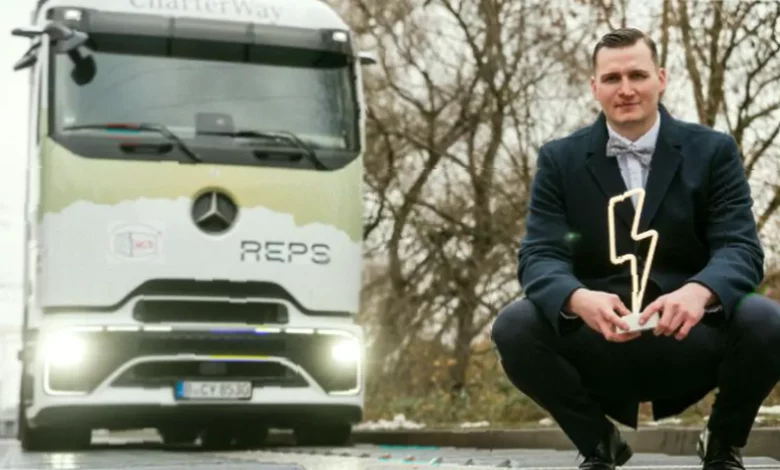
Austrian startup REPS, which has developed a system to turn road traffic into electricity, has raised $23.6 million in equity financing.
Funding secured
The company, founded in 2023 by Alfons Huber, has not disclosed the lead investor behind the latest round. According to PitchBook, its previous backers include German accelerator EWOR, Spain’s Clean Cities ClimAccelerator and Austria’s Greenstart. Huber himself was selected for the EWOR fellowship programme, with REPS ranked among the top 35 of 35,000 applicants.
Elisabeth Zehetner, Austria’s State Secretary for Energy, Startups and Tourism, praised the startup as an example of home-grown innovation. “They don’t just make small adjustments; they transform entire systems,” she said. “A road becomes a power plant, and existing infrastructure becomes a building block for a sustainable future.” Zehetner added that it is the government’s role to ensure “innovation is financed, developed, and scaled here in Austria and Europe instead of eventually returning to us as an import from the U.S. or Asia.”
REPS currently employs 12 people and expects to reach 50 by the end of the year.
The road power plant
The core of REPS’s technology is a patented mechanical energy converter, which the company calls a Road Energy Production System. Installed directly into existing road surfaces, the system uses hydraulic triggers to capture kinetic energy when vehicles drive over it, particularly when they naturally slow down or brake. That captured energy is then converted into electricity via a magnet-based generation system.
REPS claims its technology is far more efficient than existing energy-harvesting alternatives. Alfons Huber, the founder and CEO, said: “What differentiates us is the energy converter technology. Existing energy harvesting systems have historically failed due to low efficiency, short lifespan, and poor economic viability. To solve this, we had to reinvent the mechanical energy converter from the ground up, resulting in a system that is 254x more efficient than the next-best alternative currently on the market.”
The company further claims efficiencies of over 90%, and states that its system is 13,000 times more efficient than piezoelectric technologies and 254 times more efficient than dynamo-based systems. Unlike solar or wind power, REPS operates independently of weather and time of day. The system is also engineered for durability, designed to last more than 20 years under continuous heavy vehicle traffic.
Huber’s path to the invention was unconventional. He reportedly self-financed six years of research, working multiple jobs to fund his work and even dismantling his washing machine for an early prototype. His efforts led to a globally granted patent for the energy-harvesting mechanism.
From Hamburg to the world
REPS’s first commercial system has been operational at the Hamburger Container Service (HCS) terminal in the Port of Hamburg since November 2025. In its first six months, the pilot unit processed over 115,000 truck movements and generated more than 6,700 kWh of electricity under real-world conditions.
Projections based on that deployment suggest that around 230 additional REPS units installed across the Port of Hamburg’s public roads could generate approximately 10 GWh of electricity annually – enough to power about 2,800 households and offset nearly 10% of the port’s traffic-related CO₂ emissions. The return on investment in that scenario is estimated to be under four years.
On a larger scale, REPS calculates that deploying roughly 64,000 systems in a city the size of Dubai could generate 3.2 TWh of electricity each year, equivalent to about 10.8% of the city’s total energy consumption. The company is initially targeting ports, logistics hubs, industrial sites and other high-traffic infrastructure. It has identified over 1,000 potential deployment sites worldwide and is in discussions with more than 90 parties from the port industry alone, spanning Europe, the Middle East, Asia and North America. Interest has also expanded to logistics hubs and cities.
Huber sees the technology as having far wider applications. “Importantly, roads are only the first application,” he said. “The real breakthrough is the platform technology behind it: a new generation of mechanical energy harvesting capable of unlocking entirely new clean energy markets.”