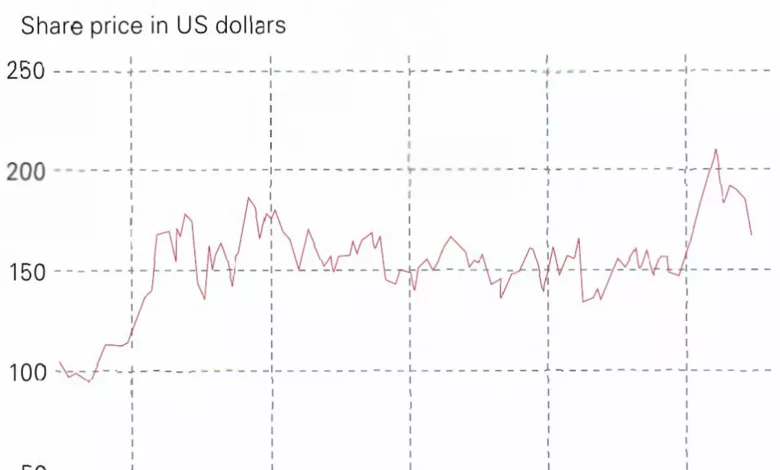
Chevron’s share price has struggled to keep pace with the wider energy sector this year, returning just 16% compared with a 19% gain for the S&P Commodity Producers Oil & Gas Exploration & Production index, which had been up as much as 40% at one point. A sharp drop in the price of Brent crude — now trading around $74 a barrel, down from $95 at the start of June, according to market data — has weighed heavily on the oil giant. For every $1 decline in Brent, the company loses $600 million in cash flow, leaving it more exposed to oil price moves than many of its peers. Yet beneath the headline weakness, a very different story is taking shape: Chevron is quietly transforming itself into a major player in liquefied natural gas (LNG) and power, businesses that could underpin its future growth for years to come.
Underperformance in a volatile oil market
The recent slide in crude prices has been driven by continued progress in Middle East peace talks, which has eased supply concerns. Brent has fallen roughly $15 a barrel since the start of the month, a welcome development for consumers and economies but a direct hit to oil producers. The S&P Commodity Producers Oil & Gas Exploration & Production index has dropped around 13% over the same period, leaving it up just 19% year-to-date after touching a 40% gain earlier in the year. Chevron’s sensitivity to oil prices is particularly acute: analysts calculate that a $1 shift in the price of Brent knocks $600 million off the company’s cash flow. That exposure explains why its shares have lagged even as the broader energy sector has recovered.
How Chevron’s LNG contracts and pricing work
Chevron is best known as an oil producer, but its most exciting business is liquefied natural gas. The company does not break out precise earnings for each facility, but for 2026 UBS has pencilled in $20.4 billion of upstream earnings and $4.3 billion of downstream earnings, with around 60% of upstream coming from liquids and the remainder from gas and LNG. LNG markets operate differently from global oil markets. Because building and maintaining LNG facilities requires enormous capital — Chevron’s flagship Gorgon LNG project in Australia, for example, cost the company and its partners $55 billion in total — producers must agree multi-year contracts with customers to guarantee a return.
Of the roughly 4.1 million barrels of oil equivalent Chevron is expected to produce in 2026, around 80% is tied to long-term fixed contracts, with the remaining 20% sold on the spot market. These contracts are fixed in duration but still influenced by market prices. LNG contracts linked to Brent prices adjust with a lag of three to four months, meaning that changes in the oil price feed through to Chevron’s revenue over time. UBS reckons that for every $10 rise in Brent, the company receives $450 million in after-tax earnings from its two major Australian LNG facilities alone.
Beyond Brent, however, it is US natural gas prices that really matter for Chevron. The company estimates that a $1 move in the price of US natural gas adds or subtracts $700 million from its bottom line. Since the beginning of April, domestic gas prices have risen nearly 30% to $3.2 per million British thermal units (MMBtu), driven by higher demand. That trend has been reinforced by a tightening LNG market: prior to March, the profit on a single LNG cargo moving from the US to Europe jumped from about $25 million to $50 million as the spread between US and European gas prices widened, according to industry news site Energy Flux, following a Middle East supply shock.
Chevron also operates a smaller LNG facility in Angola. UBS estimates that for every $2 increase in the price of the European gas benchmark — which has climbed around $5 per MMBtu over the past six months — the Angola plant could generate a $180 million boost in earnings before interest, tax, depreciation and amortisation. The Angola LNG project, of which Chevron holds a 38.1% stake in an 87-mile pipeline to the plant, processes 1.1 billion cubic feet of natural gas per day and was the first LNG project in the country. Shareholders agreed in 2019 to form a New Gas Consortium to develop non-associated gas offshore Angola, with first production expected in 2025.
The LNG market cannot quickly adjust to changes in demand because it can take decades to build a new facility. According to Shell, the world’s largest LNG trader, global LNG demand is expected to rise by 68% by 2040 in the best-case scenario, and by 85% by 2050, driven by soaring electricity requirements. The International Energy Agency believes that higher demand from electric vehicles, data centres and other sources will add the equivalent of two European Unions to global power needs by 2030 — only half of which will be met by increased renewable energy and nuclear generation.
Powering the data centre boom
Chevron is now taking its natural gas expertise directly into the power business. In a joint venture with Microsoft called Power Solutions — developed through Chevron’s subsidiary Energy Forge One LLC under the name Project Kilby — the partners plan to build a natural-gas-fired power plant in West Texas to supply Microsoft’s data centres. The first major deal, announced in March, involves a $7 billion, 2.5-gigawatt plant that will be powered by gas from Chevron’s own assets and built with room to double in size. The facility will be among the largest co-located natural gas power and data centre developments in the US. Production is expected to begin in 2027, with Chevron’s bottom line benefiting from 2028 onwards. A final investment decision has not yet been made; confirmation is anticipated by the end of 2026.
Chevron aims to build power plants producing a total of seven gigawatts in the coming years, enough to supply roughly 3 million average US homes. Selling power on long-term fixed contracts to technology “hyperscalers” will add a predictable stream of revenue, reducing the earnings volatility that has dogged the company in the past. The Electric Power Research Institute estimates that data centres could consume between 9% and 17% of all US electricity by 2030, up from 4-5% today. Chevron sees natural gas as the solution to that energy shortage and is considering additional partnerships to supply US data centres with up to four gigawatts of electricity.
Investment potential amid the sell-off
Chevron’s share price decline in recent weeks has left its valuation looking more attractive. Based on current projections, UBS analysts believe the shares trade at a forward price-to-earnings ratio of 16.6 for 2027, falling to 15.8 for 2028, assuming a 4% increase in production. The dividend yield is expected to come in at 4% this year and 4.2% next year, extending a 39-year dividend growth streak — although the payout ratio is above 100%, which may limit retained earnings for reinvestment. UBS has maintained a “Buy” rating on the stock and raised its price target to $220, seeing the recent sell-off as an entry point for long-term investors. Other analysts have “Overweight” or “Buy” ratings with targets in the $205–$222 range. While Chevron’s P/E ratio of around 30 (higher than the broader market and the energy sector) suggests a premium, its growing LNG and power businesses are not yet fully reflected in the share price. With global electricity demand forecast to rise at an annual rate of 3.6% between 2026 and 2030, and LNG demand set to climb for decades, Chevron’s diversification away from pure oil exposure could justify a higher multiple and stronger cash returns over time.