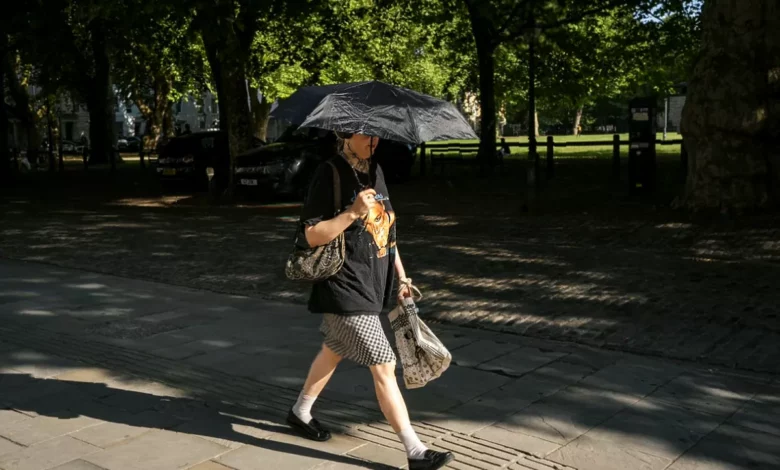
The 46-year-old June temperature record that had stood since 1976 was shattered repeatedly during last week’s heatwave, as the Met Office recorded a provisional new high of 37.7°C in Lingwood, Norfolk, on Friday.
The previous June record of 35.6°C, set in Southampton in 1976 and matched in Camden Square in 1957, was broken on three consecutive days as the heatwave intensified. On Wednesday a provisional 36.1°C was logged in Gosport, Hampshire; on Thursday the record rose to 36.7°C in Merryfield, Somerset; and on Friday the thermometer climbed again to 37.7°C in Lingwood, with a second reading of 37.3°C at Santon Downham, Suffolk, on the same day. Wales also set a new June record, reaching 35.9°C in Cardiff on 25 June. The UK experienced its hottest June night on record, with temperatures not falling below 23.5°C in Cardiff and 23.0°C in Plymouth on the night of 25–26 June.
Rare red warning for extreme heat
The exceptional conditions prompted the Met Office to issue a Red Warning for Extreme Heat – the first time since the current warning system was introduced that red warnings for extreme heat have been issued for three consecutive days. The warning covered large parts of southern and central England, as well as parts of Wales, affecting millions of people. The significance of a red warning cannot be overstated: it indicates a risk to life, even for healthy individuals, and triggers emergency response protocols across government and public services.
Professor Stephen Belcher, Chief Scientist at the Met Office, described the temperatures as “sobering” and a stark reminder of the implications of human-induced climate change. He stated that such events have become more likely and more intense because of climate change. The Met Office projects that hot spells will become more frequent, particularly in south-east England. Scientists have linked the heatwave directly to human activities, noting that analysis of UK weather records shows a clear long-term warming trend: eight of the ten warmest years in UK records have occurred since 2002, and the average length of warm spells has more than doubled since the 1960s–90s.
The health impacts were severe. The UK Health Security Agency (UKHSA) issued Heat Health Alerts, and the London Ambulance Service reported its highest-ever number of life-threatening emergencies in a single day. Between 2020 and 2024, more than 10,000 people are estimated to have died in Britain due to summer heatwaves. The extreme heat caused widespread disruption: schools and nurseries closed, hospitals declared critical incidents, trains were cancelled, court hearings were delayed, and a hosepipe ban was introduced in Kent owing to soaring water demand. Surface temperatures on pavements, rail platforms and building sites in London reached between 50°C and 60°C.
Tragically, the hot weather was also linked to several water-related deaths, including the recovery of a teenage boy’s body from Clifton Country Park in Greater Manchester and another 13-year-old boy from a lake in Syston.
Duration and historical context
The heatwave’s duration – spanning the final week of June – was notable not only for the three consecutive days of record-breaking daytime temperatures but also for the sustained overnight warmth. The previous June record of 35.6°C had stood for 46 years, a benchmark from the famous 1976 heatwave. Met Office scientists have highlighted that future heatwaves could become significantly more intense than 1976. The all-time UK temperature record remains 40.3°C, set on 19 July 2022 in Coningsby, Lincolnshire. Regional June records before this event were 33.7°C in Wales (2000), 32.2°C in Scotland, and 30.8°C in Northern Ireland.
While the red warning was in force for three days, the heatwave itself saw the June record broken on at least three consecutive days, with each day surpassing the previous one. The Met Office’s decision to issue a red warning for three days running reflects the exceptional combination of extreme temperatures, high humidity, and the cumulative health risk from prolonged exposure. Such warnings are normally reserved for short, acute events; the three-day duration marked a significant escalation in the Met Office’s assessment of the danger posed by climate-driven heat extremes.