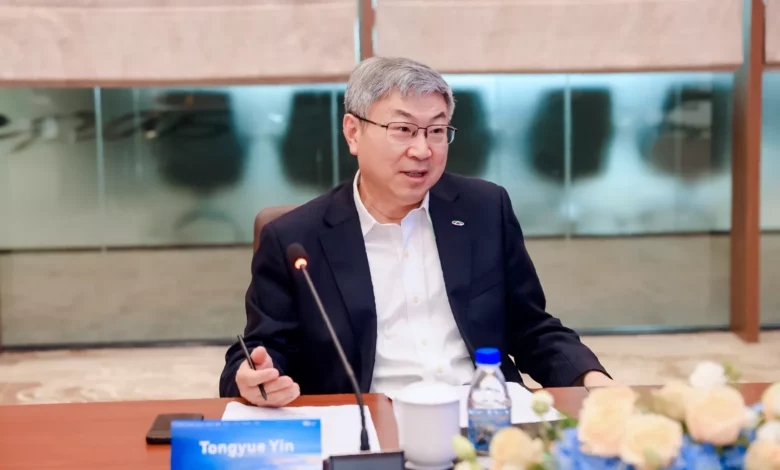
Chery chairman Yin Tongyue has declared the Chinese carmaker’s ambition to become a “citizen of the UK” by embedding local engineering, research and development, finance and manufacturing into its British operations. Speaking at the Chery International Business Summit in Wuhu, China, Yin said the UK was a “very special country” with high technology, innovation and a position as a global financial centre, adding that Chery was “strongly preparing to be local” across every aspect of its business.
Building a British footprint
Chery has already established a significant presence in the UK through its three mainstream brands – Chery, Omoda and Jaecoo – which together captured a 2.65 per cent market share in 2025 with 53,604 sales. That figure has risen to 5.86 per cent so far this year, with the Jaecoo 7 SUV becoming Britain’s best-selling new car in the crucial March registration period. In March 2026 alone, Omoda & Jaecoo UK registered 17,951 cars, giving them a 4.7 per cent share of the monthly market.
The Chery brand itself officially launched in the UK in August 2025 with the Tiggo 7 and Tiggo 8 SUVs, and the company plans to add the Tiggo 4 and Tiggo 9 in the near future. Its dealer network, which started at 25 outlets, is on course to expand to 100 by 2026. Two additional brands are also destined for the UK: Lepas, whose first model, the Lepas L8, is expected in late summer, and the iCar 4×4 brand, which is earmarked for export to Britain. Globally, Chery has set a target of one million annual sales for its Omoda and Jaecoo brands by 2027.
JLR partnership and manufacturing ambitions
Central to Chery’s strategy is its long-standing collaboration with Jaguar Land Rover, which began in China in 2012. The joint venture, Chery Jaguar Land Rover (CJLR), has revived the Freelander nameplate with a family of electric vehicles designed by JLR in the UK and engineered and built by Chery in China. The first model, the Freelander 8, was unveiled in April 2026 and is expected to be sold in the UK as part of a global export plan. Yin said: “We get a lot of support from JLR, people work very closely. And so, we have some responsibility to make JLR bigger and great again.”
Beyond the existing joint venture, Chery is exploring ways to deepen its manufacturing ties in Britain. Reports indicate that the company has held discussions with Nissan about using its Sunderland factory – currently running at roughly half its capacity – to build Chery vehicles. Chery is also understood to be considering potential deals to use JLR’s own UK factories. Separately, Chery has established a European headquarters for its Delivan commercial vehicle brand in Liverpool.
Brand revival and trade balance
Yin has made clear his interest in acquiring or reviving British automotive brands, describing a UK marque as “very fancy” and pointing to MG – a British brand now owned by China’s SAIC – as a successful precedent. “Once I have a JLR, once I have a Chery, I own it,” he said. “And then maybe we can get some local brand to be realised again.” Guibing Zhang, president of Chery International, confirmed the company’s appetite for recovering old UK names. “Generally, we are very interesting to recover some old brands in the UK,” Zhang said. “We hope in the future in the UK we also can recover what the UK people like, a very lovely brand we can do together.” Yin added: “If available, we want a UK brand.”
To help redress the trade imbalance between China and the UK – which currently favours China – Yin said Chery plans to establish a trading company that will export British products back to China. “We also promised to try and set up the trade company, to take some UK products back to China,” he explained. “The Chinese with the UK is trade unbalance. From the Chery side, we try to balance it by ourselves. We take products locally back to China – so a heavy container comes in, and we can carry the container back.”
Yin revealed that he has held high-level conversations with the UK government, including two meetings with the Prime Minister – one in Beijing and one in London. He said the government had expressed a desire to revive the country’s automotive industry, noting: “The UK government just said that the UK used to be the biggest car maker in the world, but from 2016 the government was a mess. So how can we make [the UK] fly again? This is what we want.” Yin said Chery had “promised to the government to try to do our best” and would invest in local teams and capacity, summarising the approach as: “Be somewhere, for somewhere. We say in the UK for the UK.”
Chery’s expansion strategy is backed by strong financial performance. The company reported 2025 revenue of 300.29 billion yuan, an 11.3 per cent increase, and net profit of 19.02 billion yuan, up 34.6 per cent. Overseas revenue surpassed domestic sales for the first time, and first-quarter 2026 research and development spending reached 2.85 billion yuan – a 25.5 per cent year-on-year rise. The UK government’s own DRIVE35 programme, a £2.5 billion fund (which could rise to £4 billion) designed to support automotive manufacturing and R&D, aligns with Chery’s ambitions to deepen its local operations.