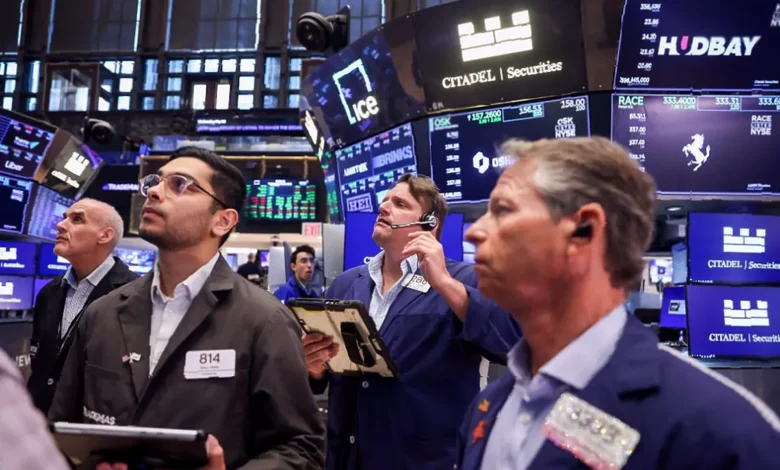
Markets Hit Fresh Highs Despite Iran Tensions
Global stock markets have powered to all-time highs, shrugging off the eruption of hostilities between Israel and Iran that had pundits forecasting oil at $200 a barrel and a recession. The FTSE 100 and the S&P 500 each fell roughly 9 per cent from their late‑March peaks before recovering every penny and pushing into record territory within three weeks. The question posed on Bloomberg’s Merryn Talks Money podcast on 17 April – “Are markets just plain wrong to keep looking through the Iran war?” – was answered emphatically. “If you think the market is wrong, it’s probably not the market, it’s you,” said the show’s John Stepek.
The resilience has been broad. The FTSE 100, which had already reached a record high in April 2024 on hopes of interest‑rate cuts, delivered a total return of 2.7 per cent over the three months to April 2026 and 5.8 per cent year‑to‑date. The UK economy itself grew by 0.5 per cent in the three months to February 2026, the first full month of the Iran war, according to the Office for National Statistics. Across the Atlantic, the S&P 500 experienced its first monthly decline since October 2023 only in April 2024, but has since surged. For the first quarter of 2026 the blended year‑over‑year earnings growth rate for the index hit 27.7 per cent – the highest since the fourth quarter of 2021 – and analysts polled by FactSet expect 21.5 per cent growth for the full calendar year.
Pundit Predictions Prove Wrong Yet Again
Every disruptive geopolitical event triggers a torrent of experts warning investors of imminent disaster, yet rarely have the pundits been as spectacularly wrong as this time. In late March and early April, forecasts of oil prices reaching $150 or even $200 a barrel were common, alongside prophecies of a surge in inflation, higher interest rates and a recession that would hammer corporate earnings and send stock markets spiralling. Gold was touted as the only safe haven.
Instead, the oil price has struggled to break above $100 a barrel. Gold has fallen roughly 12 per cent since the start of March. Bond yields have retreated – except in the United Kingdom – inflation has ticked only modestly higher, and there is still no sign of a recession, although interest rates are likely to rise, particularly in Britain. Anyone who listened to the doom‑mongers and “reduced risk” will have lost money. The US market, far from stumbling, has been led higher by the much‑maligned “magnificent seven” mega‑cap stocks. The supposed AI bubble has not burst; it is the potential victims of AI – software and data‑provider firms – that have suffered. Earnings forecasts have continued to climb. The predictions of inevitable calamity were heavily influenced by historical parallels that, on closer inspection, proved false.
Why Geopolitical Shocks Rarely Derail Markets
The pattern is as old as markets themselves. As the US strategist Ed Yardeni puts it, “earnings growth and economic expansion drive markets, not geopolitical shocks.” The data bears him out. For the S&P 500, forecast earnings per share for the next twelve months stand at $344.30, with expectations of $380 by the end of the year. That puts the index on a forward price‑to‑earnings multiple of 20.8, falling to 18.8 by year‑end. For mid‑ and small‑cap stocks the forward multiple is around 16; for the “magnificent seven” it is close to 27.
The information‑technology sector, up 8 per cent year‑to‑date, has benefited from a 33 per cent rise in forecast revenue and a 55 per cent rise in forecast earnings over the past twelve months. The semiconductor sub‑sector now accounts for 42 per cent of the technology sector, up from 15 per cent a decade ago, and contributes 47 per cent of expected earnings. Because earnings growth has been so strong, its prospective multiple is actually at a small discount to the S&P 500 as a whole. Meanwhile the application‑software sub‑sector has seen its multiple more than halve since 2021 to 23.4 – the lowest reading since 2014 – owing to fears that artificial intelligence will eat into its markets. Despite the $5.457 trillion valuation of Nvidia, the world’s most valuable company, which has increased its market capitalisation by 100.4 per cent over the past year, the evidence suggests that last year’s exuberance has given way to a more sober assessment that is finding both winners and losers.
Geopolitical crises themselves often have a surprisingly muted and short‑lived effect on developed‑market equities. The Iran war, for all its severity, has not pushed oil past $100, partly because of continued attacks on Russian refining capacity – Ukraine struck the Tamanneftegaz oil terminal, the Yaroslavl oil refinery and the Astrakhan gas processing plant in May 2026, according to the Institute for the Study of War – and partly because the closure of the Strait of Hormuz has, perversely, boosted Kremlin revenues even as it disrupts supply. The US Bureau of Labor Statistics reported that year‑over‑year CPI inflation stood at 3.81 per cent in April 2026, with core inflation at 2.75 per cent – elevated but not runaway. Goldman Sachs Research expects the Federal Reserve to deliver two 25‑basis‑point rate cuts in 2026, a sign of confidence that the economy can absorb the geopolitical shock.
Lessons: Valuations Stretched but Earnings Drive Returns
Further disruptive geopolitical crises are inevitable, and when they come the “end of the world is nigh” crowd will again dominate the airwaves. The pessimists are already scanning the horizon. With the tide against Russia in Ukraine, that war is unlikely to provide them solace: as the article notes, if Ukrainian missiles can knock out oil facilities on the Baltic coast, they could surely reach the Kremlin. A Chinese invasion of Taiwan has long been a favourite prophecy of doom, but the US Office of the Director of National Intelligence, in its 2026 Annual Threat Assessment, assesses that Beijing does not currently plan an invasion by 2027, though it continues to set conditions for unification and employs coercive actions. Analysts increasingly point to a naval blockade or quarantine as a more likely near‑term scenario, one that could disrupt semiconductor logistics. Professor Srikanth Kondapalli of Jawaharlal Nehru University warns that an invasion would be “incredibly detrimental to China’s global rise”, potentially causing catastrophic casualties for Chinese forces, and that Taiwan remains a formidable stronghold with challenging terrain. Some advisors to former President Trump believe Xi Jinping may move within five years, but a direct assault would be a highly risky venture for a country whose last military adventure – the invasion of Vietnam in support of the Khmer Rouge in Cambodia – was more than fifty years ago and ended in disaster. Modern drone technology makes any seaborne invasion even more perilous.
The key question is not what geopolitical events portend for markets, but what the market reaction tells us about the importance of such events. Nine times out of ten the market is right and the doomsters are wrong. Yet the parable of the boy who cried “wolf” teaches that one day the wolf may indeed come. It is nearly twenty years since stocks suffered a sustained bear market, as opposed to a short‑term fall that quickly recovered. The US market is expensive and heavily dependent on a pace of earnings growth that may not be sustainable. The cyclically adjusted price‑to‑earnings (CAPE) ratio for the S&P 500 stood at 39.6 in early May 2026, a level not seen since the dot‑com crash in September 2000; historically, the ratio has exceeded 39 in only 27 months since 1957. The forward 12‑month P/E ratio of 21.4 is above both the five‑year average of 19.9 and the ten‑year average of 18.9.
The CAPE ratio, however, is an unreliable indicator over the long term because of changing accounting rules, fluctuating corporation tax rates and its backwards‑looking nature. It calculates the ten‑year rolling average of corporate earnings to smooth out economic cycles. What the current elevated level really tells us is that there has not been a recession for well over a decade – merely short‑term dips. No recession is visible now, but bear markets always expose overoptimistic accounting, weak finances and fragile business models. The best protection is a moderately valued market that provides a cushion against earnings disappointments. A multiple above 20 and a ten‑year US Treasury yield approaching 4.5 per cent do not provide that. Investors are skating on fairly thin ice.
Global diversification may not offer a safe harbour. Other markets are cheaper but boast less earnings growth. Emerging markets are performing well but are heavily dependent on the technology super‑stocks of the Far East. If the US market falters, it is hard to imagine other markets carrying on regardless. The information‑technology sector alone accounts for 28 per cent of the S&P 500, and when all AI‑related shares are included, technology accounts for 45 per cent of the index – a weighting that has doubled in three years. Liam Halligan of The Telegraph warns that such concentration is unsustainable, recalling that energy made up more than 25 per cent of the US market in 1980 (it is now 3 per cent) and railways more than 60 per cent in 1900. That is likely true, but it does not prove that the US market is overvalued; rather, sector composition will continue to evolve. Meanwhile UK and European pundits can only look on with envy: their markets are significantly cheaper, but a heavy reliance on imported energy and a meagre exposure to technology mean lower revenue and earnings growth and a persistent valuation discount.
There is no need to panic, but investors need to be wary. The advice of Nathan Rothschild two centuries ago – “Buy on the sound of cannons, sell on the sound of trumpets” – suggests that taking some profits is starting to look like a better strategy than charging in. For now, markets still appear likely to deliver positive returns for the rest of the year. But the structural risks are mounting, and the cushion of moderate valuations is thin. If the US market falters, the rest of the world will find it very difficult to carry on regardless.