The long-standing ambition to bring traditional equities onto the blockchain has repeatedly foundered on a single, intractable problem: legal ownership. Attempts to directly tokenise shares simply transpose custodial and regulatory bottlenecks onto a distributed ledger, stifling scale. EquitX, a protocol founded by Mohamed Dabladji, believes it has bypassed this hurdle entirely with the launch of its Testnet and a new synthetic asset infrastructure engineered for large-cap market exposure.
At its core, the challenge is one of architecture. “Tokenising a share of stock doesn’t solve the underlying problem of custody,” explained Dabladji, EquitX’s CEO. “It simply moves a legacy legal bottleneck onto a blockchain.” His solution, the xAssets framework, makes a fundamental conceptual shift. Instead of replicating ownership, it replicates financial exposure. This separation of economic benefit from legal title is the protocol’s key innovation, designed to allow global scale without users needing to navigate fragmented, jurisdiction-specific brokerage gateways or hold the underlying asset.
Engineering for Equity Volatility
To achieve this, EquitX employs a collateralised synthetic model adapted from institutional risk architectures. When a user seeks exposure to a stock, they interact with a smart contract that mints an xAsset, a synthetic token backed by over-collateralised digital reserves. This process is supported by an AI Smart Order Router that optimises execution to minimise slippage. Crucially, the entire system is built to handle the distinct behaviour of equities, which have different volatility profiles and trading hours compared to crypto-native assets.
“Equities do not trade continuously, and they carry distinct risk profiles,” Dabladji noted. To manage this, the protocol integrates an AI-driven Risk Engine that analyses real-time volatility to dynamically adjust collateralisation ratios. Furthermore, its stability pools—a decentralised backstop where users provide capital to absorb debt from liquidated positions in return for yield—are specifically tailored for equity markets. They are engineered to ensure solvency during traditional market hours and, critically, across weekend gaps when underlying markets are closed.
The Safety Mechanisms: Oracles, Liquidation, and AI Oversight
This complex system relies on several interconnected safety components. An oracle network feeds real-time price data from traditional exchanges into the protocol. Should the value of a user’s collateral fall below a strict algorithmic threshold, an automated liquidation system triggers to protect the protocol’s overall solvency. This mirrors a foundational risk-mitigation mechanism in decentralised finance (DeFi), where automated liquidations are critical for maintaining stability during volatility.
Adding another layer of security, an AI-powered firewall continuously monitors the network as an automated circuit breaker against potential market manipulation. The technical documentation details how these elements combine, translating complex banking safeguards into immutable code. The design reflects Dabladji’s background in financial engineering and aims to provide what he calls “rigorous, banking-grade risk architecture.”
Backing and Strategic Traction
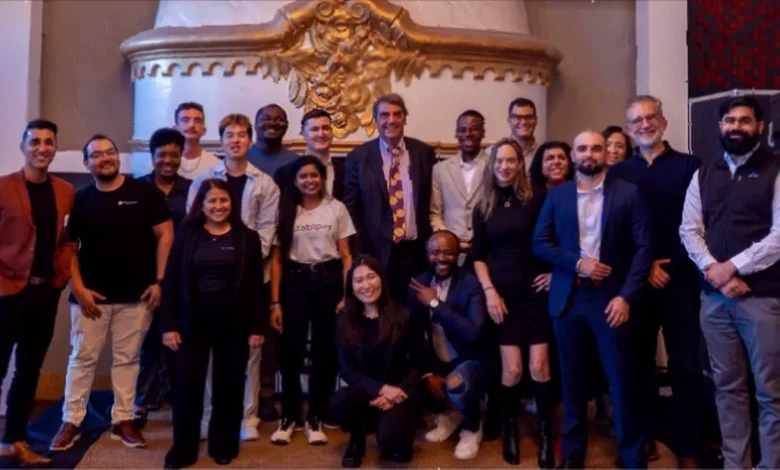
The protocol’s potential has attracted notable institutional confidence. EquitX was selected for the prestigious Embark program run by Draper University in Silicon Valley, securing strategic backing from renowned venture capitalist Tim Draper. The Embark program is highly selective, accepting only 2% of applicants, and is known for identifying transformative technologies. This support validates the project’s ambition to scale beyond the limitations of early DeFi experiments.
This traction marks a significant point in the journey for EquitX, which was founded as far back as 2007 by Dabladji and Barthelemy Houot to provide a blockchain-based equity investment platform. Company profile data from December 2025 indicated EquitX was an unfunded company, suggesting the backing from Draper represents a form of early-stage strategic support that precedes traditional funding rounds.
Developers on the Testnet are now stress-testing oracle latency and liquidation efficiency under simulated high-volatility events. A key focus is capital efficiency—optimising collateralisation ratios to balance user accessibility with uncompromising systemic safety, a common challenge for synthetic asset platforms. The protocol is gathering this operational data to refine its automated systems before pursuing broader ecosystem integration, positioning its synthetic framework as a verifiable alternative to the custodial tokenisation model that has dominated efforts to bridge traditional finance and blockchain.