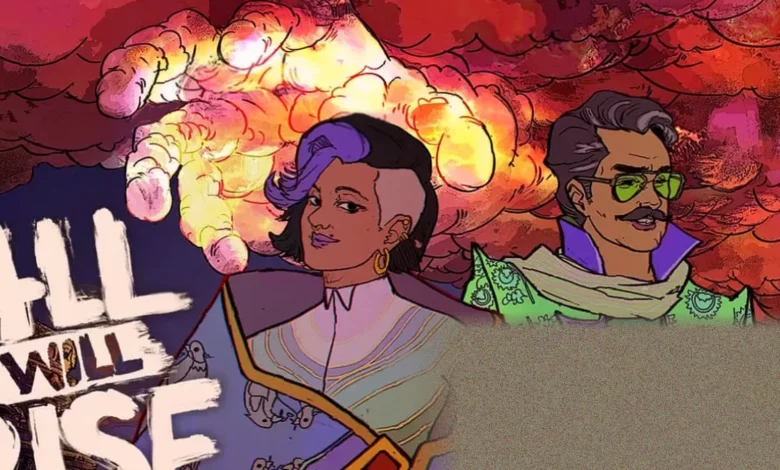
In a video games industry facing a stark funding crisis, where investment for independent developers has all but evaporated, the act of returning money from a tech giant is almost unthinkable. Yet that is precisely the move made by Speculative Agency, the studio behind the upcoming deck-building game All Will Rise, in a protest that underscores a growing ethical reckoning within gaming.
The studio confirmed it has returned development funding received from Microsoft, which was provided as part of a developer acceleration programme. The decision, the team says, is a direct response to Microsoft’s commercial ties to the Israeli military during the war in Gaza, and aligns with the “No Games for Genocide” campaign—a collective of developers, journalists, and union organisers protesting the games industry’s links to “genocide, war crimes, and the military industrial complex.”
The Campaign and Microsoft’s Links to the IDF
“No Games for Genocide” has called for a boycott of Microsoft and Xbox, citing the company’s provision of technology to the Israeli Defence Forces (IDF). According to reports, including from the Guardian, the Israeli spy service had used Microsoft’s Azure cloud for mass surveillance of Palestinian civilians. Microsoft subsequently terminated that specific access, but the IDF remains a client using other services.
Further context comes from leaked documents and reports indicating that Microsoft’s Azure cloud technology and AI systems saw increased use by the Israeli military during the conflict. Microsoft engineers are reported to have provided support to units including intelligence Unit 8200, with deals worth approximately $10 million for technical support to various IDF units struck between October 2023 and June 2024. The company also provided the Israeli military with access to OpenAI’s GPT-4 model through a partnership.
In a statement from May 2025, Microsoft said it had found “no evidence to date that Microsoft’s Azure and AI technologies have been used to target or harm people in the conflict in Gaza,” and that it disabled services to a unit after determining its products were used for mass surveillance. However, the company has acknowledged selling advanced AI and cloud computing services to the Israeli military during the Gaza war and aiding in hostage rescue efforts. Microsoft’s position has placed it on the Palestinian-led Boycott, Divestment and Sanctions (BDS) list and sparked internal protests, with some participating employees being fired.
A Principled Stand Amid a Funding Drought
For Speculative Agency, the choice was fraught given the scarcity of capital for indie studios. Meghna Jayanth, narrative designer on All Will Rise—a game about activists fighting an oligarch-run city—said the decision felt essential to the project’s ethos. “The game we’re making is about making people feel powerful, and acting, and not giving into cynicism and hopelessness,” she said. “We’re not naive – we know that our action on its own won’t move the needle much. But if enough developers and studios join us in this boycott, [we] do have the power to pressure Microsoft.”
The studio acknowledged the potential loss of reach on Microsoft platforms but ultimately felt aligning with the game’s themes of holding power to account was paramount. According to the research briefing, Microsoft has been understanding of Speculative Agency’s decision to break their contract. The company did not respond to a request for comment on having their funding returned.
The “No Games for Genocide” campaign told the Guardian it is nearing 2,800 signatories, including nine organisations. “This includes three studios that have agreed to refuse or return funding to Microsoft as long as they remain complicit in Israel’s genocide of the Palestinian people,” a spokesperson said, adding they are working to support studios navigating the risks of such a stance.
Industry Sentiment and Wider Targets
There is evident anti-war sentiment within the gaming community. Developers have raised over $1 million for Palestinian aid through charity bundles such as “Play for Peace—Games for Palestine 2025” and the “Palestinian Relief Bundle.” Streamers under the “Streamers 4 Palestinians” banner have collectively raised over €1 million, according to Streamlabs. Despite this, the largest companies in gaming have remained silent on the issue, with many employees regarding it as risky to speak out.
The campaign’s scope extends beyond Microsoft. “The BDS list includes Intel, the processor in most of our computers, Amazon, who own Twitch, and Dell and HP,” the “No Games for Genocide” spokesperson noted. They also highlighted the integration of video games into military training simulators and recruitment pipelines by the US Department of Defense and the UK military.
This protest unfolds against a backdrop of pervasive corporate influence. Electronic Arts will soon be owned by a consortium including Saudi Arabia’s Public Investment Fund and Jared Kushner’s Affinity Partners in a $55 billion deal. Microsoft itself, through acquisitions, now owns a vast swathe of the western games industry.
Other Industry Developments
Elsewhere in the industry, ethical and operational controversies abound. Krafton, the publisher which bought Subnautica developer Unknown Worlds, is facing legal repercussions after a judge in Delaware compelled it to reinstate the studio’s founders and honour a $250 million bonus. Court documents revealed that Krafton’s head, Changhan Kim, followed legal advice from ChatGPT in an alleged attempt to avoid the payout. Krafton said it disagreed with the ruling.
Technology firm Nvidia has faced backlash from developers over its new AI graphics tool, DLSS 5, which has been criticised for altering character visuals and lighting in ways some call a “creative travesty” and racially insensitive. Nvidia has called this criticism “completely wrong,” insisting developers retain control over art direction.
In more celebratory news, the BAFTA Games Awards nominations for 2024 have been announced, with Baldur’s Gate 3 leading with 10 nominations, followed by Marvel’s Spider-Man 2 with nine and Alan Wake 2 with eight. Meanwhile, for players seeking a distraction, the Greek-mythology-themed match-three puzzle game Mythmatch has been warmly recommended—available on PC and Mac, offering 10-12 hours of play.
Seeking Inclusive Communities
The industry’s social challenges are also felt at the player level. A reader, Joe, highlighted the toxic environment in online multiplayer military shooters, asking for recommendations for friendly, inclusive communities. The advice, as ever, is to seek out dedicated clans or Discord servers, such as the “Battlefield Elders” for mature gamers, though broader solutions remain elusive.
For “No Games for Genocide,” the path forward is collective action. “We feel hopeful… that there are many people in the games industry who care about this and want to do something – and we hope to empower people to do just that,” the campaign said. “None of us can do it alone, but all of us can do it together.”