Microsoft lays out contrasts between MTA and Fundamentals certifications and their substitutes

Microsoft’s entry-level MTA certification has been retired. All remaining Microsoft Technology Associate exams were officially withdrawn on 30 June 2022, after the company stopped selling exam licences a year earlier on 1 July 2021. Exam deliveries by providers including Certiport and Pearson VUE were suspended from 1 July 2022. The retirement closes a chapter for one of the technology industry’s most widely used beginner certification paths, particularly popular in schools, colleges, workforce programmes and Microsoft Imagine Academy environments.
What the MTA programme was
The Microsoft Technology Associate credential was designed as a starter certification for students, career changers and early-career professionals who wanted to validate foundational technical knowledge before moving into more advanced Microsoft tracks. It helped candidates explore whether they preferred IT infrastructure, software development or database administration — without requiring deep hands-on enterprise experience.
The programme covered three main tracks. The IT infrastructure track included exams such as Windows Operating System Fundamentals (Exam 349), Windows Server Administration Fundamentals (Exam 365), Networking Fundamentals (Exam 366), Security Fundamentals (Exam 367), Mobility and Device Fundamentals (Exam 368) and Cloud Fundamentals (Exam 369). These introduced Windows installation and management, Active Directory, TCP/IP, authentication and encryption, and basic cloud concepts.
The database track consisted of Database Fundamentals (Exam 364), which covered relational databases, SQL queries, normalisation and basic administration. The developer track offered Software Development Fundamentals (Exam 361), Web Development Fundamentals (Exam 363), Microsoft .NET Development Fundamentals (Exam 372), Gaming Development Fundamentals (Exam 374), HTML5 App Development Fundamentals (Exam 375) and Software Testing Fundamentals (Exam 379). Those exams introduced programming logic, object-oriented development, web technologies and application lifecycle management.
Why Microsoft retired MTA
Microsoft retired the MTA programme because the technology landscape had shifted significantly. The original model was built around traditional on-premises technologies such as Windows client support, Windows Server, desktop infrastructure, server infrastructure and private cloud computing. Modern organisations now rely on cloud services including Azure, Microsoft 365, cloud identity, SaaS productivity platforms, endpoint management, automation and AI-enabled services. Microsoft evolved its certifications to focus on job roles that align with current industry and hiring trends, moving away from validating isolated foundational concepts to emphasising integrated cloud and service knowledge.
Maintenance practicability was also a factor. The MTA catalogue contained 13 exams (Exam 349, 365, 366, 367, 368, 369, 364, 361, 363, 372, 374, 375, 379). Keeping all of them current across Windows, development tools, security practices and cloud technologies became less practical than maintaining fewer, modern Fundamentals exams. The MTA programme also overlapped with the newer Fundamentals certifications that Microsoft had introduced.
The replacements: Microsoft Fundamentals certifications
Microsoft Fundamentals certifications are the current entry-level options. They are designed for beginners, students, business users, technical professionals and decision-makers who need a practical understanding of Microsoft cloud and business technologies. Unlike MTA exams, which were broad academic-style introductions to technical domains, Fundamentals exams are aligned to active cloud services, business platforms and modern job roles.
The most significant difference is orientation. MTA exams such as Windows Operating System Fundamentals and Windows Server Administration Fundamentals focused on traditional foundations. Microsoft Fundamentals certifications focus on cloud-first skills and connect directly to Microsoft’s current ecosystem: Azure, Microsoft 365, Microsoft Teams, OneDrive, Exchange, SharePoint, Office, OneNote, Microsoft Copilot, Microsoft Edge, Microsoft Store, Surface, HoloLens, Microsoft Power Platform, Dynamics 365 and Microsoft Security.
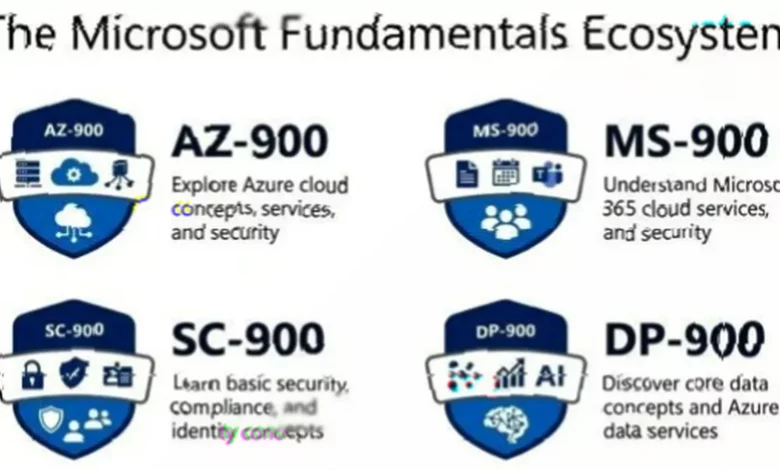
For IT infrastructure, Windows, networking and security learners, the best replacements are AZ-900 (Microsoft Azure Fundamentals), MS-900 (Microsoft 365 Fundamentals) and SC-900 (Microsoft Security, Compliance, and Identity Fundamentals). AZ-900 introduces cloud concepts, Azure architecture, compute, networking, storage, management, governance and pricing. It is the strongest replacement for Windows Server Administration Fundamentals and Networking Fundamentals because it covers the cloud version of many infrastructure ideas. MS-900 covers cloud concepts, Microsoft 365 services, apps, security, compliance, privacy, trust and licensing — making it especially relevant for desktop infrastructure and endpoint-focused learners. SC-900 is the clearest successor to Security Fundamentals, focusing on identity, Zero Trust, Microsoft Entra, compliance and threat protection within Azure and Microsoft 365 environments.
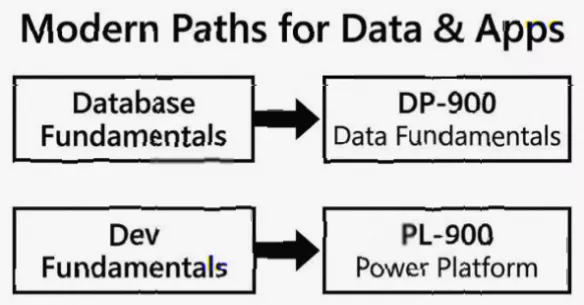
For data and database learners, DP-900 (Microsoft Azure Data Fundamentals) is the best modern entry point. It validates foundational knowledge of core data concepts, relational and non-relational databases, and data analytics. For software development, there is no single direct replacement. Microsoft recommends starting with AZ-900 for cloud basics and then using Microsoft Learn developer paths tied to Visual Studio, Azure App Service, GitHub and Microsoft Developer resources.
For low-code development, PL-900 (Microsoft Power Platform Fundamentals) covers Power Apps, Power Automate, Power BI and Power Pages. For CRM and ERP interests, MB-910 and MB-920 (Microsoft Dynamics 365 Fundamentals) are the relevant options. AI-900 (Microsoft Azure AI Fundamentals) is also part of the Fundamentals suite, reflecting the growing emphasis on artificial intelligence.
Fundamentals certifications serve as a springboard to more advanced, role-based certifications such as Azure administrator, security operations analyst, data analyst, Power Platform app maker or Microsoft 365 administrator. They have no prerequisites and do not expire — a contrast to most role-based certifications that now require annual renewal. Exam formats typically include 40 to 60 multiple-choice, multiple-response, case study and drag-and-drop questions, with a duration of 60 minutes and a passing score of 700 out of 1,000. The cost is approximately $99 USD or local currency equivalent.
Microsoft Learn is the centralised platform for preparation. It offers self-paced and instructor-led training, free access to materials, sandbox environments for hands-on practice and interactive learning paths. The Microsoft Learn Student Hub provides free fundamental exams and practice tests for eligible students. Microsoft’s Learn for Educators programme supplies resources for teachers to help students learn technical skills and prepare for certifications.
Microsoft is increasingly focusing on AI. The MS-900 certification is being phased out in favour of AB-900 (Copilot and Agent Administration Fundamentals) effective February 2026, which focuses on managing Microsoft 365 Copilot and AI agents. A new AB series of AI certifications is emerging, including AB-100 for Agentic AI Business Solutions Architects and AB-730 for AI Business Professionals.
For learners who already earned an MTA certification, the credential remains on their transcript and badge. Two years after retirement, it moves to the “Certification History” section of the candidate’s record.